
Content
The Dunning-Kruger Effect in SEO in 2025
How the Dunning-Kruger effect leads business owners to overrate AI-written SEO content, what it costs them and how experts use AI instead.
 By Alexander Thomas, Founder Updated 8 min read
Key takeaways
- The Dunning-Kruger effect describes how your confidence shoots up when you first learn something, before you realise how much you don’t know.
- AI tools can produce a readable article in seconds, which tempts business owners to assume that volume equals visibility.
- Google detects scaled content abuse, and generic AI articles that lack real experience and expertise can cost a site its rankings.
- Recovering from a ranking drop is neither quick nor cheap: you have to find, delete or rewrite the problem content and rebuild trust with Google.
- Use AI for research, outlines and first drafts that experts then heavily edit, and remember that SEO also needs technical work, link building and the right metrics.

On this page9 sections
There’s something almost theatrical happening right now in SEO, and honestly, it’s equal parts fascinating & terrifying.
Business owners are landing in my inbox with the kind of confidence you’d expect from someone who just discovered fire.
They’ve been playing with ChatGPT for three weeks, churning out blog posts like a factory line, and they’re absolutely CONVINCED they’ve cracked the code.
Then their rankings tank. Then they panic. Then they call us.
I think we’re witnessing the Dunning-Kruger effect on steroids, turbocharged with AI tools that make everything look deceptively simple.
And the fallout? It’s brutal.
What Exactly Is This Dunning-Kruger Thing?
David Dunning & Justin Kruger gave us this psychological framework back in 1999, though they probably didn’t anticipate how relevant it would become in the AI era.
The basic idea is pretty straightforward. When you first learn something new, your confidence shoots through the roof. You know just enough to feel dangerous, but not enough to realize how much you DON’T know.
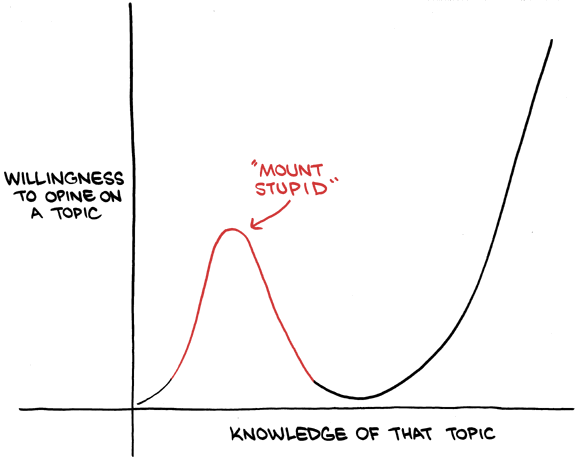
They called this peak “Mount Stupid.” Harsh name, but accurate.
You’re standing on this mountain, feeling like a genius, thinking SEO is just about keywords & content.
Then reality hits. You tumble into what they call the “Valley of Despair” where you suddenly realize the scope of what you don’t understand. Technical SEO. User signals. Authority building. Link equity. Content strategy that actually converts. The list goes on & on.
Real expertise? That’s the “Plateau of Sustainability,” and it takes years to get there. Not three weeks with an AI chatbot.
How AI Became Mount Stupid’s Express Elevator
ChatGPT and similar tools have fundamentally changed the game, but not in the way most people think.
These tools are phenomenal at generating text. You can ask for a 1000 word article on “best accounting software for small businesses” and get something readable in maybe 30 seconds. Perhaps even polished. It looks professional. It sounds authoritative.
And that’s the trap.
Business owners see this output & make a dangerous assumption.
They think the AI understands SEO strategy.
They assume that volume equals visibility.
They believe Google can’t tell the difference between AI slop & genuinely valuable content.
All three assumptions are spectacularly wrong, but you won’t realize that until you’ve already done the damage.
I’ve watched this pattern repeat maybe two dozen times in the last six months alone.
Someone discovers they can generate 50 blog posts in a weekend. They feel like they’ve found a cheat code.
They publish everything at once, sit back, and wait for the traffic flood.
Spoiler alert… it doesn’t come.
What Google Actually Cares About in 2025
Here’s where things get uncomfortable for the Mount Stupid crowd.
Google’s algorithms have gotten scary good at detecting what they call “scaled content abuse.”
That’s their polite term for what most of us would call spam. And make no mistake, pumping out dozens of generic AI articles absolutely qualifies.
The search engine isn’t just looking at keywords anymore. It hasn’t been for years, really.
They’re evaluating something called E-E-A-T, which stands for Experience, Expertise, Authoritativeness & Trustworthiness.
And this is where AI generated content typically falls flat on its face. An AI hasn’t used your product. It hasn’t spoken to your customers. It doesn’t have real insights from years of working in your industry. It’s stitching together patterns from its training data, creating something that sounds right but lacks substance.
I remember one client came to us after their site got absolutely decimated in rankings. They’d published 80 articles in two months, all AI generated, all following basically the same template. Google took one look & basically said “nope.”
Their organic traffic dropped 87% in a single core update.
That’s not a slap on the wrist. That’s an execution.
The Real Cost of DIY SEO Disasters
So what happens when you fall off Mount Stupid?
The landing hurts. A lot. We’re seeing businesses lose thousands in monthly revenue because they thought they could skip the expertise part.
They saved maybe £2000 on agency fees, then watched £15,000 in monthly organic traffic revenue vanish. The math doesn’t exactly work out in their favour.
Recovery is possible, but it’s neither quick nor cheap. You’ve got to identify all the problematic content. Delete or completely rewrite massive chunks of your site. Sometimes submit a reconsideration request if you’ve been hit with a manual penalty. Rebuild trust with Google, which can take months. All while your competitors are eating your lunch in the search results.
I won’t lie, it’s a mess.
And there’s this psychological component too, right? These business owners were SO confident. They’d told their teams they had it handled. Maybe even bragged a bit about how they didn’t need those expensive SEO agencies anymore.
Then everything collapses & they have to admit they were wrong. That’s a tough pill to swallow, though it happens more often than you’d think.
What Actual SEO Expertise Looks Like
Real SEO work in 2025 is less about content production & more about strategic thinking.
Sure, content matters. But it’s maybe 30% of the equation, not 100% like the Mount Stupid crowd believes. Because content is so easy to create, it doesn’t hold much value these days.
You need to understand search intent at a granular level. Not just “what are people searching for” but WHY are they searching for it & what do they actually need when they land on your page.
There’s technical stuff that makes most people’s eyes glaze over. Site speed optimization. Core Web Vitals. Structured data markup. XML sitemaps. Canonical tags. Mobile responsiveness that actually works, not just “technically mobile friendly” according to some automated test.
I’ve seen sites with perfect PageSpeed scores that still provide terrible user experiences because nobody actually TESTED them on a real phone.
Then there’s link building, which is its own whole nightmare.
Authority doesn’t just appear because you published 50 blog posts. You need other reputable sites linking to you. But not just any links, good links from relevant sources that actually pass authority.
Bad links can hurt you worse than no links at all. Navigating that landscape requires experience, relationships & a pretty sophisticated understanding of how link equity flows through the web.
How Professionals Actually Use AI Tools
Here’s the thing though, we DO use AI at our agency. We’re not Luddites over here refusing to touch the technology.
But there’s a massive difference between using AI as a tool versus treating it as a replacement for strategy & expertise. It’s like the difference between a skilled carpenter using a power saw versus someone who just bought a saw & thinks that makes them a carpenter.
This also happens with vibe coding. Just because you know how to use Cursor doesn’t make you a programmer.
AI is fantastic for research. For analyzing competitor content. For identifying content gaps. For creating first drafts that humans then heavily edit & enhance with actual insights. Surfer SEO, for example, can help you optimize your content for NLP. We use it a lot.
We might use it to generate an outline or brainstorm angles for a topic. Then our actual experts, people who’ve spent years in SEO, take that foundation & build something genuinely valuable.
They add case studies. Real data. Unique perspectives. The kind of stuff that makes readers think “wow, these people actually know what they’re talking about” rather than “this sounds like every other article I’ve read on this topic.”
I think that’s the key distinction people miss. AI should make experts MORE efficient, not replace them entirely. It’s an accelerant, not a substitute.
Warning Signs You’re on Mount Stupid
How do you know if you’ve fallen into this trap?
There are some pretty clear indicators. If you’re publishing multiple articles per week without any real promotion strategy, that’s a red flag.
If you genuinely believe SEO is “just content,” you’re probably missing about 70% of the picture.
If you haven’t looked at your site’s technical health in months (or ever), you’re setting yourself up for problems.
Another big one is if you’re not tracking the right metrics. Traffic is great, but what kind of traffic?
Are people actually engaging with your content?
Are they converting?
I’ve seen sites with impressive traffic numbers that generate zero business because they’re ranking for the wrong keywords & attracting the wrong audience. That’s a classic Mount Stupid mistake, optimizing for vanity metrics rather than business outcomes.
Also, if your “SEO strategy” can be described in one sentence, it’s probably not a strategy.
Good SEO is complex & multifaceted. It involves technical optimization, content strategy, link building, user experience improvements, conversion rate optimization & ongoing analysis.
If you think you’ve got all that covered because you ran a keyword tool & started writing blog posts, well… you might want to reconsider.
The Bottom Line
Look, I get the appeal of DIY SEO in 2025. AI tools make it seem so acccessible, so simple.
Why pay an SEO agency thousands when you can do it yourself for the cost of a ChatGPT subscription? I understand that logic, even if I know it’s flawed.
But here’s what I’ve learned after watching dozens of businesses go through this cycle. The Dunning-Kruger effect is real, it’s powerful & it’s expensive when you’re dealing with something as important as your online visibility.
Mount Stupid feels great when you’re standing on it. The view seems clear, the path forward obvious.
Then you realize you’ve been looking at a map upside down the whole time.
Real SEO expertise takes years to develop. It requires staying current with constant algorithm updates, understanding nuanced ranking factors & knowing how to diagnose problems when things go wrong.
AI is a powerful tool in that process, but it’s just that. A tool. Not a replacement for knowledge, experience or strategic thinking.
If your organic traffic matters to your business (and it should), maybe don’t bet everything on three weeks of experimentation with an AI chatbot.
Partner with people who’ve already made the climb, who’ve been through the Valley of Despair & come out the other side.
Your future self will probably thank you for it.
Frequently asked questions
What is the Dunning-Kruger effect?
It is a psychological framework from David Dunning and Justin Kruger, dating back to 1999. When you first learn something new, your confidence shoots through the roof: you know just enough to feel dangerous, but not enough to realise how much you don’t know. Real expertise comes much later and takes years to reach.
What does Mount Stupid mean in SEO?
Mount Stupid is the peak of confidence that comes with a little knowledge. In SEO it is the stage where you think SEO is just about keywords and content. Beyond it lies the Valley of Despair, where you realise how much you don’t understand, such as technical SEO, user signals, authority building and link equity.
Can Google spot generic AI-generated content?
Yes. Google’s algorithms have become very good at detecting what Google calls scaled content abuse, and pumping out dozens of generic AI articles qualifies. Google also evaluates E-E-A-T, which stands for Experience, Expertise, Authoritativeness and Trustworthiness, and AI content often falls flat there because an AI hasn’t used your product or spoken to your customers.
How do you recover after AI content damages your rankings?
Recovery is possible, but it is neither quick nor cheap. You have to identify all the problematic content, delete or completely rewrite large parts of your site and sometimes submit a reconsideration request after a manual penalty. Rebuilding trust with Google can take months, while your competitors gain ground in the search results.
How should AI tools be used for SEO?
Use AI as a tool, not as a replacement for strategy and expertise. It is fantastic for research, competitor content analysis, finding content gaps and first drafts that people then heavily edit with real insights. Experts then add case studies, real data and unique perspectives, so AI makes them more efficient rather than replacing them.
What are the signs that your SEO approach is too simple?
Publishing multiple articles per week without any real promotion strategy is a red flag. So is believing SEO is just content, not checking your site’s technical health for months, or chasing vanity metrics instead of business outcomes. If your SEO strategy can be described in one sentence, it is probably not a strategy.
What does SEO involve beyond writing content?
Good SEO involves technical optimisation, content strategy, link building, user experience improvements, conversion rate optimisation and ongoing analysis. The technical side includes site speed, Core Web Vitals, structured data, XML sitemaps, canonical tags and mobile responsiveness. You also need good links from reputable, relevant sites, because bad links can hurt you worse than no links at all.
Further reading
- Dunning–Kruger effect, Wikipedia
- Google Search update on scaled content abuse, Google
- Creating helpful, reliable, people-first content, Google Search Central