Avoid Squarespace If You Care About SEO

If you want the short answer without the fluff here it is. Squarespace is an excellent platform for building a beautiful brochure website quickly but it creates a glass ceiling for your organic search performance.
Squarespace limits your access to the backend code which effectively forces you to fight with one hand tied behind your back when trying to rank for competitive keywords.
I have been working in this industry for fifteen years and while I appreciate the design aesthetics Squarespace offers it simply does not provide the technical granular control required for serious SEO campaigns.
You are renting an apartment where you aren’t allowed to paint the walls or change the locks.
The Pretty Face Trap
You look at a Squarespace template and it looks slick. The images are crisp and the fonts are modern and everything just snaps into place. For a business owner who just wants to get online fast this feels like magic. But as an SEO professional looking under the hood I see a mess of tangled priorities. The platform prioritizes visual design over semantic structure every single time.
One of the most frustrating things I encounter is how heading tags are tied to visual styles. In a proper SEO strategy your H1, H2, and H3 tags are used to tell Google the hierarchy of your content. They are structural markers. On Squarespace these tags are often inextricably linked to the font size and style in the site design settings. If you want a subheading to look a certain way you might be forced to use an H2 tag when it should logically be an H3 or even just bold text. This confuses search engines about what is actually important on the page.
You end up making compromises. Do you want the page to look good for the user or do you want the structure to make sense for the bot? You shouldn’t have to choose. In 2026 we should be past this.
It seems trivial until you try to scale. When you have five pages it doesn’t matter much. When you have five hundred pages and you need to restructure your content hierarchy to target new keyword clusters you suddenly realize you have to manually redesign the look of every page because the global styles are too rigid. It is a nightmare for scalability.
Backend SEO Is Non Existent
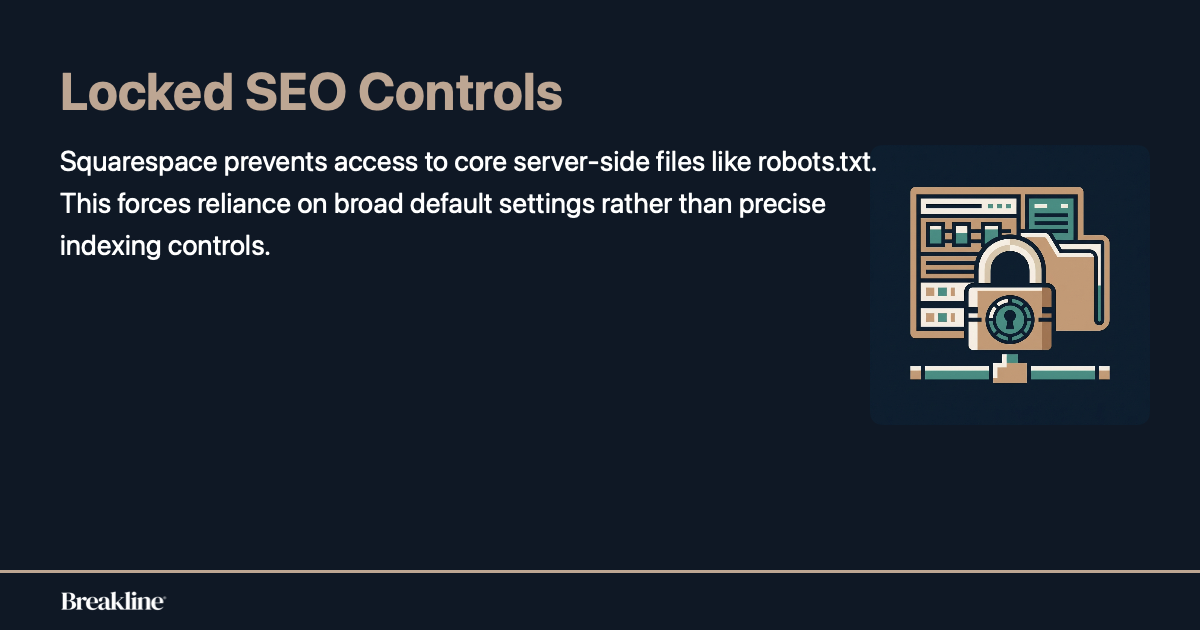
We need to talk about Backend SEO. This is the stuff that happens on the server side and in the core code structure that users never see but search engines care about deeply. On WordPress or a custom build I can access the .htaccess file. I can configure server-side caching. I can edit the robots.txt file to tell Google exactly where not to go to save crawl budget.
On Squarespace you are locked out. Completely.
You cannot edit your robots.txt file. This might sound technical and boring but it is critical for larger sites. If Squarespace generates weird duplicate URLs or search parameters that you don’t want Google to index you can’t just block them with a simple text edit. You have to rely on their default settings which are often too broad or just plain wrong for your specific needs.
I remember a client who came to us with a massive indexing bloat issue. Google was indexing thousands of low-value tag pages that Squarespace had auto-generated. On any other platform I would have fixed this in ten minutes by adding a disallow rule in the robots file. On this project we had to manually set noindex tags on pages or delete them entirely. It took hours. It cost the client money that could have been spent on content creation.
The sitemap situation is similar. Squarespace generates a sitemap for you which is nice but you can’t customize it. You can’t prioritize certain pages or exclude others easily without jumping through hoops. You just have to trust that their system knows what is best for your business. Spoiler alert. It usually doesn’t.
Speed Kills Rankings
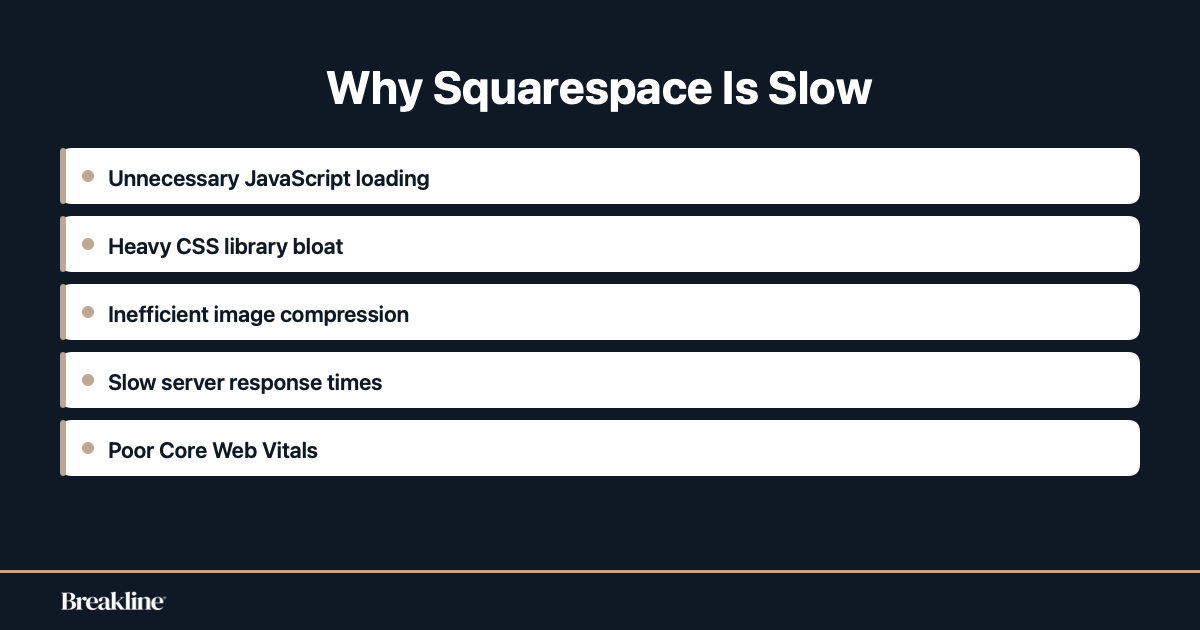
Pagespeed is a ranking factor. We know this. Google has been shouting about Core Web Vitals for years now. Specifically metrics like Largest Contentful Paint (LCP) and Interaction to Next Paint (INP) are crucial for user experience and ranking potential. When I run a Squarespace site through PageSpeed Insights the results are rarely pretty.
The problem is the bloat.
Squarespace loads a massive amount of JavaScript and CSS on every single page regardless of whether that page needs it. It is a blanket approach. A simple blog post with text and one image might be loading the code libraries for e-commerce galleries and complex animations in the background. This heaviness drags down your scores.
Then there is the image format issue. Modern web performance relies heavily on next-gen formats like WebP or AVIF which offer superior compression without quality loss. Squarespace has historically lagged behind on this. They often serve older formats or don’t compress them efficiently enough. You can upload a perfectly optimized image and the system might reprocess it in a way that increases the file size.
I have tried to optimize these sites. You compress the images before uploading. You remove unnecessary blocks. You try to keep the design minimal. But you cannot strip out the core platform scripts.
You hit a wall where you literally cannot make the site faster because the engine running it is heavy. It is frustrating to explain to a client that their site is slow not because of their content but because of their platform choice.
Structured Data and The AI Problem
This is where things get really interesting for the future. We are moving into an era of Generative Engine Optimization. Search engines are becoming answer engines. They use AI to read your content and synthesize answers directly on the results page. To do this effectively they need to understand exactly what your content is. This is where Structured Data or Schema markup comes in.
Squarespace has very limited native support for Schema. Sure it adds some basic stuff for products or local businesses but it is not enough.
If you want to add custom Schema to tell Google that this specific page is a “Review” or a “Course” or a “Recipe” with specific attributes you have to use code injection workarounds. You have to manually generate the JSON-LD code and paste it into the header of the page. This is risky. One missing comma in your code and the whole thing breaks. It also makes maintanance a headache because you can’t see the schema in a nice visual interface.
Without robust Structured Data you are invisible to the new wave of AI crawlers. They might read your text but they won’t understand the context. They won’t know that “$50” is the price and “In Stock” is the availability unless you explicitly tell them in a language they understand.
If you are building a business for the next five years why would you start on a platform that isn’t fully ready for the semantic web? It feels short-sighted.
The Migration Headache
Maybe you are thinking that you will just start on Squarespace and move later when you are bigger. I hear this all the time. It is a logical thought process but it ignores the reality of migration.
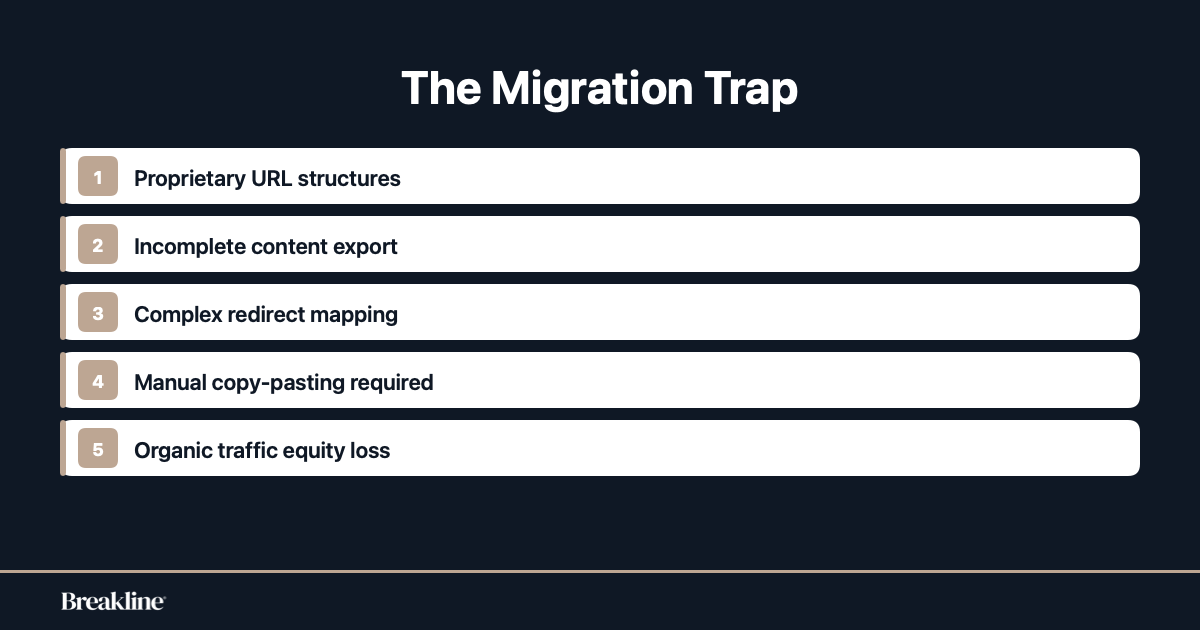
Moving away from Squarespace is painful.
The platform uses a specific URL structure for its blog posts and product pages that is hard to replicate on other systems without creating a massive redirect map. You often can’t export all your data cleanly. The images might not export with the content. You end up having to copy and paste things manually or pay for expensive migration services.
I have handled migrations where we lost organic traffic simply because the URL structures were so convoluted on the old site that we couldn’t map them 1-to-1 perfectly on the new build. You lose the equity you built up. It is often better to just bite the bullet and build on a more flexible platform from day one.
It’s like building a house on a foundation that you know you’ll have to dig up in two years. Why do that to yourself?
When Squarespace Actually Makes Sense
I don’t want to sound like I hate the platform entirely. I don’t. If you are a photographer or a local restaurant or a small portfolio business and you have zero budget for a developer then Squarespace is fine. It is better than having no website.
If your goal is just to have a digital business card that looks professional when people type in your brand name it works perfectly. You don’t need advanced SEO for that. You just need a presence.
But if your business model relies on acquiring new customers through non-branded organic search then you need to be careful. If you need to rank for “best wedding photographer in [city]” or “vegan leather boots” you are entering a competitive arena.
In that arena every percentage point of performance matters. If your competitor is on a fast custom WordPress build with perfect schema and you are on a heavy Squarespace site with default settings they are going to win. It is simple math & physics.
WordPress vs Squarespace
Let’s look at the comparison because this is usually the alternative. WordPress powers a huge chunk of the web for a reason. It is open source. This means developers can build anything for it.
With WordPress you have plugins like Yoast SEO or Rank Math. These tools give you granular control over every single meta tag, canonical URL, and sitemap entry. You can install caching plugins to make the site fly. You can optimize images automatically.
Here is a quick breakdown of the difference in control.
Customization
Squarespace gives you a control panel with knobs they allow you to touch. WordPress gives you the keys to the engine room.
Plugins
Squarespace has a closed ecosystem. You can only use what they approve. WordPress has thousands of plugins. If you have an SEO problem there is likely a plugin to fix it.
Cost of SEO
This is something people forget. It takes me longer to optimize a Squarespace site. I have to find workarounds for basic tasks. That means I have to charge the client more hours for the same result. You might save money on the hosting but you pay for it in service fees later.
Final Thoughts
I have spent years watching business owners struggle with this. They fall in love with a template and then six months later they are wondering why their traffic has plateaued. They blame the content or the market but often it is the technical ceiling of the platform itself.
You can rank on Squarespace. I have seen it happen. But it is harder. It requires more effort to achieve the same result you would get naturally on a more robust platform. As we move toward Generative Engine Optimization and more complex search algorithms the technical foundation of your site is going to matter more than ever.
If you are serious about SEO you need a platform that adapts to you not one that forces you to adapt to it.
Be smart about where you build your house.