What ROI should I expect from SEO?

Expect an average return on investment from SEO between 300% and 1,300% depending on your specific industry, with most campaigns breaking even after 5 to 14 months.
That is the blunt truth of the matter. You spend money on search engine optimisation, and eventually, it makes you a lot more money back. The formula itself focuses entirely on revenue minus costs, so we are talking about actual profit here.
But those numbers probably feel a bit abstract right now.
If you own a roofing company or a dental practice, you want to know what happens to your actual bank account when you pay an agency every month.
You are busy running a business. You want to know if this thing actually pays off or if it is just another marketing expense that vanishes into the ether.
The short answer on returns
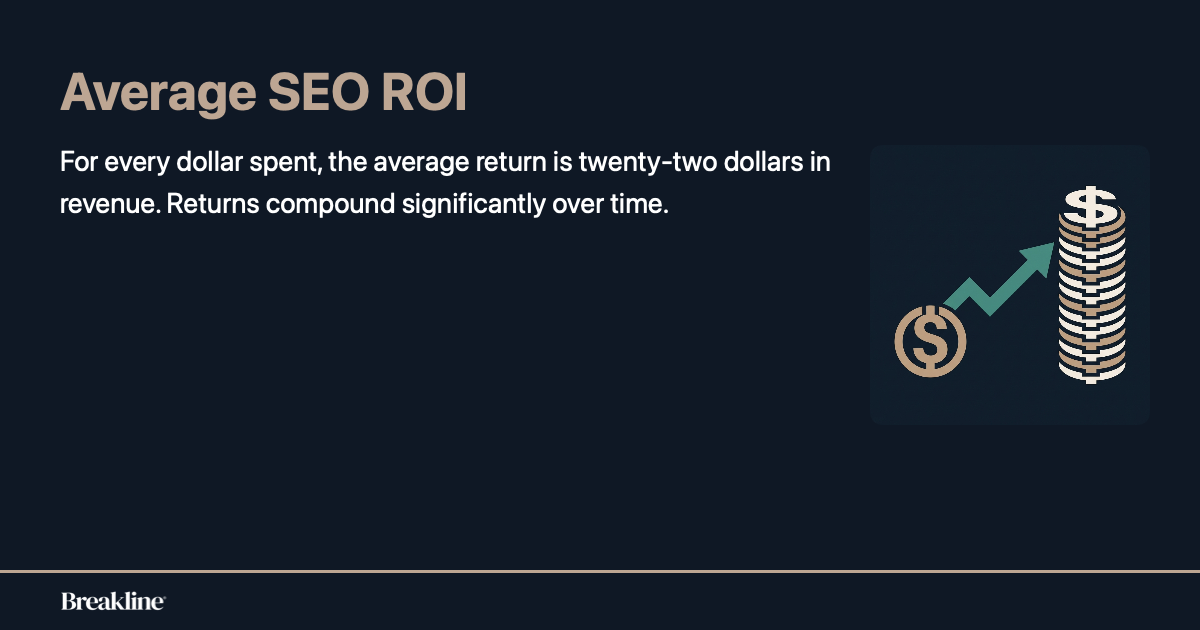
I think the easiest way to look at this is through a simple ratio. Recent data shows the average SEO ROI ratio sits at about 22 to 1.
You spend one pound, and you get twenty-two pounds back in revenue.
Obviously, it takes time to reach that point because search is not a slot machine where you put a coin in and pull a lever. The returns compound slowly over months and years.
You build momentum. A page ranks higher and starts bringing in a few leads, then a few more, then suddenly it becomes a consistent machine.
Leads from organic search close at a massive 14.6% rate. Compare that to traditional outbound marketing, which sits at a miserable 1.7% close rate.
People are literally typing their problems into Google, so they are already primed to buy your solution.
It just makes sense.
We see this all the time at Breakline. A business comes to us tired of cold calling, and within a year, their entire sales process changes because the leads are coming to them directly.
How we actually calculate the numbers
So here is the tricky part about measuring success. The math itself is incredibly basic.
You take your net profit from the campaign, subtract the costs of the campaign, and divide that by the costs. Then you multiply by 100 to get your percentage. Simple.
The problem is how people define profit.
I see business owners get obsessed with organic traffic or keyword rankings because they want to see a graph pointing up. They look at domain authority and cheer when a number changes.
Traffic does not pay your wages.
You can have ten thousand visitors a month, but if none of them pick up the phone to book a consultation, it is completely useless.
We track actual revenue generated from organic search using tools like Google Analytics to prove real financial return. We look at form fills and phone calls.
Vanity metrics are a distraction.
Why your specific industry changes everything
A local solicitor does not get the same results at the same speed as an online shoe shop. Competition dictates absolutely everything in search.
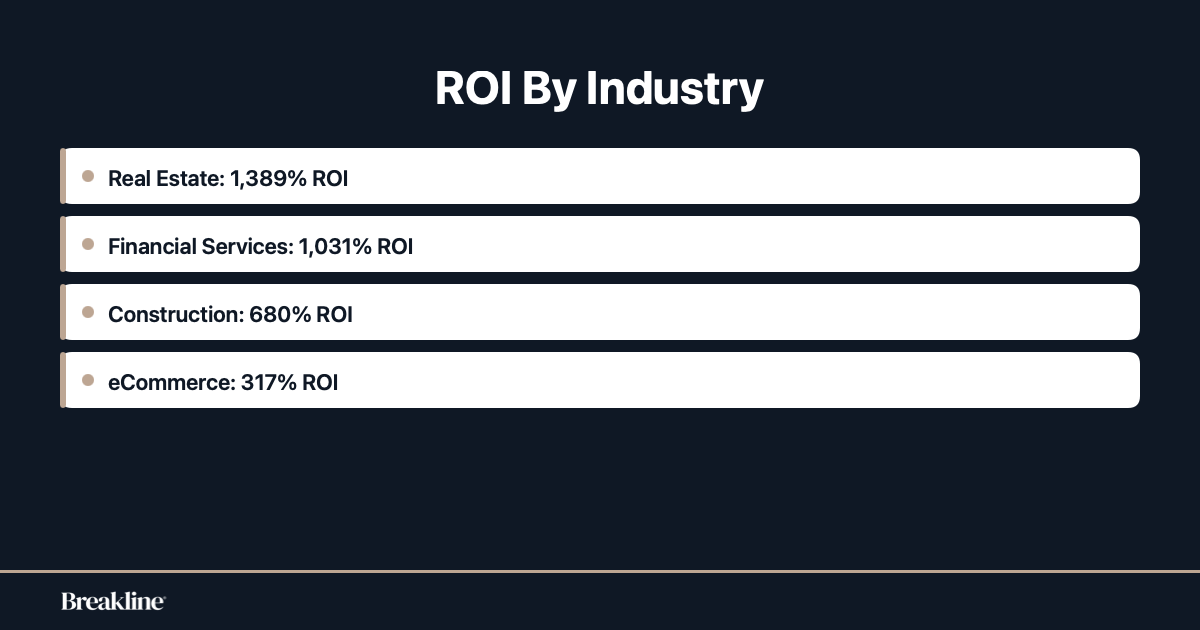
Let us look at some hard data from recent campaigns. Real estate businesses see the highest returns at roughly 1389%, taking about ten months to break even.
Financial services hit around 1031% in nine months. The ticket price for these services is huge, so a few good leads change the whole picture.
Construction companies and HVAC services are fascinating.
They often see returns around 680%, but they break even incredibly fast. Usually in just five or six months.
When someone needs a boiler fixed, they need it fixed right now. They search, they click, they call.
Then you have eCommerce. Selling products online is brutally competitive.
Returns sit lower at around 317%, and it takes nine months just to cover your costs. You really have to accommodate for these differences when planning your budget for the year.
Every sector has its own quirks.
Medical device companies might wait 13 months to see profit. But when they do, it hits nearly 1200% because the contracts are enormous.
Local businesses see different results
If you run a physical business serving a specific town, your situation is entirely unique. Local search is a completely different beast.
Small and medium enterprises actually see three times the return on investment from local search compared to other marketing channels. It brings in 300% more conversions than posting on social media.
Think about how people actually behave.
When someone’s roof is leaking, they do not scroll through Facebook looking for an advert. They go straight to Google and search for a roofer near them. They want a local expert.
A huge 86% of people rely on Google Maps to find local businesses. If your Google Business Profile is set up properly and ranking well, you capture that immediate demand.
You grab the customer exactly when they have a credit card in their hand.
Almost nine out of ten local searches lead to a phone call or a physical visit within 24 hours. That is direct revenue hitting your till.
The power of a simple map listing
People underestimate Google Maps.
They think a website is the only thing that matters, but for a dentist or a plumber, the map pack is where the real money lives.
Getting your business to show up in those top three map spots is often the most profitable thing you can do.
It builds immediate trust.
The timeline for getting your money back
Waiting for a return is the hardest part for most business owners. You are writing a cheque every month, and for the first few months, the phone isn’t ringing any more than usual.
I remember a client we worked with a few years ago. A commercial cleaning company.
By month four, the owner was getting incredibly anxious. He wanted to pull the plug because he had spent a decent chunk of money and only had a handful of new contracts to show for it.
We told him to wait just two more months.
Month six hit, and the compounding effect took over. They landed three MASSIVE office contracts in a single week, all from organic search.
They broke even and never looked back.
Legal services often take 14 months to break even but eventually yield a 526% return. You just need the stomach to wait it out.
Patience pays off in this game.
Types of work that drive the best results
Not all search marketing is created equal. The specific tactics your agency uses will dictate your financial return.
Fixing technical issues on your website is important. Making sure pages load fast and Google can read them properly.
This technical work averages a 117% return and breaks even in six months.
But the real money is in strategic content.
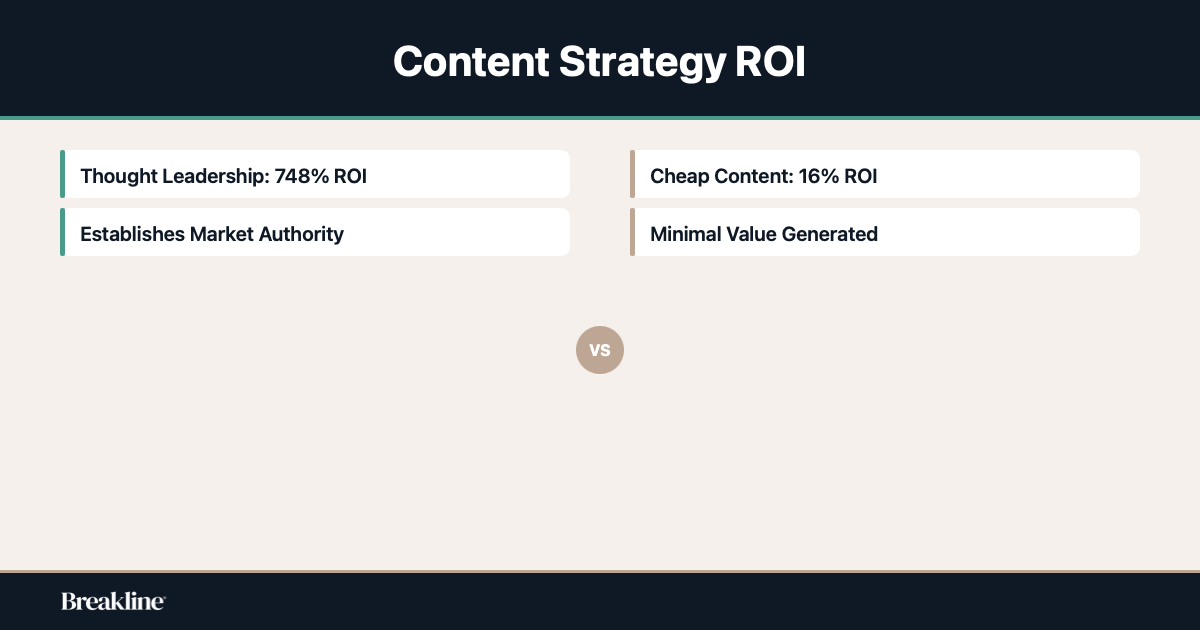
Creating high-quality articles that answer specific customer questions is known as thought leadership.
This approach drives a massive 748% return on investment. It takes about nine months to pay off, but it establishes you as the absolute authority in your market.
Basic, cheap content writing barely moves the needle. It might get you a 16% return if you are lucky, and takes over a year to show any value at all.
Quality matters significantly more than volume.
Do not cheap out on content.
Why links still matter
A backlink is just another website linking to yours. It acts like a vote of confidence in the eyes of Google.
Over 94% of pages on the internet have zero backlinks, and those pages get virtually no traffic.
Building high-quality links from relevant websites is expensive, but it pushes your return on investment higher than almost anything else.
You definitely need a strategy for earning them.
Tracking what actually matters now
Search is changing rapidly. Artificial intelligence is shifting how people find information online.
About 60% of searches now end without a click. People see the answer right there on the results page and move on.
This sounds terrible, but it actually filters out the timewasters who were never going to buy anyway.
The people who do click through to your website are the ones who actually want to hire you or buy your product.
This is why tracking vanity metrics is dangerous. If your traffic drops 10% but your revenue goes up 20% because you are capturing better quality leads, then the campaign is a huge success.
Always tie your reporting back to actual money in the bank.
If an agency only wants to talk about domain authority or search volume, they are hiding something. They should be talking about your profit margins & your close rates.
Why paid ads lose out eventually
Lots of people ask me why they shouldn’t just run Google Ads instead. It seems faster and less stressful.
You pay money, and you appear at the top immediately. That part is entirely true. But the moment you stop paying, the traffic stops completely.
Search engine optimisation outperforms paid advertising by a factor of five over the long term. Once you earn those organic positions, they keep delivering leads without you paying for every single click.
Your cost per lead drops by about 61% compared to outbound methods.
It builds an asset you actually own rather than just renting space from Google. You build equity in your own website.
That said, it is not always simple to convince a finance director to wait six months for a return. I get that. But the math speaks for itself.
The Bottom Line
Throwing money at a website and hoping for the best is a terrible business strategy. You need a clear expectation of what comes back.
The data proves that search remains one of the most profitable investments you can make for a business. It generates leads at a fraction of the cost of other channels.
Yes, it requires patience.
Yes, you will have moments where you wonder if it is actually working, and you will probably want to fire your agency at month four. That is completely normal.
But when you hit that break-even point and the leads start flowing in consistently at a lower cost than any other channel, it completely transforms a business.
It takes the pressure off your sales team and gives you breathing room.
Just find someone you trust and let the process work.