A Guide to Vector Embeddings in SEO

Vector embeddings are basically numerical maps of meaning that help search engines match your website to what a customer actually wants. Instead of just looking for exact words typed into a search box Google uses these numbers to grasp concepts & relationships between ideas. If you run a dental practice this means you get found for “fix broken tooth” even if your page only says “emergency crown repairs”.
That is the short & simple answer.
You are probably busy running your business and wondering why your website traffic dropped recently. You might have heard technical terms thrown around by agencies.
Vector Embeddings is one of those terms that sounds incredibly complicated. It really just means translating human language into a massive grid of numbers. The closer two numbers are on that grid the closer they are in meaning.
I remember when we first started talking about this stuff at Breakline years ago. People thought it was science fiction.
Now it is just how the internet works. Search engines use Large Language Models or LLMs to process these numbers. They map everything out.
This creates a system where meaning matters more than repeating the same phrase fifteen times on a page. The entire search industry had to adapt to this shift. We had to stop looking at individual words and start looking at the bigger picture.
It changed everything.
So if you are wondering why a competitor with a seemingly worse website is outranking you this might be why. Their content might just map better mathematically to the user intent. They might be hitting all the right semantic notes without even realizing it. We are going to look at how you can do the same thing.
What exactly are vector embeddings
Think of a giant invisible map of words. Every word or concept gets a specific set of coordinates.
A roofer might have a page about repairing leaks. On the map the concept of a leak is plotted right next to missing shingles and water damage.
The math behind this is called cosine similarity. It measures the angle between these points to see how related they are. If the angle is small the concepts are a tight match.
Google uses this math to figure out if your content actually answers a question. They don’t want to send someone to a page that only mentions a problem in passing. They want to send them to a resource that covers the problem completely.
You don’t need to do the math yourself.
I certainly don’t sit around calculating angles all day. But you do need to know that this map exists. It completely CHANGES how we write for the web.
We are moving away from stuffing pages with exact phrases. We focus on covering a topic completely so the AI search sees all those related coordinates. It is about proving your expertise through comprehensive answers.
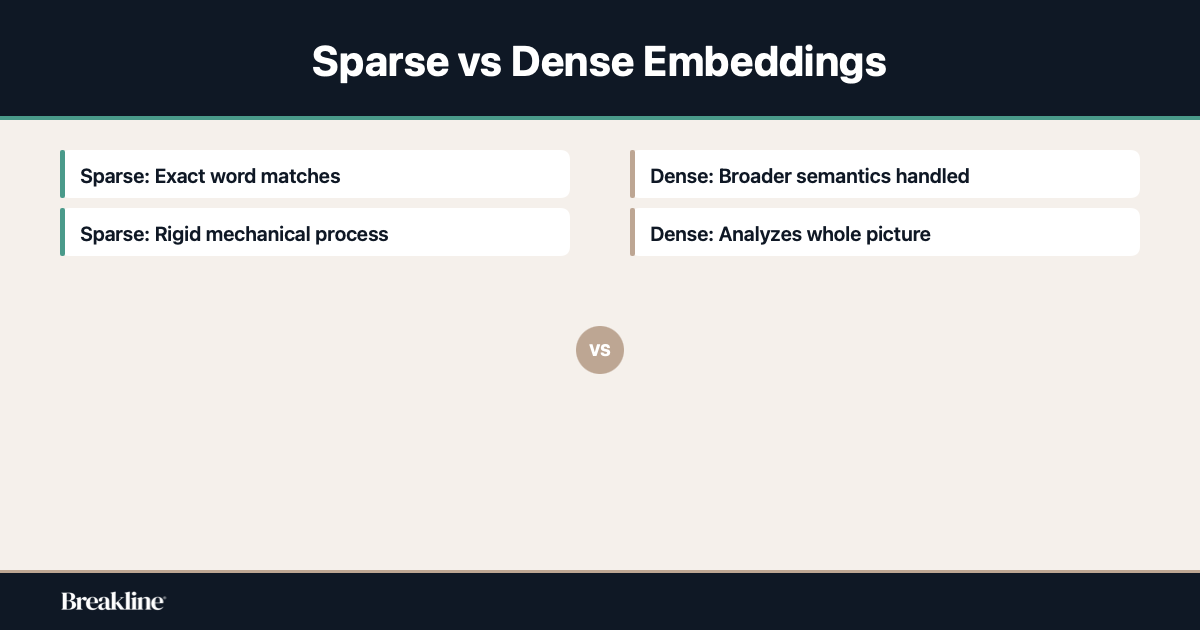
Sparse embeddings used to be the standard. They just looked for exact word matches and gave them a score.
Dense embeddings changed the game entirely. They handle the broader semantics of what a person actually means. If someone types in “my roof is dripping” the dense embedding knows they need a repair service. It connects the action of dripping to the service of repairing.
How Google reads your website now
Search used to be a very literal machine. You typed in a query and it looked for a page with those exact letters in that exact order. It was a very mechanical process.
That led to some truly awful websites. People would write “best solicitor in London” fifty times in white text on a white background. It worked for a while.
Then Google got smarter and started using early AI to read between the lines. They wanted to reward actual quality.
Now they use dense vector embeddings trained on billions of searches.
These models look at the whole picture. They look at clickstream data to see what real people do. If someone searches for an electric car they usually search for battery range right after.
The system learns that these ideas are connected. Your content needs to reflect those connections naturally. You cannot just talk about the car without talking about the battery.
Think of a conversation with an expert. An expert naturally brings up related points.
When we audit sites we often see pages that are entirely one dimensional. They pitch a service but offer no educational value. The algorithms pass right over them. They are looking for that rich cluster of related information.
Why exact keywords matter less
I think a lot of business owners still obsess over one specific keyword. They want to rank number one for “emergency plumber”.
This is a mistake. AI search tools and Generative Engine Optimization rely on broad context. When someone asks a chatbot a question it builds an answer from multiple sources.
It looks for pages that demonstrate real expertise across a whole subject. If your plumbing site only talks about emergencies but ignores pipe materials or water pressure the AI might skip you.
It wants comprehensive answers. It looks for a high cosine similarity score across a whole cluster of ideas.
You have to cover the surrounding topics.
That proves you actually know your stuff. We see this with solicitors all the time. They want to rank for conveyancing.
But they don’t explain the steps of buying a house or what a property survey actually involves. The search engines notice that missing information.
Selling a car requires talking about the engine and the brakes too. Your website has to provide the full picture. It cannot just be a flashy headline.
Some folks still try to game the system. They buy exact match domains and build thin pages. It might give a temporary bump. But the semantic engines always catch up eventually.
Generative engine optimization explained
You have probably noticed AI Overviews popping up at the top of your search results. This is where things get really interesting. It is a completely different way of presenting information.
Generative Engine Optimization or GEO is how you make sure your website is the one those AI tools quote. It is different from traditional SEO. Getting a blue link is no longer the main goal.
You must feed the machine exactly what it needs to write a summary. That means structuring your facts clearly.
You have to actually be the source material. You want the AI to rely on your data.
These large language models crave structure. They love lists and clear definitions. If you make it easy for the AI to extract a fact it is more likely to use your page.
This is where those vector mappings come back in. The AI uses them to find the most relevant and complete source. If your page has the tightest cluster of related concepts you win the citation.
It really is that straightforward.
But straightforward does not mean easy. You still have to sit down and write the content. You have to organize it logically with clear headings. You have to think like an encyclopaedia sometimes.
Fixing your site for AI search
So how do you actually fix your website to accomodate this shift. You start by looking at your existing pages.
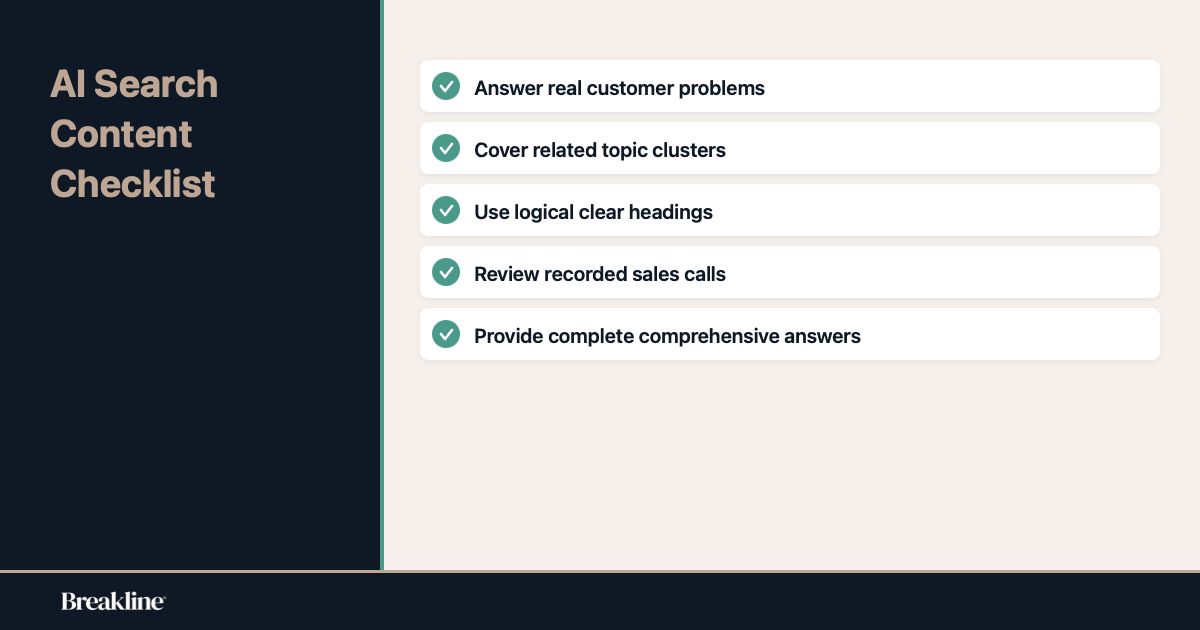
You ask yourself if they actually answer the customer’s real problem. A lot of sites are just digital brochures. They say “we are great” and list a phone number.
That does not give the AI search much to work with. You need to expand your content to cover the questions people ask when they call you.
Think about the conversations you have every day.
Those are the topics you need to write about. If you are a dentist you know people are terrified of root canals. They ask about pain & recovery time and alternatives.
Your root canal page needs to cover all of that. By doing so you naturally create a dense cluster of related terms. The vector embeddings for your page will align perfectly with the user anxious search query.
It is just good customer service translated into text. The more helpful you are the better you rank. Google wants to recommend businesses that actually help people.
I often tell clients to record their sales calls. Listen to the exact phrases customers use. Write those down and build sections on your website around them. It is cheap & effective research.
Tools to map your content
You might be wondering how to actually measure this stuff. There are tools out there that handle the heavy lifting. You don’t have to guess.
A popular one among technical folks is Screaming Frog which now includes features to vectorize your site. It crawls your pages and can actually calculate how similar they are to each other.
This is brilliant for finding duplicate content or figuring out where your internal links should go. You can literally see which pages are conceptually closest. It takes the guesswork out of site structure. It is a fantastic piece of software.
Using this software almost feels unfair once you get the hang of it. You can see the matrix.
You can also use tools like ChatGPT to generate semantic fields. You just ask it to list all the concepts related to your main service. Then you check your website to see if you actually mentioned them.
It is a very simple way to do a content audit without spending thousands on software. I use this trick all the time.
It highlights your blind spots immediately.
Sometimes you will realise you completely forgot to mention a crucial step in your service. Adding that missing information strengthens your overall topical authority. The vectors become denser. The search engines trust you more.
Making this work for your business
The biggest hurdle is usually time. Business owners are stretched thin.
Sitting down to map out semantic clusters is not high on the priority list. But you don’t have to do it all at once. Pick your most profitable service.
Spend an hour writing down every question a customer has ever asked about it. Then update that one page to include those answers.
You will definitly see a difference over time.
It is about building a resource that actually helps people. The algorithms are just trying to reward helpfulness. Sometimes I think we overcomplicate marketing.
We invent fancy terms for basic human communication. Vector embeddings are just a mathematical way of checking if you are making sense. If you speak clearly and thoroughly about what you do the math works out in your favour.
Just be genuine. Don’t try to sound like a textbook if that is not who you are. Let your actual expertise shine through.
A roofer talking honestly about why cheap shingles fail is incredibly valuable content. The AI recognises that authenticity through the specific terminology used. It maps those specific terms to high quality information. That is how you win.
The Bottom Line
Search is not going back to the way it was. The machines are only going to get better at reading context. They are learning every single day.
You cannot trick them with exact match keywords anymore. You have to actually BE the best answer on the internet for your specific niche.
That means putting effort into your content. It means thinking about the whole customer journey. It is a totally different mindset.
It is hard work but it pays off. The traffic you get is much more targeted.
I have seen so many businesses transform just by shifting their focus from keywords to whole topics. They stop worrying about the algorithm and start worrying about the user. Ironically that is exactly what the algorithm wants.
So stop counting words on your pages. Start counting the problems you solve. The math will take care of the rest.