Google’s March 2026 Spam Update: The Fastest Rollout in Search History

Google’s March 2026 Spam Update rolled out and finished in just under 20 hours to target websites breaking existing search spam policies. It started at 12 18 p.m. PDT on March 24 and wrapped up by 7 39 a.m. PDT the very next day. If your roofing company or dental practice saw a sudden drop in website traffic during that exact window you now know exactly why.
This is the fastest confirmed rollout in the history of the search engine.
I remember checking the dashboard when it was first announced. The official line from Google was that it would take a few days to complete. That is the standard corporate line they always give us. Then I woke up the next morning and it was already marked as resolved.
The December 2024 spam update took seven full days to finish rolling out. The August 2025 update dragged on for nearly four weeks.
This sub-20-hour sweep is entirely unprecedented in our line of work. It caught basically everyone by surprise because we are so accustomed to the slow grind of typical search changes.
Business owners are often left trying to figure out if they were hit or just experiencing normal seasonal fluctuations in their traffic. When an update takes a month to roll out it is pure agony for anyone watching their analytics dashboard. A fast update at least rips the plaster off quickly so you can start planning your recovery.
Breaking records with a 20 hour rollout
The sheer speed of this update caught almost everyone off guard. A rollout time of 19 hours and 21 minutes is incredibly brief for a global system change.
Record-Breaking Rollout Time
When Justia and other legal marketing experts looked at the data they were shocked at how quickly the dust settled. Shorter rollouts usually mean a very specific enforcement action. They do not indicate a massive shift in how the algorithm reads the internet.
Instead of crawling through the entire index to evaluate every single website Google likely deployed a highly targeted strike.
The engineers probably fed specific parameters into their SpamBrain AI system and let it run a highly precise sweep across the index. If you run a local solicitors firm and you play by the rules you probably didn’t even notice a blip in your daily enquiries.
But for sites relying on scraped content or aggressive manipulation the impact was immediate and severe. I think the speed tells us a lot about how confident they are in their current systems right now.
They didn’t need a month to test the waters. They flipped a switch & the bad results vanished.
What the search engine actually targeted
This update applies globally across all languages. It specifically targets sites violating the core search spam policies that have been in place for years.
We are talking about things like auto-generated gibberish or massive amounts of scraped content.
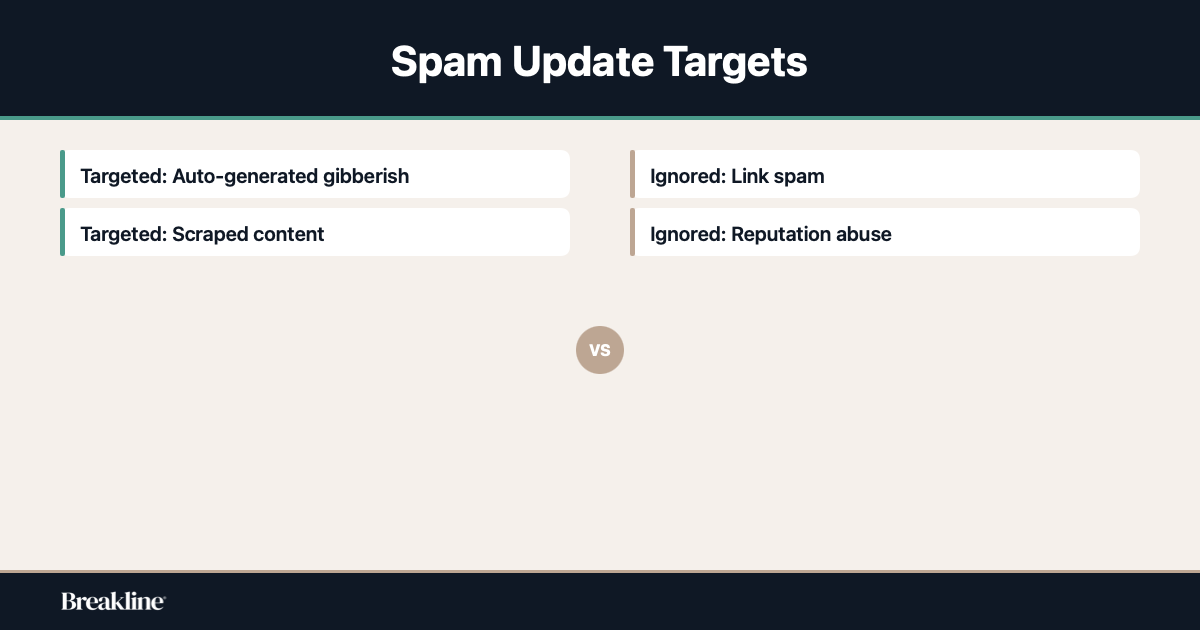
Spam Update Targets
It doesn’t target link spam or site reputation abuse which are entirely different beasts. Site reputation abuse is when a trusted website rents out a highly authoritative page to a third party so they can rank for unrelated lucrative terms.
Link spam involves buying links from other websites in bulk to artificially boost your own domain authority. If you have been buying dodgy links to push your plumbing website higher up the results this specific update probably ignored you completely.
That might sound like a relief but don’t get too comfortable.
Google handles those other issues with completely different systems. The March 2026 Spam Update was laser focused on content manipulation and clear-cut policy violations. Search Engine Roundtable confirmed that this sweep was all about the foundational spam rules. It is fascinating to watch the algorithm become so compartmentalised. They no longer try to fix everything at once.
This compartmentalisation makes troubleshooting slightly easier. You know exactly what kind of penalty you are dealing with.
Missing new rules and policy changes
You might expect a major algorithm shift to come with a massive blog post explaining new rules. That did not happen here. Google stayed completely silent on the policy front.
Google did not announce any new spam policy changes alongside the rollout. This suggests the update is just a routine refinement of their existing enforcement systems.
I was reading some analysis from Brandon Himpfen recently and he pointed out how different this is from the March 2024 update. Back then we got brand new classifications like scaled content abuse and expired domain abuse.
This time it was just business as usual but faster.
I actually prefer it when they do not introduce new rules. It means business owners do not have to scramble to accomodate a completely new way of working. If your dental clinic website was built to be genuinely helpful for your patients you are already doing the right thing.
The search engine is just getting better at catching the people who try to cheat the system. They are refining the net rather than changing the size of the holes.
Getting your organic traffic back
If your website did get caught in this sweep the road ahead is deeply frustrating. Google has emphasised repeatedly that recovery from a spam update is gradual and definetely not guaranteed for anyone.
You cannot just fix the offending pages on a Tuesday and expect your traffic to bounce back by Wednesday morning. Even after you clean up the scraped content or remove the automated gibberish improvements can take many months to appear in your analytics.
The system needs to trust your website again. Trust is notoriously hard to rebuild once it is broken.
Sometimes lost ranking gains are permanent.
If your site was ranking well because of manipulative tactics those rankings were never really yours to begin with. Once the spam is removed the site will settle into its natural position.
For a local roofer who hired a cheap marketing company to spin hundreds of location pages this is a tough pill to swallow. You have to start over with a clean slate and build real authority. I have seen businesses bounce back but it takes serious patience and a willingness to do things properly.
A lot of people ask me what is a backlink and will it save my site. The truth is no single tactic will save a site that has been penalised for heavy spam. You just have to do the hard work.
How the SEO industry reacted
The speed of this rollout completely shocked the SEO community. Prominent figures like Glenn Gabe were publicly reacting with surprise on social media almost immediately.
“Super fast rollout” was the general consensus floating around. People were genuinely caught off guard because we are so used to the slow agonizing wait of a four-week core update.
When SISTRIX marked the event as resolved just 24 hours after it started my phone started buzzing with messages from clients and colleagues. Everyone wanted to know what they missed. It is funny how an industry built on data can still be so easily surprised.
We spend all our time analyzing patents and reading official documentation.
Then a sub-20-hour update happens and we all just sit there blinking at our screens. ‘I did not see that coming’ was a phrase I heard a lot that week. It adds a bit of excitement to the job though.
You never really know what the search engine will do next. That unpredictability keeps us sharp.
A faster pace for future updates
This is already the second announced algorithm update of 2026. We just had the February 2026 Discover core update a few weeks prior. The pace is definitely picking up.
Search Engine Land noted that this rapid succession of updates might signal a much more aggressive enforcement posture from Google going forward. They are clearly trying to clean up the search results faster than ever before because users are complaining about low quality results.
A lot of this likely stems from the massive influx of AI-generated spam flooding the internet right now. Anyone with a basic software script can spin up a thousand articles in an hour now.
Google has to adapt to survive that kind of volume.
If they stick to their old schedule of one or two massive updates a year the search results would become completely unusable for regular people. They need these rapid targeted sweeps to keep the garbage out of the index.
I suspect we will see a lot more of these lightning fast updates throughout the rest of the year as they refine their tools. The algorithm is learning to identify patterns of abuse much quicker than human reviewers ever could. This is the new normal for search and we have to adapt.
Business owners need to stop looking for shortcuts. The machines are getting too smart to be fooled by cheap tricks.
Checking your own website data
So what should you actually do with all this information.
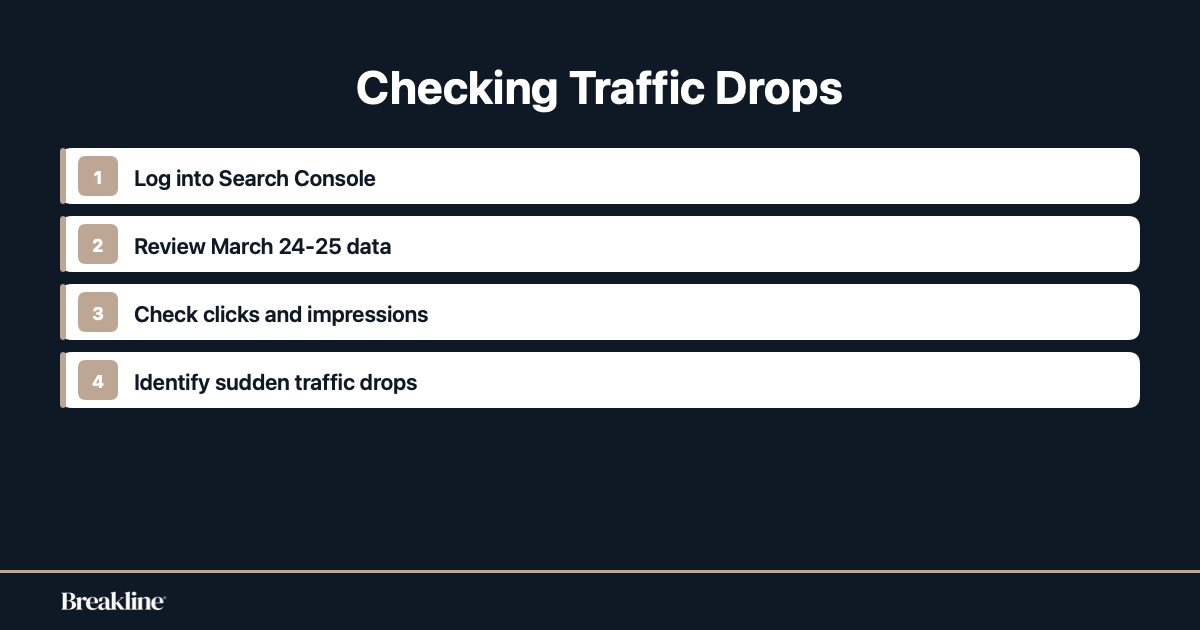
Checking Traffic Drops
The first step is to log into your Google Search Console account. You want to look at your performance data specifically for March 24 and March 25. If you see a massive cliff edge drop in clicks and impressions right around that 20 hour window you were likely hit. Do not panic immediately though.
Sometimes a drop is just a seasonal trend or a technical glitch on your website.
Interpreting the sudden traffic drop
Did all your pages drop or just the ones with thin content that you bought on the cheap. If you are a solicitor and your main service pages are fine but your blog posts about generic legal terms tanked that tells you exactly where the problem is.
The Search Console is your best friend in these situations because it does not lie. It strips away the guesswork and shows you exactly how Google views your website on a technical level. If you are ever unsure you can always reach out to a specialist agency like Breakline to help you interpret the numbers and build a plan.
A client once asked me how does Google Business Profile work in relation to these spam updates. Local profiles are generally managed by different systems but heavy website penalties can absolutely drag down your map rankings. Everything is connected eventually.
Final thoughts on the March update
This whole event feels like a turning point for how search updates operate. We are moving away from the massive drawn out events that disrupt the entire industry for a month. Instead we are getting these surgical strikes. It is a completely different approach.
I think this is ultimately a good thing for legitimate business owners. If you run a solid honest company you don’t want to be caught in the crossfire of a massive algorithm test.
You just want the search engine to quietly remove the cheaters so your website can shine.
It definitely keeps those of us in the SEO industry on our toes. We have to be faster and more adaptable. The days of waiting weeks to see how an update settles are over. We have to look at the data immediately and make quick decisions.
It is challenging & it is also what makes this job so interesting. The internet is constantly changing & we just have to change with it.