Digital PR Links vs Strategic Link Building

Strategic link building is generally superior to digital PR backlinks for driving specific keyword rankings because it gives you control.
With strategic building, you dictate the anchor text, the surrounding content relevance, and usually ensure the link is dofollow.
Digital PR links are often nofollow, the anchor text is almost always just your brand name, and the link gets buried quickly because news sites publish hundreds of thousands of articles a year.
While digital PR is great for brand awareness and vanity metrics, strategic link building is the engine that actually pushes you up the search results for the commercial terms that make money.
That might sound harsh. especially if you have just spent a chunk of your budget on a flashy PR campaign.
But I have been in this game for a long time. I have seen trends come and go. I have seen agencies pivot from one “magic bullet” to another.
Right now, digital PR is the darling of the industry. It’s sexy. It gets you logos on your homepage that say “As Seen In.” Clients love those logos. But do those logos pay the bills?
Not usually.
I want to break this down properly.
I want to look at why we are seeing this split between digital PR backlinks and strategic link building & why you need to be careful about which basket you put your eggs in.
The Anchor Text Problem
This is the big one. If you know anything about SEO, you know that anchor text is the strongest indicator of what a page is actually about. It’s the primary signal.
When you do strategic link building, you are often working with a site partner or an editor where you can suggest the anchor text. You can write a sentence like “using the best CRM software can streamline your sales” and link the words “best CRM software” to your product page.
That is gold.
Now look at digital PR. You send out a press release or a data study. A journalist picks it up. They write a story. If they link to you, and that is a big if, they will usually link to your homepage using your brand name as the anchor. Or they might use a generic phrase like “click here” or “this study.”
Does a link with the anchor text “Breakline” help me rank for “SEO agency“? Maybe a little bit. Indirectly. But it doesn’t tell Google explicitly that my page is the best result for “SEO agency.”
I think this is where many businesses get lost. They see the high Domain Authority (DA) of a newspaper and think “Wow, a link from a DA 90 site!” But they forget that relevance and anchor text are massive factors.
A DA 40 link from a relevant industry blog with exact-match anchor text often moves the needle more than a DA 90 link with a generic anchor.
It’s about precision.
Strategic link building is like using a sniper rifle. You aim at a specific keyword and you hit it. Digital PR is like using a shotgun while blindfolded.
You might hit something, but it probably won’t be the target you were aiming for.
The Nofollow Trap
Let’s talk about the technical side of things. Nofollow backlinks.
Most major news publications default to nofollow links for outbound citations. They do this to protect their own SEO and to avoid looking like they are selling links.
When a link is nofollow, it tells search engines not to pass authority (or “link juice”) to the destination page.
Proponents of digital PR will scream until they are blue in the face that “Google treats nofollow links as a hint” and that “they still have value.”
Sure. They have some value. They drive referral traffic. They signal trust.
But do they pass the raw power needed to rank for competitive keywords? In my experience, no. Not really.
I have analyzed thousands of link profiles. The sites that dominate the SERPs usually have a solid foundation of dofollow, contextual backlinks.
When you engage in strategic link building, you are almost always negotiating for a dofollow link. You are building a relationship with a webmaster or an editor in your niche.
You are creating value for them, and in exchange, you get a link that actually counts in the algorithm’s eyes.
It seems crazy to me to spend thousands on a campaign that results in a handful of nofollow links that Google might largely ignore when calculating rankings.
I remember a client a few years back. They had a massive PR win. Got mentioned in the Guardian, the BBC, the works. They were ecstatic. They popped champagne.
Two months later, their organic traffic hadn’t budged an inch. Why? Because the links were nofollow and the stories had nothing to do with their core service keywords.
It was a hard conversation to have.
Content Velocity and Dilution
Here is a factor people rarely talk about. Content velocity.
News sites are content mills. They have to be. Their business model relies on churning out fresh stories every single hour to capture clicks and ad revenue.
A major news site might publish hundreds of articles a day. Hundreds of thousands a year.
What does that mean for your link?
It means your link is on the homepage for maybe twenty minutes. Then it’s on the second page of the section. Then it’s in the archive. Within a week, it is buried under thousands of new URLs.
This immense volume of content dilutes the internal link equity of the site. If a site has ten million pages, the amount of authority flowing to any single archived article is microscopic.
Compare this to a niche industry blog that publishes two or three high-quality articles a week. Your guest post or strategic placement stays on the homepage for days. It remains in the “recent posts” sidebar for weeks. The site structure is smaller, tighter. The link equity is concentrated.
I would rather have a link on a site that treats its content like a library than a site that treats its content like a landfill.
It’s about lifespan. Strategic links tend to live in an environment where content is evergreen. Digital PR links live in the news cycle, and the news cycle is brutal. It forgets you instantly.
The Relevance of Surrounding Content
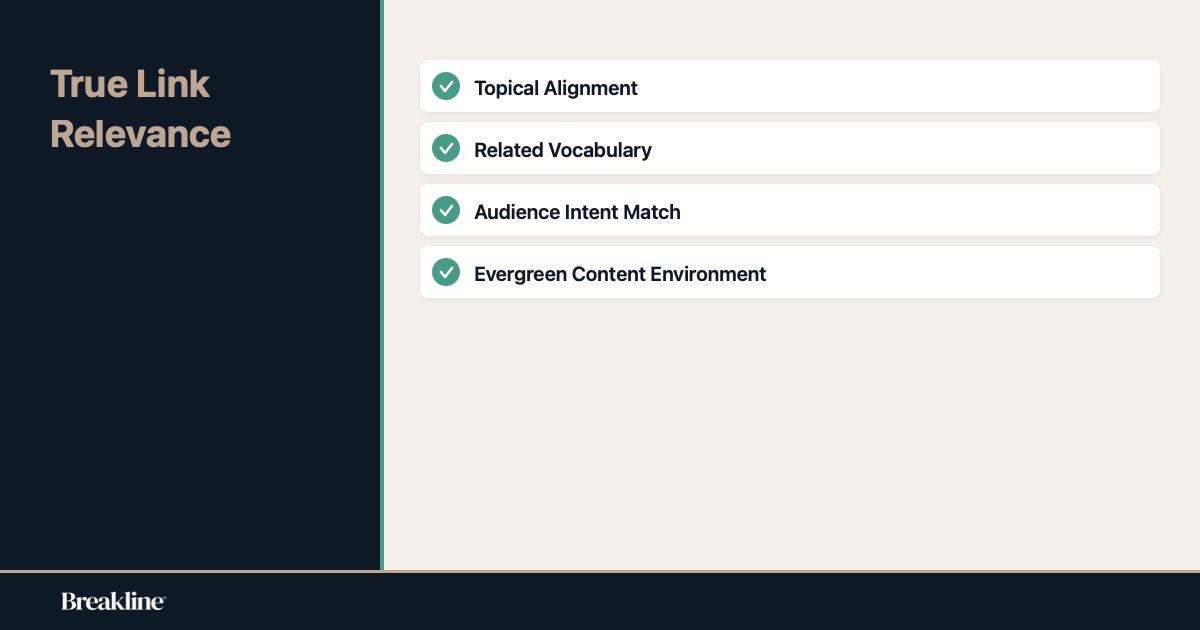
Content relevance is critical. We know this.
When you secure a digital PR link, it is often part of a broader story. Maybe you released a survey about “workplace habits.” The journalist writes a story about “how people are lazy on Fridays” and quotes your CEO.
The context of that link is “workplace habits” or “laziness.”
But what if you sell accounting software? The context of the article has zero to do with accounting software. Google sees the link, but it struggles to connect the topical relevance of the source page to your target page.
With strategic link building, you control the narrative.
You can pitch an article specifically about “How Accounting Software Improves Friday Productivity.”
Now the content relevance is 100% aligned. The words surrounding your link are “accounting,” “finance,” “software,” “automation.”
This signals to Google that you are an authority on *this specific topic*.
I honestly believe this is why so many digital PR campaigns fail to drive ranking improvements. They get links, yes. But they get links from irrelevant contexts. It confuses the algorithm.
You can’t just throw spaghetti at the wall. You have to be deliberate.
There is also the issue of syndication. You see this a lot. Agencies will promise “100 links!” What they mean is they got one story on a newswire, and it was syndicated to 99 local news affiliates.
It’s the same clickbait articles repeated over and over.
Google is smart enough to know that this is duplicate content. It usually picks one version to index and ignores the rest.
So you paid for 100 links and you got one. And that one is probably nofollow.
It feels a bit like a scam sometimes.
Generative Engine Optimization and AI
Things are changing though. We have to talk about Generative Engine Optimization (GEO) and how AI is shifting the landscape.
In 2026 and beyond, we are looking at a world where users might not even click through to a website. They will get an AI-generated answer right there in the search results. For this, brand mentions, even unlinked ones, might become more valuable.
Digital PR is actually quite good for this. If an AI is scraping the web to learn about a topic, and it sees your brand mentioned in major publications, it associates you with that entity.
So, is digital PR useless? No. It helps feed the knowledge graph. It helps with what we call E-E-A-T (Experience, Expertise, Authoritativeness, and Trustworthiness).
But here is the catch.
To rank in the AI snapshots, you still need authority. And to get the AI to cite you as a source, you need to be seen as a topical expert. Strategic link building builds that topical depth better than PR does.
If I build 50 links from high-end SEO blogs discussing “technical audit strategies,” I am screaming to the AI that I am an expert on technical audits.
If I get 50 links from newspapers discussing my “fun office culture,” the AI learns I have a fun office, not that I am a technical SEO expert.
See the difference?
SEO is moving towards entity understanding. You need to define your entity clearly. Strategic placements allow you to do that definition work. PR leaves it up to the journalist, who probably doesn’t care about your entity definition.
The Agency Perspective
I run an agency. I know how the sausage is made.
Digital PR is attractive to agencies because it is scalable in a different way. If you have a great creative team, you can come up with one “campaign”, say, a map of the UK showing which cities love pizza the most, and blast it out to thousands of journalists.
If it hits, you get a ton of links for a relatively low unit cost. The margins can be good.
Strategic link building is hard work. It is manual. It grinds you down.
You have to find the sites.
You have to vet them.
You have to email them.
You have to negotiate.
You have to write the content.
You have to chase them up.
You have to fix the link when they mess it up.
It is not easy to scale.
Because it is hard, many agencies shy away from it or they outsource it to low-quality vendors who build links on spammy sites. That gives strategic link building a bad name.
But when done right? When done by a team that actually cares? It is unbeatable.
I have had clients come to me after spending six figures on digital PR with another agency. They have these beautiful reports full of logos. Breakline has to be the one to tell them that their traffic is flatlining because they have no keyword relevance.
It’s awkward. I hate doing it. But I have to be honest.
There is a vanity element to it. CMOs like to show the CEO that they got covered in Forbes.
It justifies their salary. Saying “we got a guest post on a niche manufacturing blog” doesn’t sound as cool in the boardroom.
But the manufacturing blog is the one that brings the qualified leads.
The Quality vs Quantity Debate
There is a misconception that more is better. Digital PR often focuses on quantity. “We got you 50 links this month!”
Strategic link building focuses on quality and intent. “We got you 5 links this month, but they are all from sites your customers actually read, and they all point to your ‘buy now’ page.”
I will take the 5 links every time.
It is important to understand that not all links are created equal.
A link that drives zero traffic and has generic anchor text is barely a link at all.
A link that drives qualified traffic and has keyword-rich anchor text is a powerful asset.
Sometimes I wonder if the industry has forgotten the basics. We get so caught up in “tactics” and “hacks” that we forget the fundamental purpose of a link. It is a vote of confidence. It is a pathway for a user.
If the user doesn’t want to walk down that path, the link is useless.
Strategic building forces you to think about the user. You have to write content that fits the host site.
You have to make the link make sense in context. You can’t just shove it in. This forces a level of quality that PR often lacks.
In PR, the link is often an afterthought. A footnote.
A Note on Risk
Some people worry that strategic link building is riskier. They think Google will penalize them for “building” links. They think “earning” links via PR is safer.
There is some truth to that, but only if you are sloppy. If you are buying links on “link farms” or sites that openly sell posts, yes, you are asking for trouble.
But true strategic building, outreach, relationship building, guest posting on real sites, is very safe.
In fact, I would argue that a sudden influx of 500 low-quality news links from a viral PR campaign can sometimes trigger spam filters more than a steady drip-feed of high-quality relevant links.
It’s about patterns. Does it look natural? Strategic building allows you to mimic natural growth perfectly.
You can control the velocity.
When Digital PR Fails
I want to share a specific example. I won’t name names.
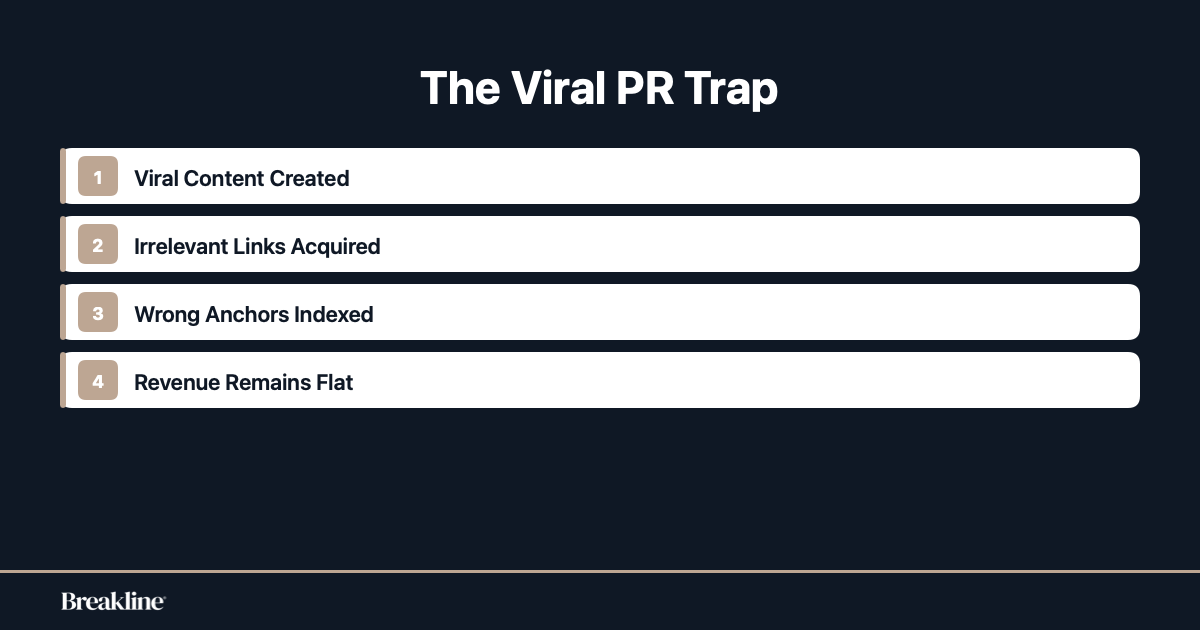
We worked with a finance company.
Before they came to us, they had a viral hit. They created a “calculator” that showed how much money you wasted on coffee. It went everywhere. Major news sites. Blogs. Social media.
They got thousands of backlinks.
Their domain authority shot up. But their rankings for “business loans”, their main money maker, didn’t move.
Why?
Because all the links were about coffee. The anchor text was “coffee calculator.” The surrounding content was about caffeine habits.
Google thought they were a coffee authority.
We had to come in and build boring, steady, strategic links about finance, loans, and business growth.
It took six months to correct the course. But once we did, they started ranking for the terms that actually brought in revenue.
That is the danger of chasing the shiny object.
Sometimes you need to just do the boring work. The work that doesn’t get you a round of applause at the marketing conference but gets you a bonus at the end of the year because sales are up.
I think we sometimes forget that we are in the business of making money, not just making noise.
Finding a Middle Ground
Am I saying you should never do digital PR? No.
If you have the budget, do both. They serve different purposes.
Digital PR is great for top-of-funnel awareness. It gets your name out there.
It can drive social signals. It can help with the overall “trust” of the domain.
But you cannot rely on it as your primary SEO strategy. It is too unpredictable. It is too uncontrollable.
Think of digital PR as the icing on the cake. Strategic link building is the sponge. You need the sponge to hold the cake together. The icing just makes it look nice.
Actually, that’s a terrible analogy. I’m hungry.
Let’s say digital PR is the paint on the house, and strategic link building is the brickwork. You can paint a house made of straw, but it will still blow down.
You need the bricks first.
The best campaigns I have seen use digital PR data to fuel strategic outreach.
You create the study, but instead of just blasting it to news desks, you offer it as an exclusive guest post to high-authority industry blogs.
You get the best of both worlds. Data-driven content, but with controlled placement and dofollow links.
That takes more effort. It takes coordination.
Most agencies don’t want to do that because it breaks their assembly line process. They want to fit you into a box.
Don’t let them.
The Future of Link Building
Looking ahead, I see the gap widening. As the web gets flooded with AI content, genuine, human-curated links will become even more valuable.
Google is going to get better at ignoring the noise.
They will get better at identifying syndicated content and ignoring it.
They will get better at devaluing links that appear in irrelevant sections of news sites.
This means strategic link building, where you are getting a placement on a site that is topically relevant and has a real audience, will become the premium standard.
It will get harder. Site owners are getting savvy. They know the value of their links. Prices will go up.
Standards will go up.
But the fundamentals won’t change. A link is a recommendation. If a trusted expert in your field recommends you, that carries weight. If a random person on the street shouts your name, it means nothing.
We need to stop chasing the shouts and start chasing the recommendations.
There is also the aspect of “relationship building” which is often overlooked. When you do strategic outreach, you are making friends in the industry.
These relationships can lead to other things, partnerships, webinars, client referrals. It is not just about the link.
With digital PR, the relationship is transactional and fleeting. The journalist uses your data and moves on.
They don’t care about you.
I prefer building something lasting. Maybe that’s just me getting old. But I like to know that the work I put in today will still have value in five years.
Final Thoughts
So, where does this leave us?
It leaves us with a choice between vanity and sanity.
Digital PR is flashy. It feels good. It impresses people who don’t understand SEO. But it is often hollow when you look at the metrics that matter.
The lack of anchor text control, the prevalence of nofollow tags, and the high content velocity of news sites make it a shaky foundation for a ranking strategy.
Strategic link building is the workhorse. It allows you to target specific keywords, control the context, and build a profile that is resilient to algorithm updates.
It is slower. It is harder. It is less glamorous.
But it works.
If you have to choose one, choose the one that gives you control. Choose the one that drives revenue, not just ego. In this industry, results are the only currency that matters.
Don’t get distracted by the noise.