Is Wix bad for SEO?

The short answer is yes. If you care about ranking high on Google and building a sustainable business online then Wix is one of the worst platforms you can choose.
I have been working in this industry for 15 years at Breakline and I have seen countless business owners struggle to get traction because their foundation was built on sand. While Wix has made some improvements recently with things like server-side rendering the fundamental truth remains that it prioritizes ease of use over technical performance.
It is great for a hobbyist or a portfolio but for a serious business relying on organic traffic it puts you at a massive disadvantage right out of the gate.
I don’t say this to be mean. I know how appealing the drag-and-drop builder is when you are just starting out. It feels like magic.
You move a box here and a picture there and suddenly you have a website. But search engines do not see the pretty pictures the way you do. They see the code. And the code Wix generates is often bloated and heavy.
The problem with drag and drop builders
Let’s be honest about what Wix actually is. It is a visual builder designed to make web design accessible to everyone. That is a noble goal. My mom could build a website on Wix and she still types with one finger. But there is a trade-off. To make that visual editor work the platform has to inject a massive amount of scripts and code into the backend of the site.

Code Bloat Defined
When you drag an element one pixel to the right the system has to write code to tell the browser to display it there. This results in what we call code bloat. Instead of clean streamlined HTML you get layers and layers of unnecessary scripts. This makes the site heavy.
I think it is important to understand that Wix is designed for looks not performance.
The priority for their engineering team is ensuring the editor doesn’t break when you move things around. It is not ensuring that the page loads in under a second on a 3G connection in a rural area. I have had clients come to me with stunning Wix sites that take 10 seconds to load. In the world of SEO that is a death sentence. Google has been very clear that page speed is a ranking factor. If your site is slow users leave. If users leave Google drops your rankings. It is a vicious cycle.
Why speed matters more than you think

Real World Load Times
We need to talk about the numbers because feelings don’t rank websites. A recent test by Seobility showed a Wix site taking 13.9 seconds to load. That is an eternity. Imagine clicking a link and counting to fourteen. You would have hit the back button by the time you got to three.
This poor performance is largely due to the unnecessary scripts I mentioned earlier. Even if you have a simple page with just text and an image Wix might load a bunch of code for e-commerce features or animations that you aren’t even using. You can’t just go in and delete that code because you don’t have access to it.
Core Web Vitals are a set of metrics Google uses to measure user experience. They look at loading performance interactivity and visual stability. While Wix has improved its Core Web Vitals scores recently often matching unoptimized WordPress sites on mobile according to the HTTP Archive there is a catch.
An unoptimized WordPress site is a low bar. A properly optimized WordPress site runs circles around Wix.
The issue is the ceiling. With other platforms you can strip away the junk. You can optimize the server. You can fine-tune the caching. On Wix you are stuck with their infrastructure. If their server response time is slow there is nothing you can do about it. You are renting a room in a house where the landlord controls the thermostat.
Backend SEO is a nightmare
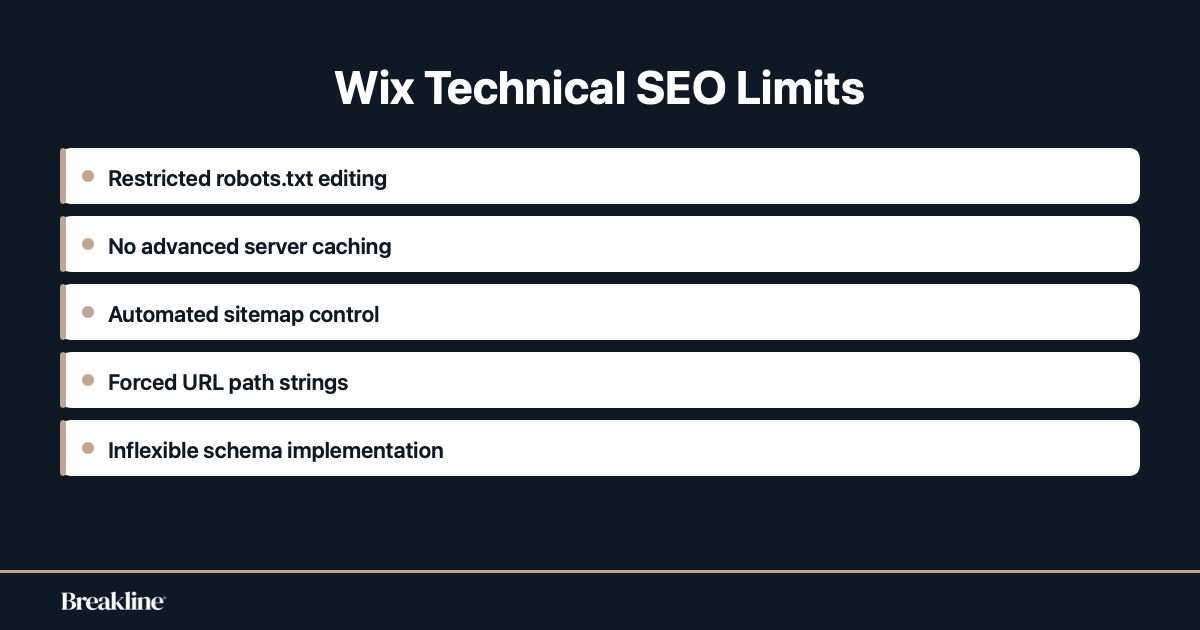
Wix Technical SEO Limits
This is where I get really frustrated. As an SEO professional I need to be able to get under the hood. I need to be able to adjust the technical aspects of a website to help search engines understand it better. This is often called Backend SEO.
On Wix my hands are tied.
For example let’s talk about the robots.txt file. This is a file that tells search engines which parts of your site they should or shouldn’t crawl. For years Wix didn’t even let you edit this. Now they allow some basic edits but it is still restrictive compared to an open-source platform.
Then there are the sitemaps. Wix generates them automatically which sounds nice for a beginner. But what if I want to exclude a specific tag page from the sitemap to prevent keyword cannibalization? It becomes a headache. You often have to use workarounds that simply shouldn’t be necessary in 2026.
The server-side configurations are completely off-limits.
If you want to implement advanced caching rules or change how the server handles certain requests you can’t. You are locked out of the engine room. This might not matter if you are running a local bakery site with five pages. But if you are trying to scale a business this lack of control is suffocating. It is why many SEOs say Wix is horrible for SEO when it comes to technical implementation. We know what needs to be done to fix the problem but the platform won’t let us do it.
Structured data and AI search
The internet is changing fast. We aren’t just optimizing for ten blue links anymore. We are looking at AI overviews and rich results. This requires structured data.
Structured data is a standardized format for providing information about a page and classifying the page content. It helps search engines understand that a string of numbers is a phone number or a price. Wix does support JSON-LD which is the preferred format. You can add standard schema for local businesses or products.
However it lacks granularity.
If you have a complex service offering or you want to nest different types of schema together it gets messy very quickly. You often have to rely on third-party apps from the Wix App Market & sometimes those apps are poorly coded or cost extra money.
We are also entering the era of Generative Engine Optimization or GEO. This is all about how AI models like ChatGPT or Google’s Gemini interpret your content.
These models rely heavily on clear structured data and clean code to understand context. Because Wix code is so dense and sometimes convoluted it can be harder for these AI models to parse the information accurately compared to a clean HTML site.
I’ve tried to implement advanced schema on client sites before only to find that the platform overrides my custom code or simply doesn’t render it the way I expect. It is maddening. You spend hours troubleshooting something that takes five minutes on WordPress.
The URL structure problem
Here is a specific gripe that drives me crazy. The URL structure. For the longest time Wix used these terrible hashbang URLs that looked like domain.com/#!/about. Google hated them. Users hated them.
They have fixed that thankfully. But they still force certain strings into the URL. For a store product it might force /product-page/ into the URL. For a blog post it forces /post/. You might think this is a small detail.
It isn’t.
Clean concise URLs are a ranking factor. They also help with user trust. If I am building a silo structure for a site I want complete control over the hierarchy. I want domain.com/shoes/running not domain.com/product-page/shoes-running. It creates unnecessary depth and makes the site architecture harder to manage.
This rigidity is a common theme with Wix. It tries to be helpful by automating things but in doing so it removes the flexibility that professionals need to compete in tough markets. It fails to accomodate the nuance required for high-level strategy. When you are fighting for the number one spot against a competitor with a custom-coded site every little percentage point matters.
Is it ever the right choice?
I want to be fair here. I don’t want to sound like an elitist snob who thinks everyone needs a $10,000 custom website. There is a place for Wix.
If you are a photographer who just needs a portfolio to show clients. If you are a small local restaurant that just needs a menu and a phone number online. If you are starting a hobby blog. Wix is fine. It really is.
John Mueller from Google has said that Wix websites “work fine in search”. And he is right technically. They get indexed. They can rank.
But “working fine” is not the same as excelling.
If your livelihood depends on organic search traffic “fine” is not good enough. You need exceptional. You need fast. You need optimized. The problem is that many people start on Wix because it is easy & then they grow. They reach a point where the platform becomes a bottleneck.
Migrating away from Wix is a pain. You can’t just export your database and import it into WordPress. You often have to rebuild the site from scratch and copy-paste your content. I have managed these migrations for clients and they are expensive and stressful. It is better to start on a scalable platform than to have to tear everything down two years later.
Final Thoughts
I get asked this question almost every week. Usually by a business owner who is frustrated that their beautiful Wix site is sitting on page 5 of Google. They have done the keyword research. They have written good content. But the needle isn’t moving.
It is heartbreaking to tell them that the tool they chose is part of the problem.
Wix has done a great job of marketing itself as an all-in-one solution. And for design it is undeniably impressive. But SEO is a technical discipline. It requires precision and control. Wix offers automation and restriction.
If you are serious about SEO. If you want to compete with the big guys. If you want a site that loads instantly and gives you full control over your data. Avoid Wix.
Save yourself the headache and the future migration costs. Learn WordPress or hire someone who knows how to build a clean semantic website. Your future self will thank you.