What’s the difference between on-page, off-page, and technical SEO?

On-page SEO is everything you do directly on your website’s pages to make them relevant, like changing text and headlines. Off-page SEO is what happens away from your site to build authority, mostly getting links from other websites. Technical SEO is the backend work that ensures search engines can actually read and index your site code properly.
That is the short answer. If you have five minutes I can explain why it matters and why ignoring one usually breaks the others.
I have been working in SEO for about 15 years now. I have seen plenty of business owners get confused by these terms. It’s not your fault. The industry loves to make things sound more complicated than they are. You just want your phone to ring or your enquiry form to fill up.
Think of your website like a car. Technical SEO is the engine and the mechanics. On-page SEO is the bodywork and the interior comfort. Off-page SEO is the reputation of the car brand and what the reviews say about it.
You need all three. A car with a great engine but no seats isn’t useful. A car that looks beautiful but won’t start is useless. And a car that runs well but has a reputation for exploding won’t get bought.
The engine, the paint job and the reputation

I like analogies because they strip away the jargon. When you hire an agency like Breakline or even a freelancer you need to know what you are paying for. If someone says they are doing “SEO” but they are only tweaking your title tags that is just one piece of a much larger puzzle.
Let’s break it down properly.
Imagine you are a dentist in Bristol. You want people to find you when they have a toothache. Simple goal.
On-page SEO is you making sure your website actually says “Dentist in Bristol” and lists your services like “emergency extraction” clearly. It is about relevance.
Technical SEO is making sure that when someone clicks your site on their mobile phone it loads instantly and doesn’t look broken. It is about usability and access.
Off-page SEO is the local newspaper writing an article about your new clinic and linking to your site. It is about trust.
Google looks at hundreds of signals but they all basically fall into these three buckets. Relevance. Usability. Trust.
On-page SEO is strictly about your content
This is usually where people start because it feels the most controllable. You can log into your website and change the words. It feels productive.
On-page SEO involves optimizing the HTML source code and the visible content. The goal is to help Google understand the context of your page. If Google doesn’t know what your page is about it can’t rank you.
I see a lot of people mess this up by being too clever.
I once reviewed a site for a roofing company. Their main heading wasn’t “Roof Repair in Leeds”. It was “Reaching New Heights in Home Protection”.
That sounds nice.
But nobody searches for that. Nobody types “home protection heights” into Google when their ceiling is leaking at 2am. They search for “roofer near me” or “leaking roof repair”.
Your on-page work needs to align with what users actually type. We call this search intent.
Here is what you should look at first.
Title Tags. This is the blue link text that shows up in Google results. It needs to include your main service and your location if you are local. Keep it under 60 characters or it gets cut off.
Headings. Your H1 tag is the main headline on the page. You should only have one. It should clearly state what the page is. Your H2s and H3s break up the text so it is readable.
Images. Google can’t “see” images like we do. You have to give them “alt text” which describes the image. It helps with accessibility too.
But be careful.
Years ago you could just stuff the word “plumber” onto a page 50 times and rank. That doesn’t work anymore. In fact it will get you penalized. You need to write for humans first. If it reads like a robot wrote it hit delete and start again.
Technical SEO happens behind the scenes
This is the part that scares people.
Technical SEO has nothing to do with the content on your page. It is about the infrastructure. It is about making it easy for search engine spiders to crawl and index your site.
If technical SEO is broken nothing else matters. I mean that literally.
I have seen beautiful websites with amazing content that get zero traffic. Why? because a developer accidentally left a piece of code called a “noindex” tag on the site. This tag tells Google “go away, do not look at this site”.
It is like building a shop and locking the front door.
Here are the big things to watch.
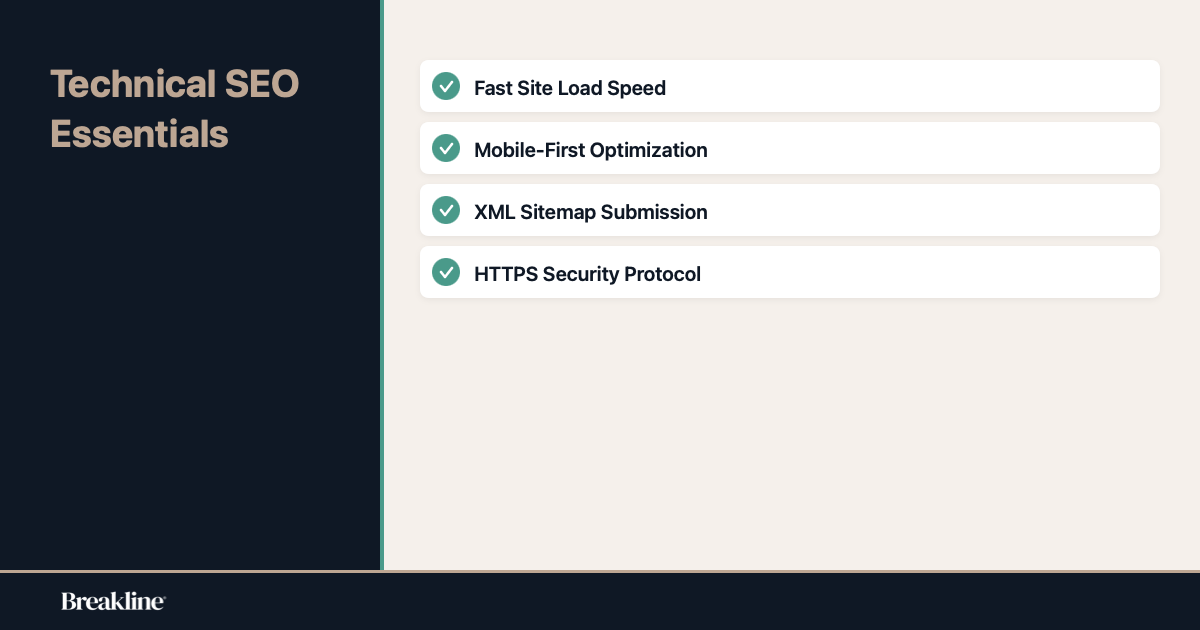
Site Speed. People are impatient. If your site takes 5 seconds to load on a 4G connection they are gone. They will go to your competitor. Google knows this so they rank slow sites lower. You can check your speed using Google PageSpeed Insights.
Mobile Friendliness. Most searches happen on phones now. Google uses “mobile-first indexing“. This means they look at the mobile version of your site to decide where you rank & not the desktop version. If your text is too small or buttons are too close together you have a problem.
Sitemaps. This is an XML file that lists all the pages on your site. It’s like a map for Google. You submit it via Google Search Console to help them find your content faster.
Security. You see that little padlock in your browser bar? That means the site uses HTTPS. If you don’t have that Google might show a big red warning to visitors saying your site isn’t safe. That kills trust instantly.
Technical SEO is often a “set it and forget it” task for smaller sites. Once it is fixed you just need to monitor it. But for large e-commerce sites with thousands of products it is a daily battle.
Off-page SEO is how the internet sees you
This is the hardest part. By far.
Off-page SEO refers to actions taken outside of your own website to impact your rankings. The biggest factor here is backlinks.
A backlink is when another website links to yours. Google views these links as votes of confidence. If the BBC links to your business it tells Google “this site is trustworthy”. If a dodgy gambling site links to you it might tell Google nothing or even hurt you.
Why is it hard? Because you can’t control it directly.
You have to earn it.
You can create great content that people want to link to. You can do digital PR. You can ask partners or suppliers to link to you. But you cannot force it. Well you can buy links but that is against Google’s rules and I strongly advise against it. It works until it doesn’t and then your site disappears from the rankings entirely.
Think about it like high school popularity.
On-page SEO is you dressing well and being interesting. Off-page SEO is the cool kids inviting you to sit at their table. You can try to force it but it looks desperate.
It is definately tricky to manage because you are relying on other people. Sometimes you send a hundred emails asking for a link and get zero replies. It is frustrating.
But off-page isn’t just links.
It is also about brand mentions. Even if they don’t link to you, having people talk about your brand online helps. It is about your Google Business Profile reviews. If you are a local business getting 5-star reviews is a massive off-page signal.
Social media plays a role too. It doesn’t directly boost rankings the way a backlink does but it drives traffic. And traffic creates opportunities for links.
Why you generally need all three working
I often hear business owners say “I just want to focus on content” or “I just want to buy some links”.
It doesn’t work like that.
Imagine you have amazing off-page SEO. The New York Times linked to you. You have huge authority. But your technical SEO is garbage and your site takes 10 seconds to load.
Google sends a user to your site. The user waits. The user gets annoyed. The user leaves. Google sees this “bounce” and thinks “maybe this result isn’t good after all”. Down you go.
Or flip it.
You have a technically perfect site. It loads in milliseconds. But you have no content on your pages. Just a few pictures and a phone number.
Google crawls the site and thinks “this is fast but I have no idea what this business does”. You won’t rank for any keywords because you haven’t used any.
You need balance.
For a small local business the mix might look like this.
Technical: Ensure the site is secure, mobile-friendly and fast. Set up Google Search Console. Done.
On-page: Create a page for each service you offer. Write 500 words on each describing what you do and where you do it. Add photos of your actual work.
Off-page: Get listed in local directories like Yell or Yelp. Ask happy customers for reviews. Maybe sponsor a local kid’s football team to get a link from their club website.
That is a solid strategy. It doesn’t need to be fancier than that.
How to spot where you are failing
If you aren’t ranking it is usually one of these three pillars that is weak. But which one?

Here is a quick diagnostic thought process I use.
Scenario A: You are nowhere to be found. Not page 1. Not page 10.
Likely Issue: Technical. Is your site indexed? Check Google Search Console. Have you blocked the bots? Or maybe it is a brand new site and you have zero authority (Off-page).
Scenario B: You are on page 2 or 3. You are stuck.
Likely Issue: Off-page. Google knows who you are and likes your content enough to index it. But it trusts your competitors more because they have more backlinks.
Scenario C: You rank for the wrong things. Or you get traffic but no calls.
Likely Issue: On-page. You might be targeting keywords that are too broad. Or your content doesn’t answer the user’s question so they leave without buying.
I remember a client who sold high-end office chairs. They were ranking for “office chairs”. Sounds good right?
No.
Because people searching “office chairs” often want a cheap £50 seat from IKEA. This client sold £1,000 ergonomic chairs. Their bounce rate was huge. We tweaked their on-page SEO to target “luxury ergonomic office chairs” and “executive seating”. Traffic went down but sales went up. Relevance is key.
A few tools that actually help
You don’t need to spend a fortune on software. There are expensive tools like Ahrefs or Semrush which agencies use. They are brilliant but overkill for most small business owners.
Start with the free stuff.
Google Search Console. I have mentioned it twice already because it is essential. It tells you if Google is having technical trouble reading your site. It also tells you what keywords you are ranking for.
Google Analytics. This tells you what people do once they are on your site. Do they leave immediately? Do they visit the contact page? This helps with on-page optimization.
Screaming Frog. This is a crawler tool. It sounds weird but it mimics a search engine. The free version lets you crawl 500 URLs. It is great for spotting broken links or missing titles.
For off-page checking your own backlinks is harder without paid tools. But you can often just search your brand name in Google to see who is talking about you.
Don’t get obsessed with the data though. I see people staring at charts for hours instead of writing a new blog post or calling a customer.
The tool is not the strategy.
Final thoughts
SEO can feel overwhelming. I get it. There are a million acronyms and Google changes the rules all the time. But the fundamentals haven’t actually changed that much in a decade.
Make a website that works. Write content that helps people. Build a reputation that earns trust.
If you are a business owner you don’t need to be an expert in all three areas. You just need to know enough to spot if someone is selling you snake oil.
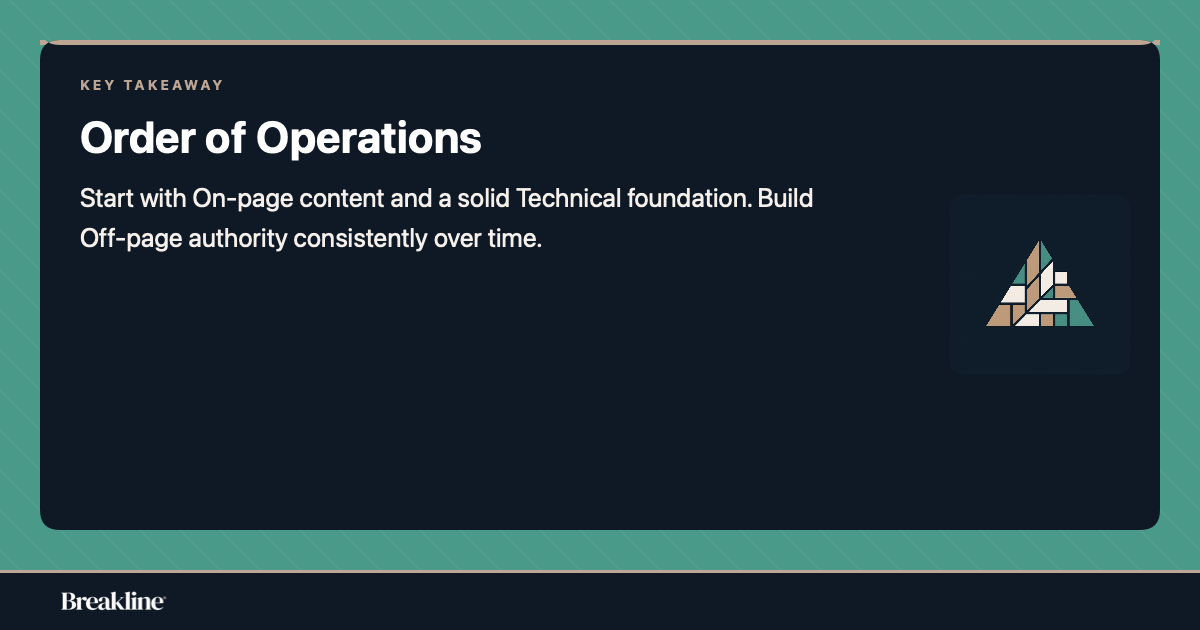
Start with your on-page content. It is the easiest to fix. Then make sure the technical foundation is solid. Then chip away at the off-page authority over time. It is a marathon & not a sprint.
Just don’t ignore the technical stuff because it looks boring. That is usually where the biggest wins are hiding.