
Choosing an agency
SEO agency vs hiring in-house
Compare an SEO agency with an in-house hire on cost, speed to results, control, technical work and link building, and see when a hybrid model fits.
 By Alexander Thomas, Founder Updated 9 min read
Key takeaways
- If organic search drives less than 10% of your revenue, an agency is the smarter financial move.
- In-house teams only become truly cost-effective when search is responsible for over 40% of your business pipeline.
- An internal hire needs three to six months to reach acceptable productivity, while an agency can start fixing errors within weeks.
- A hybrid model keeps strategy and content in-house and hands technical audits and outreach to an agency.
- Technical work and link building need specialist depth and industry relationships that most internal marketing teams lack.

On this page9 sections
Choosing between an SEO agency vs hiring in-house comes down to your pipeline dependency and how fast you need results.
If organic search drives less than 10% of your revenue an agency is the smarter financial move offering measurable improvements within weeks for around £90,000 annually.
Building an internal team takes three to six months to ramp up and costs upwards of £329,000 when you factor in salaries tools and training.
In-house teams only become truly cost-effective when search is responsible for over 40% of your business pipeline.
A solicitor looking to get more local clients doesn’t need a massive internal department. They just need the phone to ring.
I think a lot of business owners get stuck believing they must own the entire process internally. They read articles about building company culture and assume that applies to every single marketing function.
It doesn’t.
Sometimes you just need someone else to handle the heavy lifting while you focus on running your actual business.
When you search for why your website isn’t ranking you are usually met with a wall of technical jargon.
People start talking about algorithms and canonical tags. It gets overwhelming fast.
You just want customers to find you without needing a computer science degree to make it happen.
The choice is rarely black and white.
The true cost of doing SEO
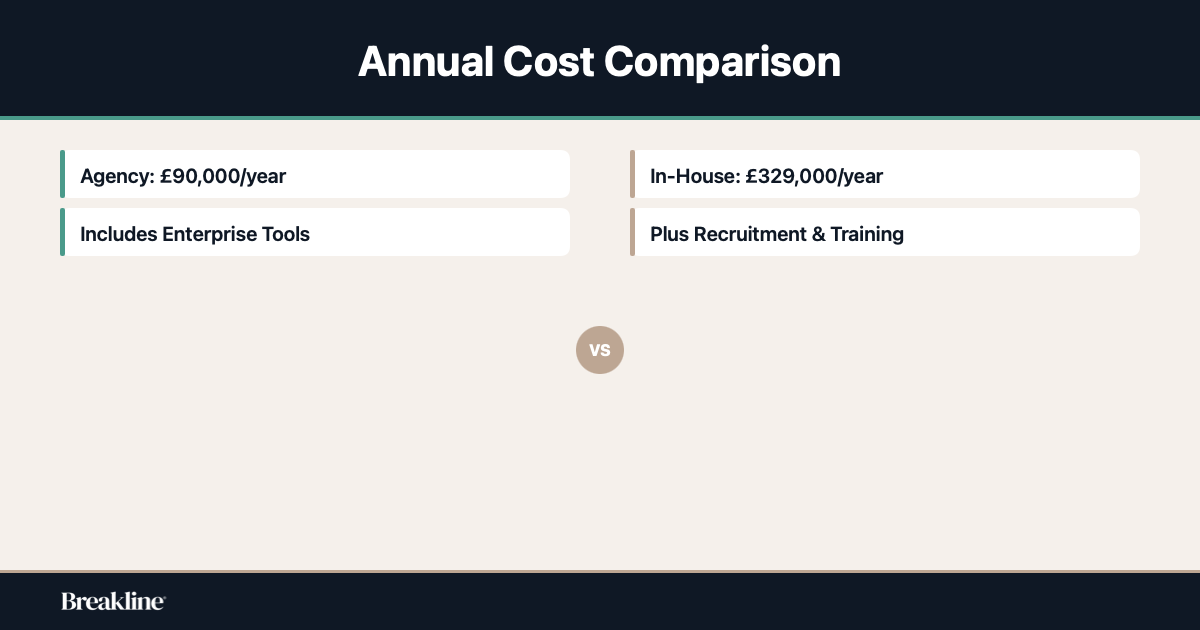
Let us look at the numbers because they usually dictate the decision. A full-time senior specialist will cost you roughly £329,000 a year. That figure includes salary benefits and the expensive software required to do the job properly.
Tools like SEMrush or Ahrefs add tens of thousands to your annual bill. You also have to pay for rank trackers crawling software and various reporting dashboards.
A single enterprise license for a good crawling tool can cost £5,000 a year. Then you need a subscription for keyword tracking. Then another for backlink analysis. It adds up rapidly.
Agencies operate differently entirely. A typical agency retainer starts around £90,000 per year. For small to medium businesses this saves approximately £52,000 annually compared to a mid-level internal hire.
You get access to the same enterprise tools without paying the individual licenses. The agency absorbs the cost of the software because they spread it across dozens of clients.
When you hire an agency you bypass the recruitment fees. You don’t pay headhunters. You don’t waste thirty hours interviewing candidates who look great on paper but can’t explain what a basic technical audit entails.
A massive saving right there.
But cost is not just about the money leaving your bank account each month. When you hire internally you are paying for sick days holidays and the inevitable learning curve.
An agency absorbs those inefficiencies. They have multiple people covering different disciplines so the work never really stops. If your technical person goes on holiday the content team keeps publishing.
How fast do you need results
Speed is where the agency model really flexes its muscles. A specialized team can audit your site fix glaring errors and start publishing optimized content within weeks.
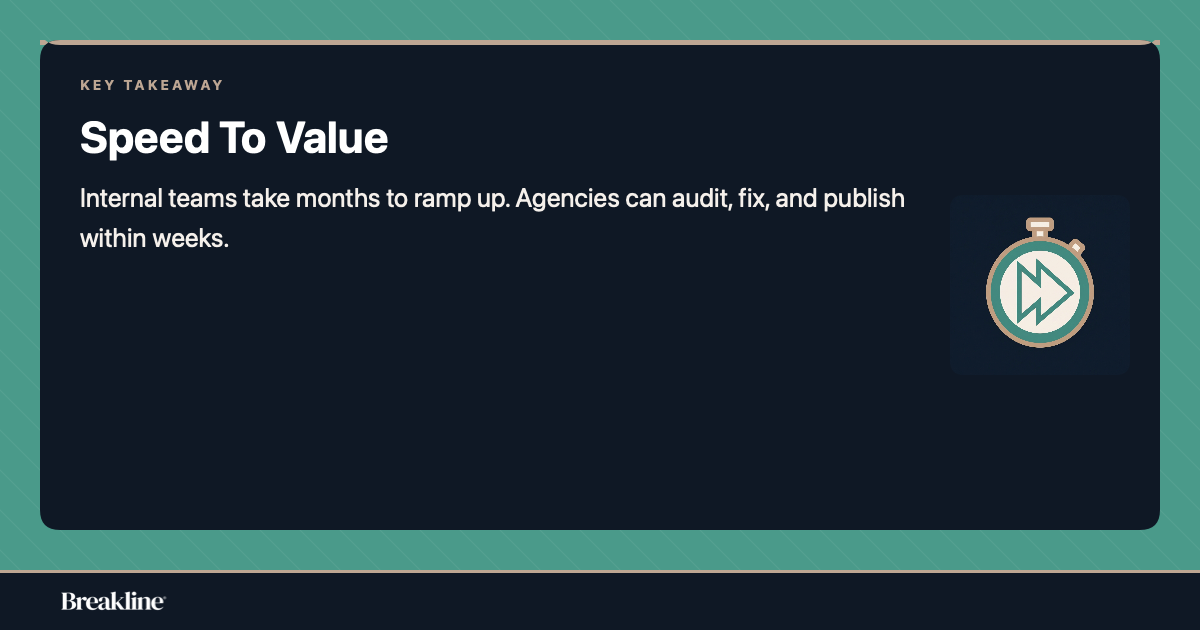
An internal hire needs time to settle in. They have to learn your internal systems meet the team and figure out where the login details are kept.
You are looking at three to six months before productivity reaches acceptable levels. That is a long time to wait if a competitor is actively stealing your market share.
For B2B SaaS companies where organic traffic might only drive a small fraction of the pipeline right now speed is everything. You need to prove the channel works before the board cuts the budget entirely.
I remember working with a roofing company that tried building an internal team first.
They spent four months just trying to get their new hire access to the right server.
The poor guy sat there reading blogs all day because IT wouldn’t approve his software requests.
We stepped in at Breakline and had their local visibility fixed in about eighteen days.
Agencies bring established frameworks to the table. We don’t have to invent a process for a new client because we already know exactly what works.
A good agency will have a kickoff call on Monday and be fixing your broken links by Wednesday.
The artificial intelligence shift
Search has changed massively with the rollout of AI overviews. Optimizing for these generative results requires a completely different skillset compared to traditional keyword matching.
You need significant expertise in entity optimization and AI content engineering.
Google is pushing generative AI into the search results heavily. People are asking questions and getting instant AI-generated answers. If your brand isn’t mentioned in those answers you are invisible.
Agencies have a distinct advantage here because they test strategies across hundreds of websites. They see what works and what fails in real time.
An internal team is isolated to your single website. They are guessing most of the time based on what they read on X.
Building AI expertise internally takes substantial time and failed experiments. You have to accomodate a lot of trial and error.
Most businesses simply cannot afford to get this wrong while the technology moves so fast. If your internal person guesses incorrectly your traffic drops to zero. An agency relies on data gathered from a massive portfolio of sites.
They know exactly how to structure content so the AI picks it up.
Keeping control over your strategy
Business owners often worry about losing control when they outsource. ‘Will an agency care about my business as much as my own team?’ Usually they won’t at first. Generic agencies often fail completely here.
A specialized agency working in your specific sector will bridge that gap quickly. You maintain strategic control but you hand over the daily operational headaches. You set the KPIs. The agency executes the plan.
Some owners worry an agency will do something shady and get their site penalized. That was a valid fear a decade ago. Now a reputable agency is far more conservative than a rogue internal employee trying to hit a desperate bonus target.
This setup prevents micromanagement. You don’t need to know how to configure structured data for a dental practice.
You just need to know the agency is doing it correctly. Trust is built through reporting and results rather than watching someone sit at a desk.
Internal teams do develop an intimate knowledge of your brand values. They sit in your meetings and absorb the company culture. That context translates into highly authentic content that external writers sometimes struggle to match.
This is definitely a valid point for companies with highly technical or unique products. If you sell complex medical equipment an external copywriter will need a lot of handholding to get the tone right.
The hybrid model compromise
You don’t have to choose strictly between one or the other. Many companies now use a hybrid approach. They keep strategy and content creation in-house where brand knowledge is strongest.
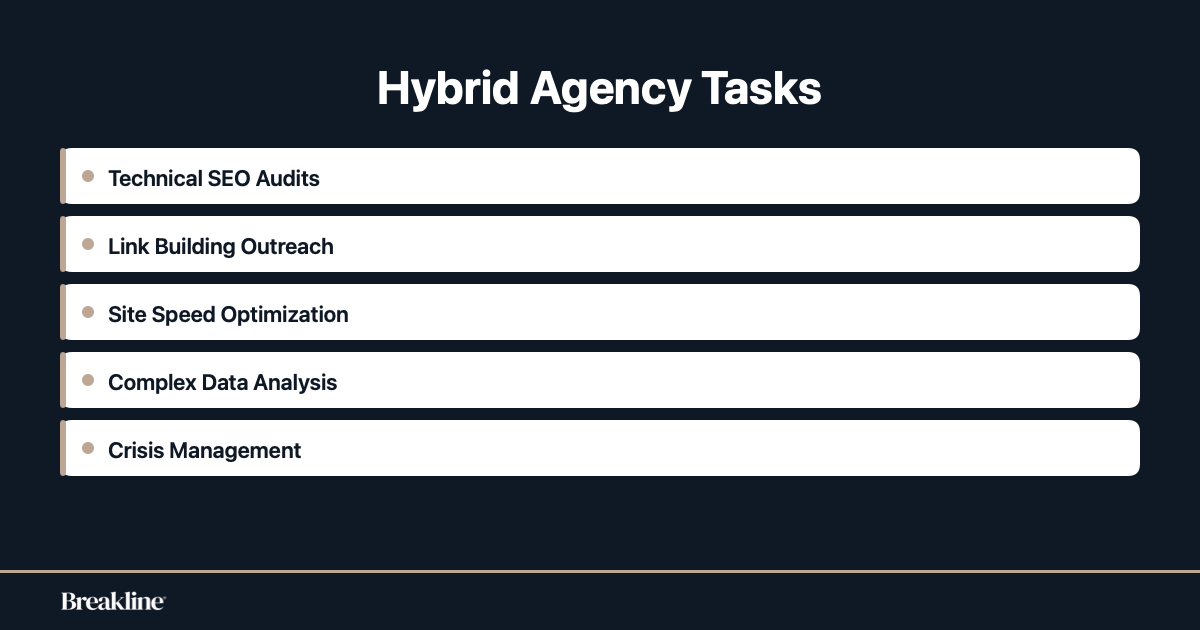
The agency is then brought in to handle the highly technical work. They manage site speed optimization backlink campaigns and complex data analysis.
The hybrid model is gaining serious traction. Internal teams handle the daily monitoring and write the blog posts. The agency handles the technical audits and the outreach.
I think this is often the smartest route for businesses where organic traffic drives 20 to 30 percent of their revenue. You get the benefit of your team’s product knowledge combined with the agency’s advanced tools. It distributes the risk too.
If your internal SEO manager resigns the agency keeps the lights on while you recruit. You are never left completely exposed. It requires clear communication though. You can’t have the agency & the internal team fighting over who caused a drop in rankings.
Everyone needs to leave their ego at the door.
It is a very pragmatic way to run a marketing department. Agencies scale their services up or down based on your current requirements without the drama of HR meetings.
Dealing with technical headaches
Modern technical optimization is incredibly complex. It involves mobile responsiveness crawlability fixes and ensuring search engines can actually read your pages. Most internal marketing teams lack this specific technical depth.
If your website is slow or broken Google will simply ignore it. You might write the best article in your industry but nobody will ever see it.
Site speed is a perfect example. Making a website load faster often requires rewriting code compressing images and configuring caching on the server. A standard marketing manager doesn’t know how to do that. They usually end up breaking the website trying to install a plugin.
Why server logs matter
Technical errors act like a handbrake on your visibility. This is where having an experienced partner pays off. We spend all day looking at server logs and core web vitals. It is tedious work but it forms the foundation of everything else.
The invisible stuff that makes the visible stuff work.
Without a solid technical foundation any content you publish is essentially wasted effort. Search engine bots need a clear path to crawl your website. If they hit a wall of bad code they leave.
Building links and authority
Earning high-quality backlinks is arguably the hardest part of the job. It requires established industry relationships and dedicated outreach specialists. In-house teams rarely have the network required to do this at scale.
Think of backlinks like votes of confidence. If a major newspaper links to your site Google sees that as a massive endorsement.
An agency already has those connections. They know journalists bloggers & webmasters across different sectors. They can secure placements that an isolated internal team would never even get a reply from.
Even in hybrid models link building is almost always outsourced. The resource required to run effective outreach campaigns internally is staggering. You need databases email software and people who handle rejection exceptionally well. Most internal marketers hate doing outreach because it feels like cold calling. They send ten emails get no replies and give up.
It is much easier to let an agency leverage their existing black book.
They have teams dedicated solely to building relationships with publishers. That kind of singular focus is impossible to replicate in-house unless you hire a full-time PR person.
Final Thoughts
Deciding between an SEO agency vs hiring in-house is mostly about being honest regarding your resources.
If you have the budget the patience and the management bandwidth an internal team can be fantastic long-term.
But most businesses don’t have those luxuries. They need growth now. They need expertise they don’t currently possess.
You have to weigh up what matters most to your current situation. Control versus speed. Long-term capability versus immediate execution.
I’ve watched search engine optimization change for over fifteen years. The technical requirements keep increasing. The margin for error keeps shrinking. Trying to build all that capability from scratch is a massive undertaking.
You are competing against companies that have been refining their digital presence for a decade.
A single internal hire is going to struggle against an entire agency team working for your competitor.
Sometimes it’s just better to rent the expertise.
Frequently asked questions
When does it make sense to build an in-house SEO team?
In-house teams only become truly cost-effective when search is responsible for over 40% of your business pipeline. An internal team can be fantastic long-term if you have the budget, the patience and the management bandwidth. Internal staff also absorb your brand values, which helps companies with highly technical or unique products.
How does the cost of an SEO agency compare with an in-house team?
Building an internal team costs upwards of £329,000 once you factor in salaries, tools and training, while a typical agency retainer starts at around £90,000 per year. With an agency you also get the same enterprise tools without paying for individual licences. You avoid recruitment fees and the cost of sick days, holidays and the learning curve too.
How long does a new in-house SEO hire take to become productive?
You are looking at three to six months before an internal hire's productivity reaches acceptable levels. They need time to learn your systems, meet the team and get access to what they need. An agency, by contrast, can audit your site, fix glaring errors and start publishing content within weeks.
What is a hybrid SEO model?
A hybrid model splits the work between your own team and an agency. Strategy and content creation stay in-house, where brand knowledge is strongest, while the agency handles technical audits, site speed, backlink campaigns and complex data analysis. It often suits businesses where organic traffic drives 20 to 30 percent of their revenue.
Do you lose control of your SEO strategy when you hire an agency?
No, you maintain strategic control: you set the KPIs and the agency executes the plan, taking on the operational headaches. At first an agency usually won't care about your business as much as your own team, and generic agencies often fail here, but one working in your specific sector bridges that gap quickly. Trust is built through reporting and results.
Why is link building usually outsourced to an agency?
Earning good backlinks takes industry contacts and people who do outreach full time, and in-house teams rarely have that network. Agencies already know journalists, bloggers and webmasters in many sectors. Doing outreach yourself also needs databases, email software and people who cope well with rejection, so even hybrid models almost always outsource it.
Why do in-house marketing teams struggle with technical SEO?
Technical work covers mobile responsiveness, crawlability and making sure search engines can read your pages, and most internal marketing teams lack that depth. Making a site load faster often means rewriting code, compressing images and configuring caching on the server. A standard marketing manager usually doesn't know how to do that.
Further reading
- Ramp-up period for new hires, Remuner
- In-house vs agency SEO costs, Bulldog Digital Media
- How much SEO costs for a small business, Media Village
- Local SEO agency vs in-house in London, Jamie Grand