The Evolution of SEO: From Keywords to AI & Semantic Search
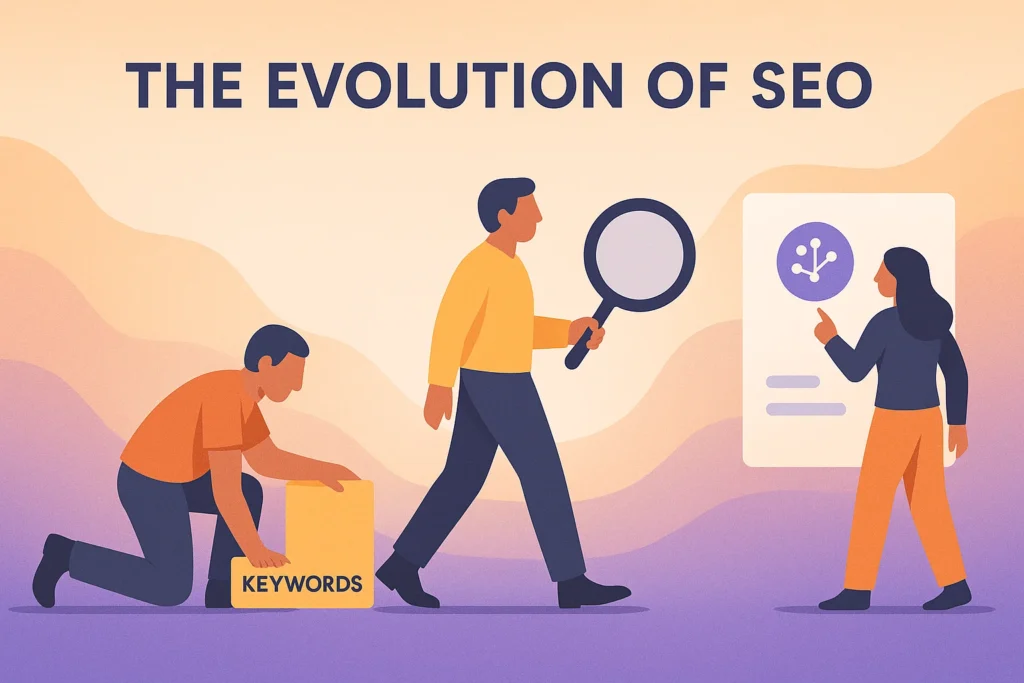
Remember when SEO was just about cramming as many keywords as possible into a webpage? Those were simpler times, though not necessarily better ones. The search engine optimisation game has transformed dramatically over the past two decades, evolving from crude keyword manipulation to sophisticated AI-driven systems that can actually understand what people are searching for.
It’s been quite the journey, really. What started as a Wild West of black-hat tactics & keyword stuffing has become a nuanced discipline that rewards quality content and genuine user experience. Let me walk you through this fascinating transformation.
The Wild West Era of Keywords
Back in the late 1990s and early 2000s, SEO was laughably simple yet completely chaotic. Webmasters would literally hide thousands of keywords in white text on white backgrounds, thinking they were clever. You’d see pages with footer text like “cheap flights cheap flights cheap flights” repeated ad nauseam.
Meta keyword tags were treated like golden tickets. People believed that stuffing 50+ keywords into those tags would guarantee top rankings. Spoiler alert: it didn’t work for long.
The keyword density obsession was real. SEO “experts” would insist on exactly 3.7% keyword density or some other arbitrary figure. Content became almost unreadable because writers were forcing keywords into every other sentence. It was painful to read, but somehow it worked… until it didn’t.
Link farms sprouted everywhere. Websites would link to hundreds or thousands of completely unrelated sites just to game PageRank. The internet was becoming a mess of interconnected spam, and Google knew something had to change.
Google Strikes Back
Google’s response was swift and decisive. They began rolling out algorithm updates that would fundamentally reshape how SEO worked, starting with some game-changing releases that sent shockwaves through the industry.
The Florida update in 2003 was perhaps the first major wake-up call. Suddenly, websites that had been ranking well for commercial terms found themselves buried on page 10. The SEO community was in uproar, but Google was just getting started.
Each subsequent update made it clear that the old tactics weren’t just ineffective — they were becoming actively harmful. The writing was on the wall, though many SEOs were slow to read it.
Panda Changes Everything
February 2011 marked a turning point with the Panda update. This wasn’t just another algorithmic tweak; it was a complete shift in philosophy. Google started evaluating content quality on a massive scale, and thin, duplicate, or low-quality content got hammered.
Content farms — those sites that churned out hundreds of superficial articles daily — saw their traffic evaporate overnight. Sites like eHow and About.com, which had dominated search results with mediocre content, suddenly found themselves struggling.
What made Panda particularly interesting was how it tried to mimic human quality raters. Google essentially asked: “Would you trust this site with your credit card? Would you be comfortable giving medical advice from this content to your family?” These weren’t technical metrics anymore; they were human judgment calls being automated.
The update rolled out gradually, affecting different languages and regions over time. But the message was clear: quality mattered more than quantity, and thin content wouldn’t cut it anymore.
Penguin Targets Link Schemes
Then came Penguin in April 2012, and link building was never the same again.
Where Panda focused on content quality, Penguin went after manipulative link practices. Those link farms I mentioned earlier? Toast. Exact-match anchor text spam? Penalised. Buying links from dodgy networks? Your site would be demoted faster than you could say “natural link profile.”
I remember the panic in SEO forums when Penguin first hit. Agencies that had built their entire business model around buying cheap links suddenly found their clients’ websites disappearing from search results. The recovery process was often lengthy & painful, requiring manual disavowing of thousands of toxic links.
What’s fascinating is how Penguin forced the industry to mature. Link building evolved from a numbers game to a relationships game. Quality outreach, genuine content marketing, and earning links through merit became the new standard.
Hummingbird Introduces Semantic Understanding
September 2013 brought Hummingbird, though Google had been quietly testing it for months. This update was different — it wasn’t about penalising bad practices but about fundamentally improving how Google understood search queries.
Hummingbird marked Google’s first serious attempt at semantic search. Instead of just matching keywords, the algorithm started trying to understand the intent behind searches. A query like “what’s the best place near me for pizza” would now be interpreted as a local business search, not just a hunt for pages containing those exact words.
This shift was huge for long-tail keywords & conversational queries. Voice search was beginning to emerge, and people don’t speak to their phones the way they type into search boxes. They ask complete questions, use natural language, and expect relevant answers.
The update also emphasised the importance of topic authority rather than just individual page optimisation. Websites that comprehensively covered topics started ranking better than those with isolated, keyword-focused pages.
The Rise of Machine Learning
Then Google dropped RankBrain on us in October 2015, though they’d been testing it for months beforehand.
RankBrain represented Google’s first major deployment of machine learning in search results. It was designed to help process search queries that Google had never seen before — which, surprisingly, make up about 15% of daily searches.
What made RankBrain special was its ability to find patterns between seemingly unrelated searches. If someone searched for “grey console developed by Sony” and others searched for “PlayStation console,” RankBrain could connect these concepts even without explicit keyword matches.
The system learned from user behaviour too. If people consistently clicked on the third result instead of the first, RankBrain would take note and potentially adjust rankings accordingly. This feedback loop made search results more dynamic and responsive to actual user preferences.
For SEOs, RankBrain meant that traditional keyword research became less predictable. You couldn’t just target specific phrases anymore; you needed to think about topics, user intent, and semantic relationships between concepts.
BERT Revolutionises Language Processing
BERT (Bidirectional Encoder Representations from Transformers) launched in October 2019 & changed everything again.
Where previous updates improved search incrementally, BERT was revolutionary. It could understand context and nuance in ways that seemed almost human. The classic example Google gave was the query “2019 brazil traveller to usa need a visa” — before BERT, Google might focus on “brazil” and “usa” but miss that the searcher was a Brazilian wanting to visit America, not the other way around.
BERT processes words in relation to all other words in a sentence, rather than one-by-one in order. This bidirectional approach means it can understand that “bank” means something different in “river bank” versus “savings bank” based on surrounding context.
The update particularly improved long-tail and conversational queries. Featured snippets became more accurate, and voice search results got significantly better. Google was finally starting to understand language the way humans do.
For content creators, BERT reinforced the importance of natural, helpful writing. Keyword stuffing became even more pointless because the algorithm could understand topical relevance without explicit keyword matches.
Modern SEO in the AI Era
These days, SEO feels completely different from those early keyword-stuffing days. We’re dealing with systems that can understand context, intent, user behaviour, and even emotional nuance in content.
Google’s MUM (Multitask Unified Model) takes things even further, understanding information across multiple languages and media formats. It can theoretically understand that a search for “Everest base camp preparation” might benefit from images of hiking boots, videos about altitude training, and articles about weather conditions.
The focus has shifted entirely to user experience. Core Web Vitals, mobile-first indexing, and page experience signals all emphasise that technical performance matters as much as content quality. A slow-loading page with excellent content might still rank poorly if it provides a frustrating user experience.
Perhaps most importantly, modern SEO requires thinking like a user rather than a search engine. What questions are people really asking? What problems are they trying to solve? How can you provide the most helpful, comprehensive answer?
The tools have evolved too. Keyword research now involves understanding topic clusters, search intent classification, and semantic relationships. We analyse SERP features, user journeys, and content gaps rather than just search volumes and competition levels.
The Bottom Line
Looking back at this evolution, it’s clear that Google has consistently moved towards better understanding human language and intent. Each major update has made search results more helpful for users, even if it initially caused chaos for SEO practitioners.
The keyword-stuffing days seem almost quaint now. We’ve progressed from trying to trick algorithms to creating genuinely useful content that serves real human needs. It’s been a rocky journey, but the destination is undoubtedly better for everyone.
What’s next? Probably even more sophisticated AI that can understand multimedia content, real-time context, and perhaps even predict what users need before they search for it. The one constant in SEO has been change, and that’s unlikely to stop anytime soon.
The smartest approach remains the same as it’s been for years: create helpful, high-quality content for real people, ensure your site provides an excellent user experience, and stay curious about how search technology continues to evolve.