
AI search
What to do if you don’t show in Google’s Knowledge Graph?
Why Google leaves your brand out of the Knowledge Graph, and how consistent data, schema and trusted mentions help you earn a Knowledge Panel.
 By Alexander Thomas, Founder Updated 8 min read
Key takeaways
- If you are missing from Google's Knowledge Graph, Google does not yet trust that you are a notable and distinct entity.
- Messy data is the usual cause, so keep your name, address and phone number identical everywhere, copied from one truth sheet.
- Add Organization schema in JSON-LD to your homepage, link your social profiles with the sameAs property and check it with the Rich Results Test.
- Build authority outside your website through high-trust sources such as Wikidata, Crunchbase or an industry-specific database.
- A Knowledge Panel can appear two weeks after the fixes or take six months, and there is no button to submit one.
On this page9 sections
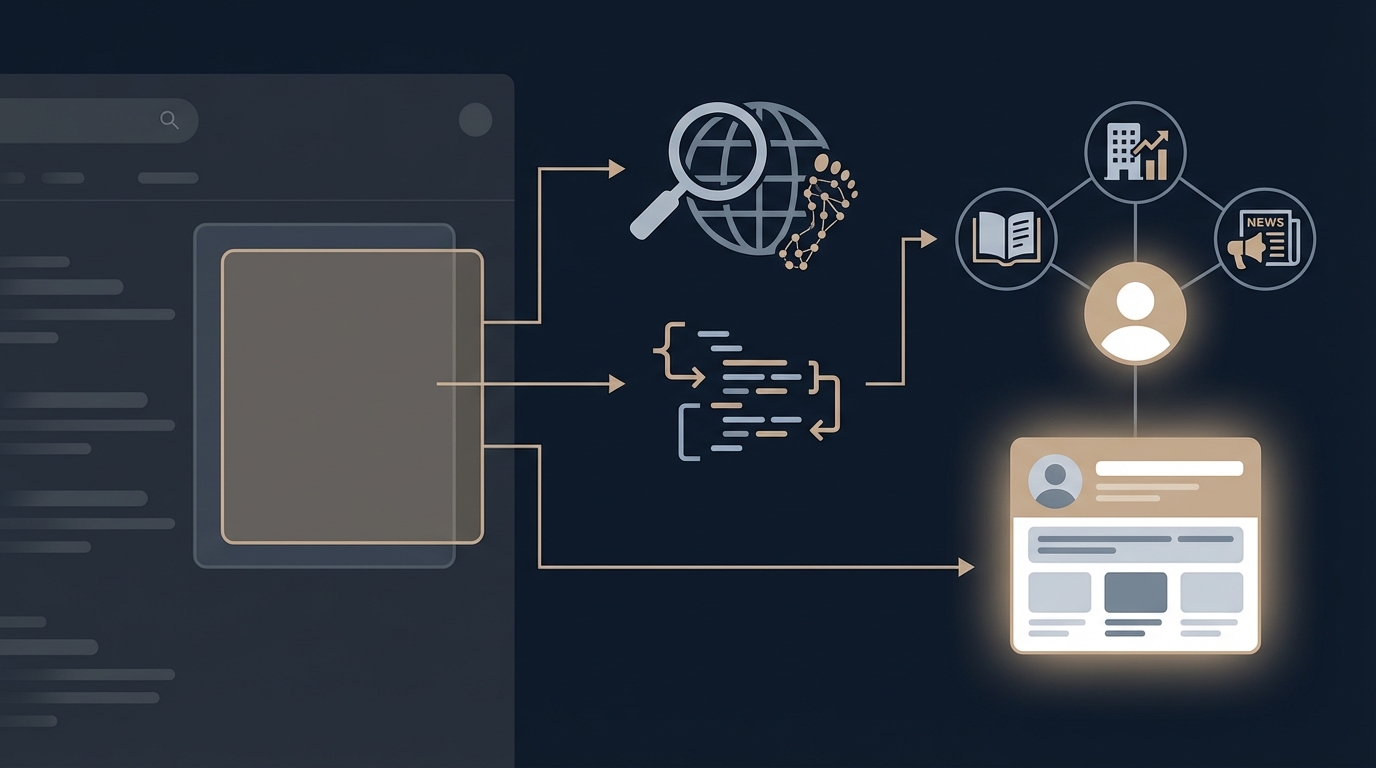
If you are not showing up in Google’s Knowledge Graph it means the search engine does not trust that you are a notable and distinct entity yet so you need to feed it consistent corroborating evidence.
You have to audit your digital footprint for consistency, implement structured data markup specifically Organization or Person schema, and build authority through third-party mentions on trusted platforms like Wikipedia or Crunchbase. It is basically a branding exercise disguised as code.
I know. That sounds harsh.
But it is the reality of the machine we are dealing with. I have sat in meetings with founders who have invented incredible things and have massive revenue but Google treats them like they do not exist. It is frustrating. I get it. You search for your brand name and instead of that beautiful shiny Knowledge Panel on the right side you just see a list of blue links or maybe a competitor’s ads. It feels like a snub.
The good news is that this is fixable. It is not magic and it certainly is not luck. It is engineering.
Why the Knowledge Graph ignores you
Google is a librarian. A very pedantic overworked librarian.
To get into the specialized catalogue that is Google’s Knowledge Graph you need to prove you are worthy of a card in the index. Most people think SEO is just about ranking for “best running shoes” or whatever. It is not. Not anymore.
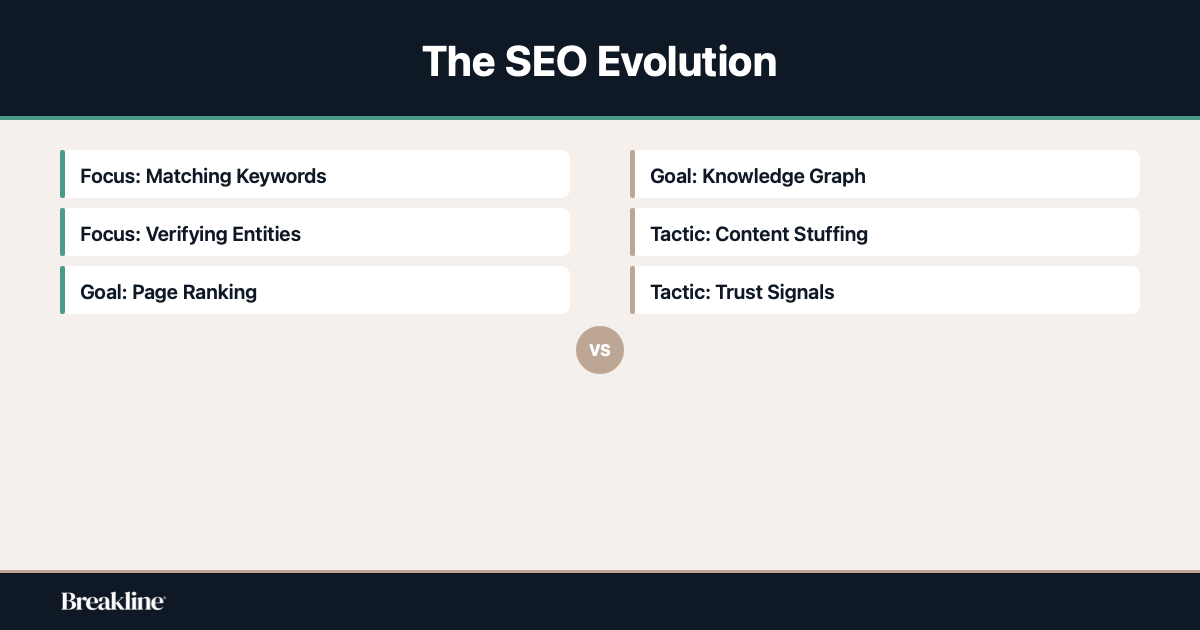
It is about Entity SEO. That means shifting the focus from keywords to things. People. Places. Concepts.
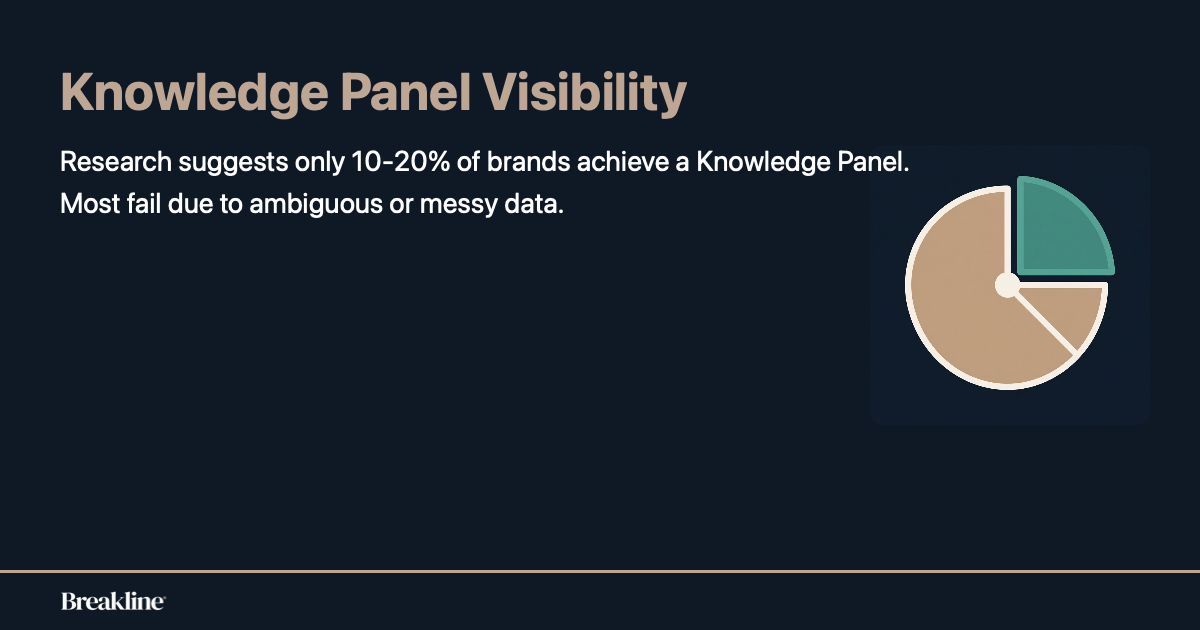
The stats on this are actually kind of depressing if you look at them the wrong way. Research suggests that only about 10-20% of brands actually achieve that coveted Knowledge Panel visibility. Why so low? Because most businesses have messy data. They have one address on Facebook and a slightly different one on their footer. They use “Inc.” sometimes and “Ltd.” other times.
Google hates ambiguity.
If the machine is even 1% unsure that the “John Smith” on LinkedIn is the same “John Smith” mentioned in a press release it will hesitate. And when Google hesitates you do not get a panel. You get nothing. It is safer for the algorithm to show nothing than to show wrong information. That is the golden rule of the search team. Accuracy over coverage.
The shift from keywords to entities
I remember a few years back when we could just stuff a page with terms and watch it fly. Those were the wild west days.
The SEO Evolution
Now we are looking at a landscape dominated by things like the Multitask Unified Model. MUM. Sounds like a flower but it is actually a beast of an AI system. By 2026 we are expecting 60% of searches to involve some kind of generative AI response. That is massive. If you are not an entity in the graph you are going to be invisible in those AI Overviews.
Think about it.
The search engine is trying to understand the world like a human does. It connects dots. Entity SEO is the process of drawing those lines for Google so it does not have to guess. If you leave it guessing it will guess wrong or it will ignore you.
I have seen sites with terrible content rank simply because Google understood who they were better than the competition. It is about entity trust signals.
Experts are calling this the era of owning “entity space”. It is land grabbing. But instead of land it is semantic real estate. You want Google to know not just your name but your CEO, your founding date, your subsidiary products, and your social profiles.
Cleaning up your digital footprint
Start with the basics. Please.
Digital Footprint Consistency
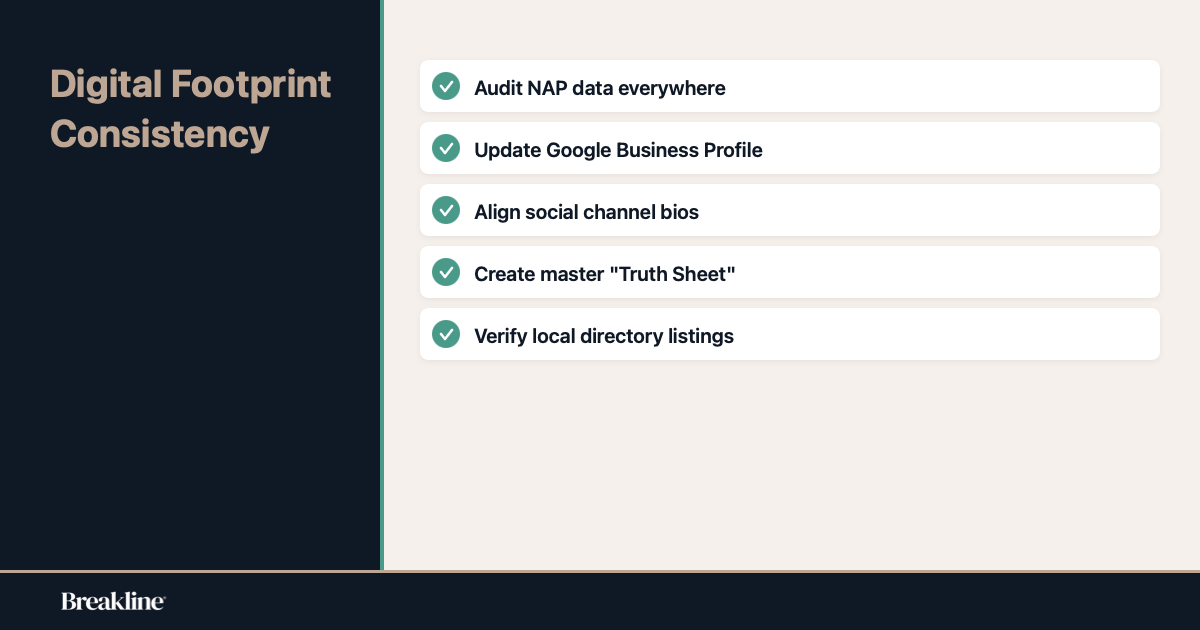
I cannot tell you how many times I audit a client and their Google Business Profile says they open at 9 AM but their website says 8 AM. It seems trivial. To a human it is a minor annoyance. To a machine trying to verify facts it is a red flag. It screams “unreliable data source”.
You need consistent NAP data. Name. Address. Phone. Everywhere.
This includes your social channels. Your Crunchbase. Your local directory listings. If you moved offices three years ago and forgot to update a listing on Yell that is hurting your entity trust signals. It is like having a credit report with missed payments. You look risky.
I advise my clients to create a “truth sheet”. One document that has the exact formatting of the company name and details. Copy and paste from that sheet only.
Never type it out manually because you might accidentally type “Street” instead of “St” and while Google is smart enough to know the difference usually, why take the risk?
Speaking Google’s language with schema
Here is where we get a bit nerdy. But stay with me.
Implementing Entity Schema
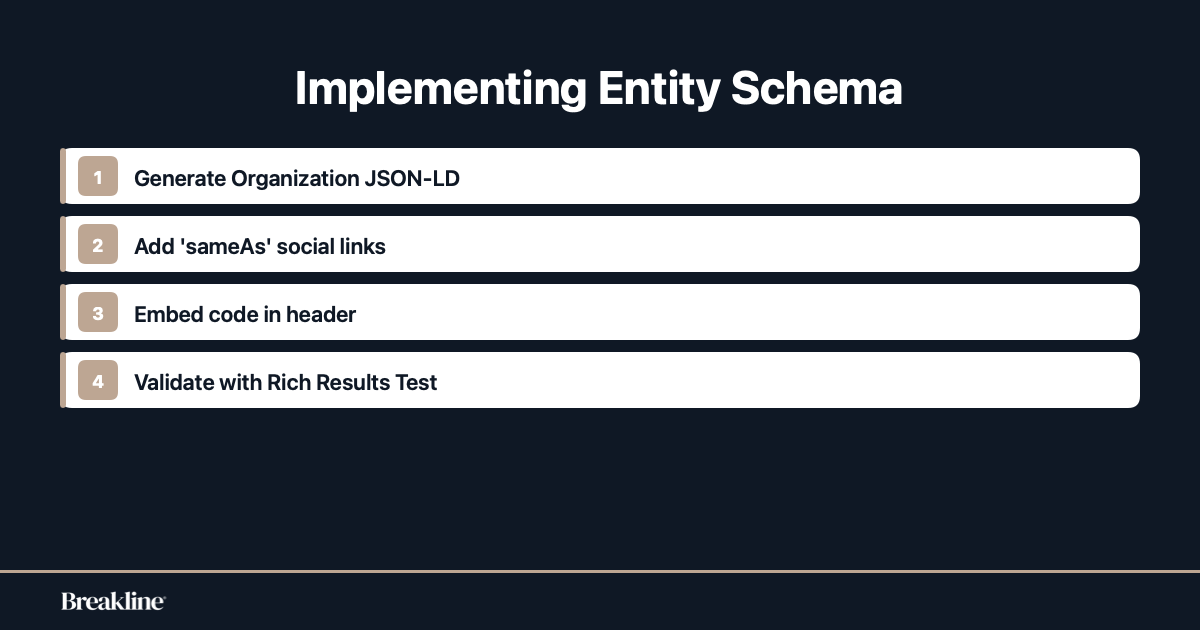
You need to use schema markup. Specifically JSON-LD. Think of this as handing Google a business card in its own native language. You are not hoping it reads your “About Us” page correctly. You are explicitly telling it “Here is our logo” and “Here are our social profiles”.
Search Engine Land calls schema your “machine-readable handshake” with the Google’s Knowledge Graph. I love that phrasing. It is polite. It is professional.
You should be using Organization schema on your homepage. Link to your social profiles using the ‘sameAs’ property. This is critical. It connects the nodes.
You are telling Google “Hey, that Twitter profile with 500 followers? That is us. Connect the dots.”
Do not rely on plugins to do this automatically without checking them. Plugins are great but they are often generic. They might miss the specific ‘id’ reference that ties everything together. I prefer to write the code or at least audit it manually. It is safer that way.
Also check for errors.
If your code is broken Google ignores it. Use the Rich Results Test tool. It is free. There is no excuse for broken schema. Sometimes it can be tricky to accomodate all the different properties required for a complex organization but it is worth the effort.
If you are a local business use LocalBusiness schema. If you are a corporation use Organization. Be specific.
Building authority outside your website
You cannot just say “I am famous” and expect Google to believe you.
Trusted Authority Sources
You need others to vouch for you. This is where external citations come in. A link from the New York Times is great for ranking but a mention in a specialized industry database is better for Entity SEO. It confirms you are who you say you are within a specific context.
Wikipedia is the holy grail here.
But be careful.
Getting a Wikipedia page is hard. Really hard. The editors there are ruthless and they should be. If you try to create a vanity page it will get deleted and you will be blacklisted. I have seen it happen. It is embarrassing.
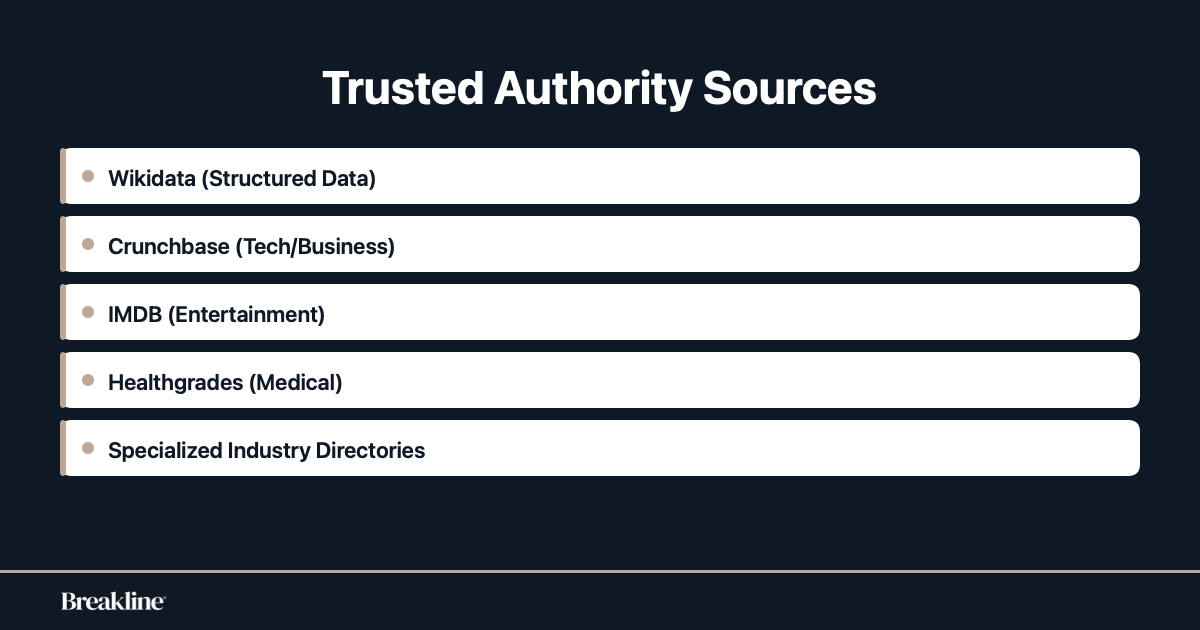
Instead focus on Wikidata. It is the structured data version of Wikipedia. It is slightly easier to get into if you have verifiable sources but it feeds directly into Google’s Knowledge Graph.
If you can’t get into those look at industry-specific equivalents. Crunchbase for tech. IMDB for film. Healthgrades for doctors.
These are high-trust sources. Google reads them.
Generative Engine Optimization is here
We have a new acronym in town. Generative Engine Optimization. GEO.
It sounds fancy but it is really just the evolution of what we have been doing. As we move toward 2026 and beyond the search engines are becoming answer engines. They want to generate a summary not just give a list of links.
To win here you need to optimize for citations in AI outputs. This means your content needs to be structured in a way that is easy for an AI to summarize. Clear headings. Direct answers.
I suspect that Generative Engine Optimization will eventually replace traditional SEO entirely but we aren’t there yet. For now it is a layer on top.
You need to build content clusters. Topic clusters turn your website into a reliable source of knowledge. If you cover every angle of a topic Google sees you as an authority.
If you are an expert on “coffee beans” do not just write about selling them. Write about roasting temps. Write about grinding methods. Write about the history of the bean. Connect it all.
This semantic internal linking helps the bot understand the relationship between the entities on your site.
It helps the user too. Which is nice.
How long does this actually take?
This is the question every client asks me. Usually about five minutes after we sign the contract.
“When do I get the panel?”
I wish I had a date for you. I don’t. It varies. I have seen a Knowledge Panel pop up two weeks after implementing schema and cleaning up citations.
I have also seen it take six months. It depends on how much data Google already has on you and how confused it was before you started fixing things.
You can’t force it.
There is no “submit” button for a Knowledge Panel. You can claim one once it exists but you cannot conjure it out of thin air. You have to wait for the algorithm to reach a confidence threshold.
Patience is arguably the most important SEO skill.
While you wait monitor the SERPs. Search your brand name in incognito mode. Look for changes.
Sometimes you will see a small “knowledge card” appear before the full panel. That is a good sign. It means the machine is learning.
Final Thoughts
I think we sometimes forget that Google is just a piece of software. It is incredibly advanced software but it is still just code written by humans to organize information.
It wants to understand you. It really does.
When you do not show up in the Knowledge Graph it is not personal. It is just a lack of data. Or a lack of clear data.
Your job is to make it easy for the machine. Be consistent. Be authoritative. Use the language it understands.
I have spent the last 15 years watching this industry shift from keyword stuffing to semantic understanding. It is better now. It is harder but it is better. If you build a real brand with real authority the graph will follow. Eventually. Just don’t expect it to happen by Tuesday.
Frequently asked questions
Why does Google not show a Knowledge Panel for my brand?
Google does not yet trust that you are a notable and distinct entity. Most businesses have messy data, such as one address on Facebook and a slightly different one in the website footer. When Google is unsure, it shows nothing rather than risk showing wrong information.
What is a truth sheet and why does it help?
A truth sheet is one document with the exact formatting of your company name and details. Copy and paste from that sheet only, rather than typing details out by hand, so your name, address and phone number match on your website, social channels, Crunchbase and local directory listings.
Which schema helps Google understand who you are?
Use schema markup written in JSON-LD: Organization schema on your homepage if you are a corporation, or LocalBusiness schema if you are a local business. Link to your social profiles with the sameAs property, which connects the nodes. Check the code with the Rich Results Test tool, because Google ignores broken schema.
Should you create a Wikipedia page to get into the Knowledge Graph?
Getting a Wikipedia page is very hard, and a vanity page will get deleted. Focus on Wikidata instead, the structured data version of Wikipedia, which is slightly easier to get into if you have verifiable sources and feeds directly into Google's Knowledge Graph. Industry-specific sources such as Crunchbase, IMDB or Healthgrades also help.
Can you submit a request to Google for a Knowledge Panel?
No, there is no submit button for a Knowledge Panel. You can claim one once it exists, but you cannot create it yourself; you have to wait for the algorithm to reach a confidence threshold. While you wait, search your brand name in incognito mode and look for changes, such as a small knowledge card.
How long does it take for a Knowledge Panel to appear?
It varies. A Knowledge Panel can pop up two weeks after you implement schema and clean up citations, or it can take six months. It depends on how much data Google already has on you and how confused it was before you started fixing things.
Further reading
- Rich Results Test, Google
- Wikidata, Wikimedia Foundation
- Google Business Profile, Google
- Introducing MUM, the Multitask Unified Model, Google
- Ofcom Adults' Media Use and Attitudes 2026 report, Ofcom