Why your competitor ranks with fewer reviews?

Your competitor ranks higher in the Local pack because Google cares more about how fresh your reviews are than how many you have in total. It is called Review velocity and it matters more than the big number sitting next to your stars.
If you have 50 reviews but the last one was six months ago, Google thinks you might have closed down or stopped caring. If your competitor has 15 reviews but gets two new ones every month, Google sees a pulse. They look active. They look relevant.
There are other reasons too like how close they are to the person searching or how well they filled out their profile. But usually, it is the speed of the reviews that catches people out.
You stop asking because you think you have enough. That is when you lose your spot.
It is about the speed not the pile
I see this all the time. A business owner comes to me with a frantic look in their eye.
They have worked for ten years building up a solid reputation. They have hundreds of five-star ratings on their Google Business Profile.
Then some new guy opens up down the street.
He has been open six months. He has maybe 12 reviews. And there he is. Sitting right at the top of the map while the established business is pushed down to fourth or fifth place.
It feels unfair. It feels broken.
But it isn’t broken.
Google is trying to answer a question for the user. The question isn’t “who was good five years ago?” The question is “who is good right now?”
Review velocity is the signal that answers that question. It is the steady drip of feedback. Think of it like a heartbeat.
If a profile gets five reviews in a week and then silence for a year, that looks suspicious. It looks like you ran a campaign or asked all your mates to help you out. Google’s algorithm is smart enough to smell that a mile off.
But a profile that gets one or two reviews every single month? That looks like a real business doing real work. It signals consistency.
The research backs this up. Data suggests that getting just two new reviews a month is far better for your ranking than sitting on a hoard of old ones. It’s about momentum.
So if you are wondering why the guy with 12 reviews is beating your 100, check the dates. I bet his last review was last week. Yours might be from last Christmas.
The map does not lie about location
Sometimes the answer is frustratingly simple. It has nothing to do with how good you are at your job.
It is just physics.
Google’s number one job is to show the user the most relevant result. And often, relevant just means “close by.” This is the proximity factor.
If I am standing in the city centre and I search for “coffee shop,” I don’t want the best coffee shop in the suburbs. I want the one I can walk to in three minutes. Google knows this.
Your competitor might be ranking higher simply because they are closer to the person doing the searching. Or they are closer to the city centre centroid which Google often uses as a default location marker.
I have had to have some tough conversations about this.
A client will have a perfect profile. Great photos. Steady reviews. Everything done right.
But their office is three miles out of town.
The competitor is right on the high street. In that specific scenario, the competitor wins. You can’t optimize your way out of a bad location. Well, not easily.
You can try to target different areas or create pages for those suburbs, but for the main Local pack map results, distance is king. It is a hard pill to swallow but it saves you wasting time tweaking descriptions when the real issue is geography.
You should check where you are searching from. Are you sitting in your own office searching for yourself? Of course you rank well there. You are standing on top of the pin.
Try searching from the other side of town. The results will change. That is proximity in action.
Filling in the boring bits matters
You would be amazed how many people skip the details.
They put in their business name. They slap in a phone number. Maybe they upload a logo. Then they call it a day.
Meanwhile, the competitor ranking above you has filled in absolutely everything. And I mean everything.
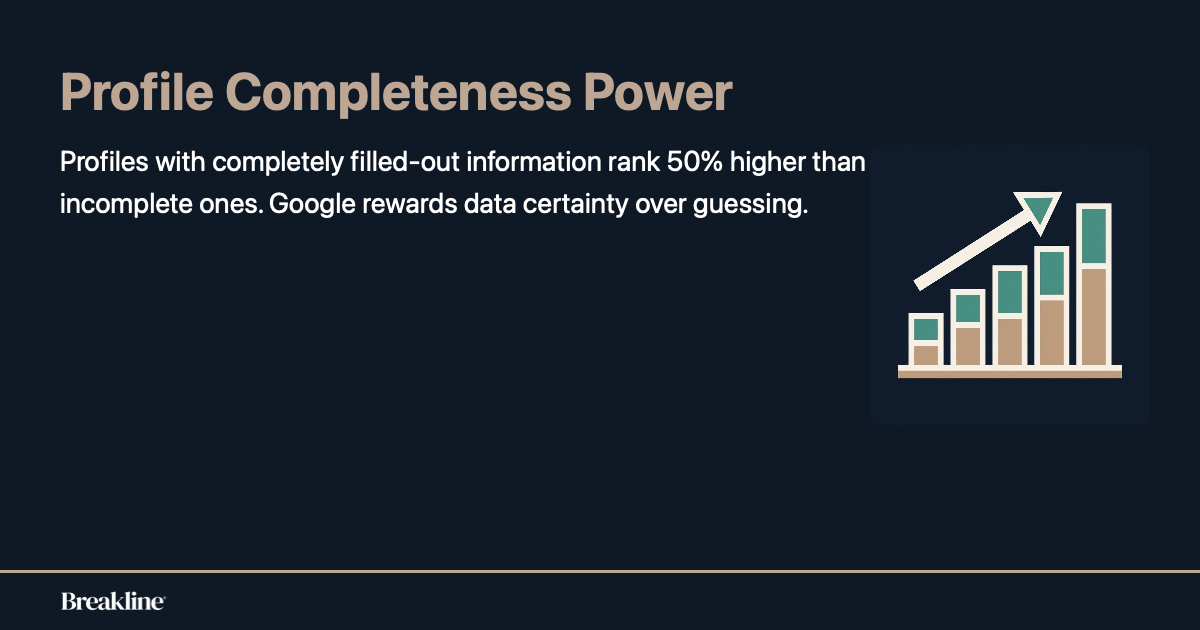
There is a stat floating around that says profiles with complete information rank 50% higher. I believe it. I see it happen.
Google gives you fields for a reason. They want data.
They want to know your opening hours. They want to know if you have wheelchair access. They want to know if you are women-led or veteran-owned.
They want to know your specific services.
If you are a plumber, don’t just select “Plumber” as a category and walk away. List the services.
Drain cleaning. Boiler repair. Emergency pipe fixing. Use the products tab if you sell physical items.
When you leave these blank, you are forcing Google to guess. Google hates guessing. It wants certainty.
Your competitor might have fewer reviews, but if their profile tells Google exactly what they do, when they are open, and what attributes they have, Google trusts them more. It feels safer sending a user to a complete profile than a half-finished one.
It is tedious work. I know. Nobody starts a business to spend their evening ticking boxes on a digital form. But it is the difference between page one and page nowhere.
Even things like special holiday hours matter. If a bank holiday is coming up and you update your hours to say “Closed” or “Open,” Google loves that. It shows you are home. It shows someone is managing the shop.
The “Openness” signal is becoming huge. If a user searches “plumber open now” and you haven’t updated your hours, you won’t show up. Your competitor who updated their hours will.
Photos prove you actually exist
Let’s talk about trust for a second.
Anyone can make a fake listing. You can verify it with a postcard to a PO Box if you are sneaky enough. Google knows this and they are fighting it hard.
One of the ways they fight it is with Vision AI. This is Google’s artificial intelligence that looks at images and understands what is in them.
If your competitor is uploading photos every week, they are winning.
I am not talking about stock photos of smiling people in suits shaking hands. Google knows those are fake.
I am talking about real photos. A branded van parked in front of a local landmark. A team member holding a tool. The reception desk.
When Google scans these photos, it sees the logo on the shirt. It sees the local architecture in the background. It connects the dots. It says “Okay, this is a real business in the real world.”
If your profile just has your logo and a picture of the outside of your building from three years ago, you look dormant.
I tell clients to treat their Google Business Profile like Instagram but for boring stuff.
Just finished a job? Snap a photo. New stock arrived? Snap a photo.
It doesn’t have to be art. It just has to be real.
Profiles that add photos regularly get way more interaction. People can see what they are getting. It reduces the risk for the customer.
And here is a quirky thing I have noticed. The businesses that upload photos tend to rank better even if their reviews are lower. It seems Google treats fresh visual content as a very strong signal of life.
So if you are losing to a guy with fewer reviews, check his photos. I bet he has got a gallery of recent work that makes him look busy and popular.
Categories are the sorting hat
This is the most common technical mistake I see.
You pick a category that describes you broadly. But your competitor picks a category that describes exactly what the user is looking for.
Let’s say you are a dentist. You pick “Dentist” as your primary category. Makes sense.
But your competitor picks “Cosmetic Dentist” or “Emergency Dental Service.”
If someone searches for “teeth whitening,” the cosmetic dentist wins. If someone searches for “toothache help,” the emergency guy wins. Even if they have fewer reviews than you.
The primary category is the single biggest ranking factor in the Local pack after where you are located. It tells Google which bucket to put you in.
You can have secondary categories, and you should. But that primary one carries the most weight.
You need to look at what your competitor is using. There are tools like GMB Everywhere that can show you this if you don’t want to dig into the source code.
Sometimes just swapping your primary category can jump you up three spots overnight. It is that powerful.
I once worked with a law firm that was ranking nowhere for “divorce lawyer.” They were listed as “Law Firm.” We changed their primary category to “Divorce Lawyer” and moved “Law Firm” to secondary. They popped into the top three within a week.
They didn’t get any new reviews. They didn’t move office. They just changed the label on the jar.
Behaviour is the new currency
Google is watching what people do when they see your listing.
Do they click to call? Do they ask for directions? Do they click through to your website and stay there, or do they bounce back immediately?
These are behavioral signals. Some people call it “Interaction Prominence.”
If your competitor has fewer reviews but a much higher click-through rate, Google thinks they are more relevant. Maybe their main photo is more appealing. Maybe their name is catchy.
If ten people search for “roofer” and seven of them click on the second result, eventually Google is going to move that second result to the top. It assumes the users know something it doesn’t.
This is why you can’t just rest on your laurels. You need to be attractive.
If your listing looks boring or your hours are wrong so people don’t call, you are sending negative signals. You are telling Google “people see me but they don’t want me.”
I suspect this is why some businesses with lower ratings rank well. They might be a 3.8 star business, but they are open 24 hours and they answer the phone. So people engage with them.
Google wants to send users to businesses that solve the problem. A 5-star business that never answers the phone doesn’t solve the problem.
When the name game gets dirty
I hesitate to bring this up because it is a bit of a grey area.
Actually it is not grey. It is against the rules. But people do it and it works.
I am talking about putting keywords in your business name.
If your business is called “Smith & Sons” but you rename your profile to “Smith & Sons – Emergency Plumbing Leeds,” you will probably rank higher for “emergency plumbing.”
Ranko Media and other experts have noted that having the keyword in the business title is a massive ranking factor. It is stupidly effective.
Your competitor who is beating you? Check their name. Is it their legal registered business name? Or have they stuffed a few extra words in there?
If they have, that is likely why they are winning. Google gives a huge amount of credit to the words in the title.
Now, I am not telling you to do this. Google can suspend your listing if they catch you. It is risky. But I am telling you this so you understand why it is happening.
If you see a competitor doing this blatantly, you can suggest an edit to Google. You can report the name as incorrect. If Google accepts the edit, their ranking will drop like a stone.
It feels a bit like telling on someone in school. But if they are cheating to take food off your table, I say go for it.
The website connection
Your Google Business Profile doesn’t live in a vacuum. It is tethered to your website.
If your website is a mess, your map ranking suffers.
Google crawls your site to verify what you say on your profile. If your profile says you are open 24/7 but your website footer says 9-5, that is a conflict.
Google gets confused. It lowers your trust score.
We call this NAP consistency. Name, Address, Phone.
It needs to be identical. Not just similar. Identical.
Also, look at the page you are linking to. Are you linking your profile to your homepage? Or a specific location page?
If you are a multi-location business, you should link to the specific page for that town. It helps Google connect the dots between the map pin and the website content.
I have seen businesses fail to accommodate these basic checks. They change their phone number on the profile but forget the website. Or they move office and update the site but forget the profile.
These little disconnects act like anchors. They drag you down.
Your competitor might have a website that is perfectly tuned to their local area. It mentions the town name, the landmarks, the local services. It feeds the map listing with relevance.
Final Thoughts
It hurts to see someone else in your spot. I get it.
Especially when you know you do better work. You have been around longer. You have treated more customers right.
But Google is a machine. It doesn’t know you personally. It only knows the data you feed it.
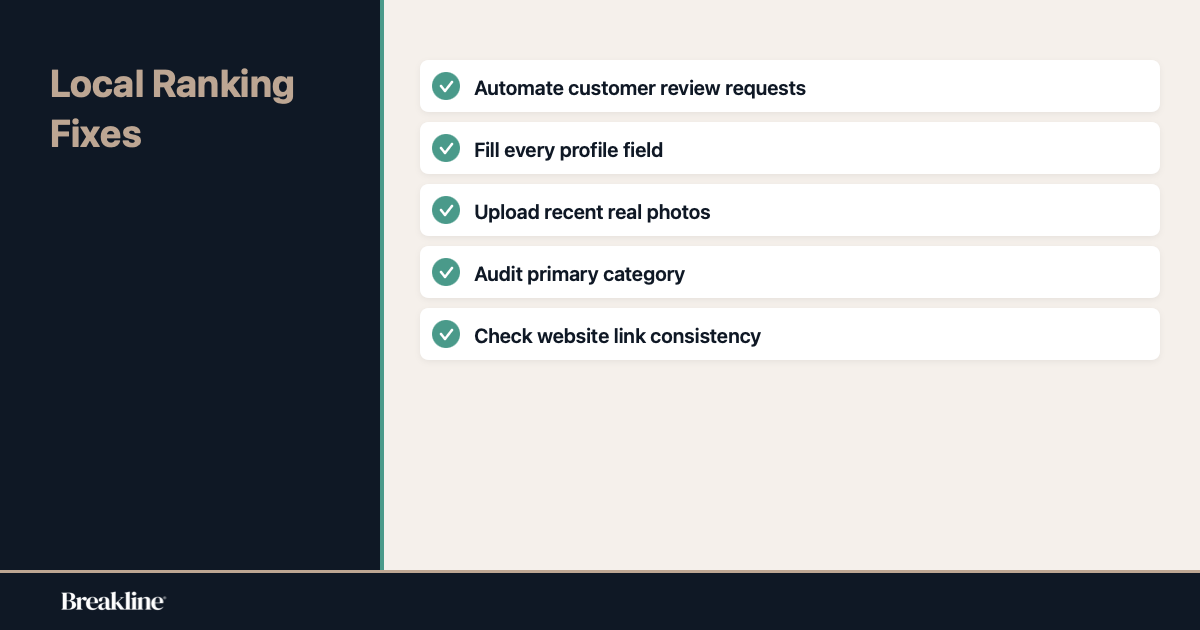
The good news is that most of this is fixable. You can’t change your location, but you can fix your velocity. You can start asking for reviews today. Not next month. Today.
Get a system in place. Send a text to every happy client. Get that heartbeat going again.
Fill in the blanks on your profile. Take some photos of the van. Check your categories.
It is not magic. It is just maintenance. And the best time to start is right now.