
Content
Different Content Types for SEO: Blogs, Guides & Video
When to use blog posts, long-form guides, video, interactive tools or infographics for SEO, and how to match each format to search intent.
 By Alexander Thomas, Founder Updated 7 min read
Key takeaways
- The format of your content matters as much as what you say, because Google wants the right type of content for each search query.
- Short blog posts of 600-800 words suit specific questions, while medium-length posts of 1000-1500 words hit a sweet spot for most commercial topics.
- Comprehensive guides suit competitive keywords, B2B topics and high-value purchases, and one well-crafted guide can rank for dozens of related keywords.
- Video works best for demonstration-based content, but it is not automatically better than text: it depends on search intent and user preference.
- Interactive tools and good infographics tend to attract backlinks over time, though infographics need supporting text to rank effectively.
On this page9 sections
Content marketing feels like a massive puzzle sometimes. You’ve got keywords to target, audiences to satisfy & search engines to please. But here’s what most people miss – the format of your content matters just as much as what you’re actually saying.
I’ve spent years experimenting with different content types, and honestly? Some formats just work better for certain situations. It’s not rocket science, but it’s not completely obvious either.
The thing is, Google doesn’t just want “content” anymore. It wants the RIGHT type of content for each search query. And that’s where understanding format strategy becomes crucial.
Why Content Format Actually Matters for SEO
Search engines have become surprisingly sophisticated at understanding user intent. When someone searches “how to change a tyre,” they probably want a step-by-step guide or video tutorial. Not a 500-word blog post about tyre maintenance philosophy.
This intent matching goes deeper than you might think. Google’s algorithm considers dwell time, bounce rates & user engagement signals. If people land on your page and immediately click back, that’s a problem. Often, it’s because you’ve chosen the wrong content format for their needs.
I’ve seen websites ranking on page three suddenly jump to position two simply by reformatting their content. Same information, different presentation. Magic? Hardly. Just better audience alignment.
The search results themselves give you clues about what format works best. If the top results are all comprehensive guides, maybe your short blog post isn’t going to cut it.
Blog Posts Still Rule for Topical Authority
Blog posts remain the backbone of most SEO strategies, and for good reason. They’re versatile, relatively quick to produce & perfect for targeting long-tail keywords.
Short blog posts work brilliantly for answering specific questions. Something like “What colours work best for kitchen walls?” doesn’t need 3000 words. You can provide solid value in 600-800 words, hit the key points & satisfy search intent without waffle.
The beauty of blog posts lies in their flexibility. You can update them easily, add new sections & respond to changing search trends. I think that’s why they’ve survived every major algorithm update – they adapt.
But here’s where people go wrong with blog posts – they try to make every single one comprehensive. Sometimes you just need to answer the question & move on. Not every blog post needs to be War and Peace.
Medium-length blog posts (1000-1500 words) hit a sweet spot for most commercial topics. You can cover the essentials, include some depth & still keep readers engaged. This length also tends to perform well across social media platforms.
Blog posts excel when you’re building topical clusters around your main services or products. They’re the perfect way to target supporting keywords that feed into your main conversion pages.
Long Form Guides for Complex Topics
Comprehensive guides are absolute powerhouses for competitive keywords. When someone searches for “complete guide to kitchen renovation,” they want exactly that – everything in one place.
These beasts typically run 3000+ words and cover every conceivable angle of a topic. They’re time-intensive to create, but the SEO rewards can be substantial. One well-crafted guide can rank for dozens of related keywords.
I’ve noticed that guides work particularly well for B2B topics and high-value purchases. People researching expensive decisions want thorough information. They’ll happily spend 15 minutes reading if it helps them make a better choice.
The structure matters enormously with long-form guides. You need clear headings, logical flow & plenty of white space. Nobody wants to face a wall of text, no matter how valuable the information might be.
Guides also tend to attract high-quality backlinks naturally. Other websites love linking to comprehensive resources because they add value for their own readers.
When to Choose Guides Over Blog Posts
Guides make sense when the search intent demands comprehensive coverage. If people are comparing multiple options, making significant purchases or learning complex processes, a guide usually outperforms shorter content.
They’re also brilliant for establishing expertise in your field. A detailed guide demonstrates knowledge depth in ways that shorter posts simply cannot.
However, guides require serious commitment. You can’t half-heartedly produce a 4000-word guide and expect it to compete. Quality becomes even more critical at this length.
Video Content Changes the Game
Video has completely transformed how we approach SEO. YouTube is essentially the second largest search engine, and video results increasingly appear in regular Google searches.
What’s fascinating about video SEO is how differently it behaves compared to traditional text content. Engagement metrics become paramount. Watch time, comments, shares – these signals carry enormous weight in video rankings.
I’ve seen businesses transform their organic reach by embracing video content. A local plumber in Manchester went from invisibility to dominating local searches simply by creating helpful repair videos. Nothing fancy, just genuine expertise shared clearly.
Video works exceptionally well for demonstration-based content. Try explaining how to fix a leaking tap in text versus showing it in a two-minute video. The video wins every time for user experience.
But video isn’t automatically better than text. It depends entirely on search intent and user preference. Some people prefer reading instructions; others want visual demonstration. The key is recognising which camp your audience falls into.
YouTube SEO has its own peculiarities too. Thumbnails, titles & descriptions all need optimisation, just like traditional content. But the ranking factors include things like subscriber engagement and session duration that don’t apply to written content.
Interactive Content for Engagement Boost
Interactive tools and calculators create unique SEO opportunities. They solve specific problems in ways that passive content cannot match.
A mortgage calculator, for instance, provides immediate value that a blog post about mortgage calculations simply can’t deliver. Users spend longer on the page, often return multiple times & frequently share these tools with others.
The technical requirements can be challenging, though. Interactive content often needs custom development, which means higher costs and longer timescales compared to traditional content creation.
But when interactive content works, it really works. These pieces tend to accumulate backlinks steadily over time because they provide ongoing utility rather than just information.
Quizzes, assessments & diagnostic tools also fall into this category. They’re particularly effective for lead generation because they naturally encourage email signups for results delivery.
Infographics for Complex Data
Infographics occupy an interesting middle ground between text and video content. They can simplify complex information and make dry statistics engaging.
The challenge with infographics lies in making them genuinely useful rather than just pretty. I’ve seen countless infographics that look beautiful but provide minimal actual value. Those don’t tend to perform well in search results.
Good infographics work brilliantly for link building campaigns. Websites love sharing visual content that supports their own articles. This can lead to natural backlink accumulation over time.
However, infographics need supporting text content to rank effectively. Search engines can’t read images (despite improving AI capabilities), so you need descriptive text, alt tags & contextual information.
The production process for quality infographics can be surprisingly involved. You need data analysis, design skills & often custom illustrations. It’s not as simple as throwing some statistics into a template.
Mobile optimisation becomes crucial with infographics too. Many designs that look great on desktop become unreadable on smartphones.
Matching Content Type to Search Intent
The secret to successful content format selection lies in understanding what searchers actually want. This sounds obvious, but it’s surprisingly easy to get wrong.
Commercial search terms often benefit from comparison guides or detailed reviews. People researching purchases want comprehensive information to inform their decisions. A brief blog post rarely satisfies this intent effectively.
Informational queries might work better with shorter, focused content. Someone searching “what time do shops close on Sunday” doesn’t want a 2000-word guide about retail opening hours.
Local searches often favour video content, particularly for service-based businesses. Seeing the actual person or team behind a business builds trust in ways that text content struggles to match.
Problem-solving searches frequently perform well with step-by-step guides or video tutorials. The format should match how people naturally want to consume that type of information.
Seasonal content might benefit from different formats at different times. Holiday gift guides work well as both written lists and video presentations, depending on timing and audience preferences.
The Bottom Line
Content format strategy isn’t about following rigid rules. It’s about understanding your audience and matching their preferences with search engine expectations.
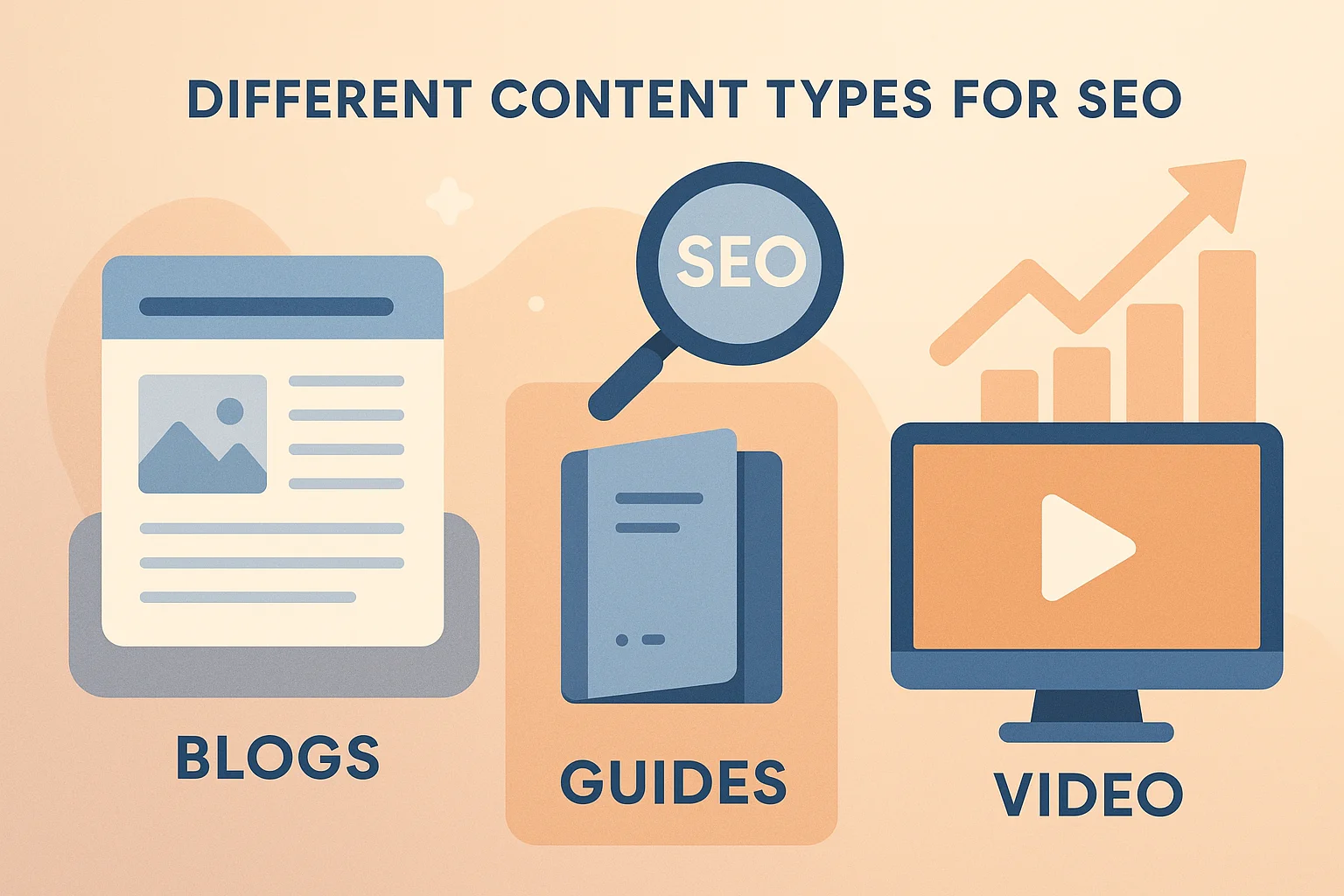
The most successful SEO strategies I’ve observed use multiple content formats strategically. Blog posts for quick answers, comprehensive guides for detailed research & videos for demonstration. Each format supports the others while targeting different search behaviours.
Don’t feel pressured to master every content format immediately. Start with what you can execute well, then gradually expand your capabilities. A brilliant blog post beats a mediocre video every time.
The key is staying flexible and responsive to what actually works for your specific audience and industry. SEO success comes from giving people exactly what they’re looking for, in the format they prefer.
Frequently asked questions
How do you know which content format a search query needs?
The search results themselves give you clues. If the top results are all comprehensive guides, a short blog post probably will not cut it. A search such as how to change a tyre usually calls for a step-by-step guide or video tutorial, and the wrong format can send people straight back to the results.
How long should a blog post be for SEO?
It depends on the question you are answering. Short blog posts of 600-800 words work well for specific questions, letting you hit the key points without waffle. Medium-length posts of 1000-1500 words hit a sweet spot for most commercial topics, covering the essentials with some depth while keeping readers engaged.
When is a long-form guide better than a short blog post?
A guide makes sense when the search intent demands comprehensive coverage, such as when people are comparing multiple options, making significant purchases or learning complex processes. Guides are also brilliant for establishing expertise in your field. They need serious commitment, though, because quality becomes even more critical at that length.
What makes video SEO different from SEO for written content?
Video rankings lean heavily on engagement, so watch time, comments and shares carry a lot of weight. You still need to optimise thumbnails, titles and descriptions, just like text content. YouTube also looks at things like subscriber engagement and session duration, which do not apply to written content.
Why do interactive tools and calculators help SEO?
They solve specific problems in ways passive content cannot, so users spend longer on the page, often return and frequently share them. They tend to accumulate backlinks steadily because they provide ongoing utility. The downside is that interactive content often needs custom development, which means higher costs and longer timescales.
Do infographics help a page rank in search?
Good infographics can simplify complex information and work brilliantly for link building campaigns, because websites love sharing visual content. They need supporting text to rank effectively, including descriptive text, alt tags and contextual information. Make them genuinely useful rather than just pretty, and check they stay readable on smartphones.