Google Search Console Introduces Generative AI Performance Reports

Google has officially added Generative AI performance reports to Google Search Console. This means site owners finally have a first-party way to measure how often their content shows up in AI Overviews & other generative AI surfaces in Search. Right now the reports only show visibility metrics like impressions, page-level data, and device breakdowns. Click metrics like CTR are completely missing at launch.
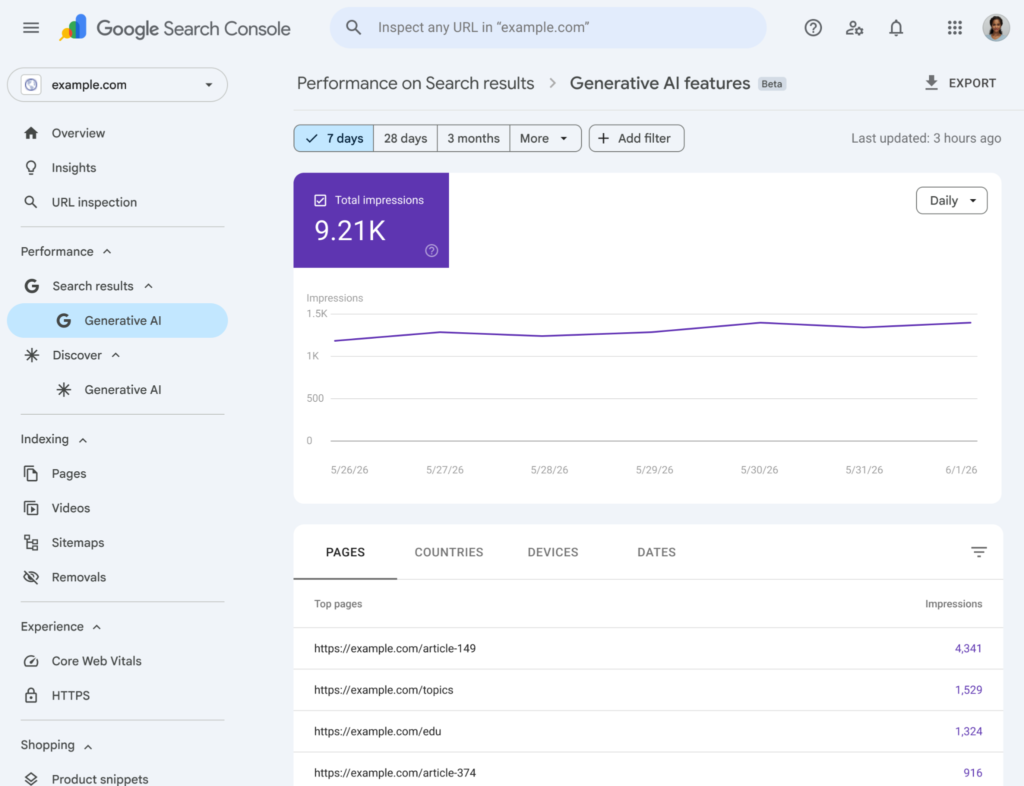
Still, this phased rollout is a massive shift. It lets marketers stop guessing about their AI visibility and start benchmarking it against traditional search results to prove the value of AI optimization to stakeholders.
I remember sitting at my desk a few months ago staring at a spreadsheet full of speculative data. Optimizing for AI felt like throwing darts in the dark. We just did not know what was working. Now we have actual numbers from Google.
Well, sort of.
It is a big step forward for SEO professionals who have been begging for transparency since AI Overviews first started showing up in search results. Having a dedicated dashboard changes the conversation you have with clients.
You can finally point to a graph and say that Google’s AI systems are actually reading and citing your content. That alone is worth celebrating even if the data isn’t perfectly complete yet.
What this new report actually does

Google introduced this new Generative AI performance reporting inside Search Console as a dedicated report type. It is designed to show how often your content gets surfaced in generative AI experiences on Google Search.
This is completely separate from classic web results. You can find it sitting right there in the navigation menu if your property is included in the rollout.
These generative experiences mostly mean AI Overviews and related AI-powered answer formats where Google models synthesize information from multiple pages. The report provides impression data showing how many times your site content was eligible and actually shown within these generative answers.
This is a big deal. Impression data shows that your content is making the cut when the AI decides what sources to pull from.
Data is broken down at the page level. Publishers can finally see which URLs are getting visibility within AI-generated results.
You can segment performance by device like desktop versus mobile to see where this AI visibility is happening. I think this is incredibly useful because user behavior on mobile AI searches might be drastically different than on a desktop.
The report integrates right into the regular Search Console Performance section. You can filter queries and compare your AI visibility against traditional search data. It is honestly a relief to see it sitting there in the interface.
You can set up comparison views to see if a page that gets a lot of regular organic impressions is also getting picked up by the AI Overviews. Sometimes they correlate perfectly. Sometimes they don’t.
The missing click data situation
At launch click, CTR, and position metrics are not available for generative AI surfaces. I know this is frustrating. It is important context for setting expectations with clients or your boss.

When you show them a report with thousands of impressions and zero clicks they might panic. You have to explain that Google just isn’t tracking the clicks for us yet.
Clicks and CTR would be amazing but impression-level data is still a huge step forward. It tells us where we stand in Google’s AI comprehension of our site.
Even without clicks impression trends show whether Google generative systems consider your content a reliable source to cite. Or if they just ignore you entirely. A lack of impressions is a clear signal that your content needs work.
Speaking of tricky user experiences I bought a new coffee machine last week that requires a smartphone app just to brew a basic espresso. I spent twenty minutes trying to sync it to my Wi-Fi before giving up and using my old French press. Technology is supposed to make things easier but sometimes it just adds another layer of abstraction.
Anyway, the lack of clicks in this report feels a bit like that coffee machine. We have this shiny new tool but we can’t quite use it for the one thing we really want yet.
You can still track before and after impacts of content changes designed to improve AI visibility. You just have to rely on impressions as a leading indicator of future traffic. If impressions go up steadily over a month you are probably doing something right.
Moving away from guesswork

Before this update optimizing for AI Overviews was mostly speculative guesswork based on third-party tools and manual spot checks. Marketers had absolutely zero first-party telemetry at scale about which URLs appeared in AI summaries. We were just hoping for the best and relying on anecdotal evidence.
Now the Generative AI Google Search Console reports change everything. You can actually do baseline measurement of AI exposure. You can run trend analysis over time.
You can compare AI impressions with traditional web search impressions right there in the Generative AI GSC dashboard. It is so much easier to justify your SEO budget when you have Generative AI Google Search Console data backing up your claims.
I have spent hours digging through Google Search Console over the years. Seeing this new Generative AI GSC data pop up is exciting. It directly supports the idea that marketers can now benchmark AI visibility against traditional search.
We are finally moving from a phase of blind experimentation into a phase of measurable strategy.
You can prove the value of AI optimization to stakeholders. If you see Generative AI Google Search Console impressions going up after a content refresh you have actual evidence that your strategy is working.
It is not just ‘trust me bro’ SEO anymore. Having concrete numbers from the search engine itself is the ultimate validation for the work we do.
Impact on content strategy
Entity-rich authoritative content that gets frequently cited by AI Overviews will show higher AI impressions. This gives SEO teams hard evidence to invest more in structured content and expert-driven articles. The AI clearly favors content that is easy to parse and packed with facts.
Clear concise answers are what the AI wants. The ability to measure AI impressions at the URL level means you can start reworking underperforming pages.
You can consolidate thin content into comprehensive resources that the AI is more likely to use. It takes time to accommodate these changes but the data is there to guide you. If a page has high organic traffic but zero AI impressions it probably needs better formatting.
Device segmentation helps you understand whether AI surfaces are more active on mobile versus desktop. This is crucial for prioritizing mobile UX where AI Search usage is often highest. If your site is slow on mobile the AI might just skip over it entirely.
Google recent algorithm updates emphasize helpful people-first content with strong E-E-A-T signals. The content chosen for AI Overviews is definitely influenced by these same quality signals.
The Generative AI report basically becomes a proxy for how well your content aligns with Google trust criteria. If you are writing good stuff the AI will notice.
What the experts are saying
The SEO community has been buzzing about this. For the first time we can quantify how often Google AI systems actually use our content.
This is the missing visibility layer everyone has been asking for since AI Overviews launched. People on social media have been sharing screenshots of their new dashboards constantly.
Being able to compare generative AI impressions with classic web impressions in the same interface turns AI visibility into a standard KPI.
It is no longer just a weird side experiment. It is a core part of reporting. A lot of agencies are already updating their monthly client reports to include this new metric.
I was reading some commentary from well-known SEOs recently. Most agree that while clicks would be great impression data is a massive win. It tells us where we stand.
If you want to check out some great analysis of this I highly recommend looking at Search Engine Land for their breakdown of the rollout. They always have good insights on these product updates.
Google described the launch as a phased rollout. Not all properties will see the new report immediately.
Rollout is happening over several weeks with gradual expansion to more accounts and regions. If you don’t see it yet just check back periodically.
It is basically a soft launch. Very similar to how Core Web Vitals & Discover reports were introduced.
Frequently asked questions
What exactly is the Generative AI performance report?
It is a dedicated report showing how often your content appears in Google generative AI experiences like AI Overviews. It sits alongside your standard search performance data.
Where do you find it?
It appears in the left navigation under Performance or as a new report card. You will only see it once your property has sufficient data and is included in the rollout. Do not panic if it is missing right now.
Why is CTR not available?
Google has not enabled click tracking for these AI surfaces yet. They are starting with visibility measurement only. Perhaps they are worried about the data looking terrible initially or they are still tweaking the user interface of the Overviews themselves.
Does every site get this data?
No. You only see data if your site appears in relevant generative AI answers and you are in a region where AI Overviews are live. You also need enough impressions to meet the reporting thresholds.
Will Generative AI impressions lead to less organic traffic?
This is still hotly debated. The report helps you observe whether your AI impressions are rising while clicks stay flat. It is something we all need to monitor closely over the next few months to see the real impact.
Technical stuff to consider
You really need a clean site architecture so Google can understand your topic clusters. Structured data like FAQ and product markup helps machines parse meaning. Fast mobile-friendly pages align with where users interact with AI surfaces the most.

Technical SEO is not dead it is just shifting focus.
There are potential future benefits if Google adds richer filters.
Imagine if we could filter by AI experience type. Or if they align more of their AI selection criteria with structured signals. The possibilities for technical optimization are pretty exciting.
Writing for the machine
Google guidelines discourage low-quality AI-generated content. They emphasize human oversight and value.
Appearing in generative AI answers rewards original insights and expertise. You cannot just spin up a thousand pages with ChatGPT and expect to dominate the AI Overviews.
Responsible use of AI as a drafting tool plus expert review can still align with Google policies. Fact-checking and citations are super important since Google AI systems draw from trusted sources. If your facts are wrong the AI will probably ignore you.
I think we are going to see a lot of SEOs pivoting their technical audits to focus heavily on entity extraction. Making sure the AI can easily read and summarize your page is half the battle now. Use clear headings and bullet points where appropriate.
Final Thoughts
This whole shift to generative AI in search is messy. Having actual data in Google Search Console makes it slightly less messy.
We can finally see if our optimization efforts are actually moving the needle in AI Overviews. It feels good to have some control back.
Sure the lack of click data is a bummer. But impressions are a start. They give us a baseline to work from.
They let us prove to clients that we are actually showing up in these new search experiences. And honestly just knowing that Google is actively building reporting tools for this gives me hope for the future of SEO.
I am genuinely curious to see how this report evolves. Will Google eventually give us CTR? Will they break down the types of AI answers?
We just have to wait and see. For now I am just glad to have some hard numbers to look at instead of relying on gut feelings and third-party rank trackers.
Keep an eye on your Search Console. Start tracking those AI impressions. The way people search is changing and we need to adapt our strategies to match.