The Monumental SEO Shifts of Jan-Feb 2026
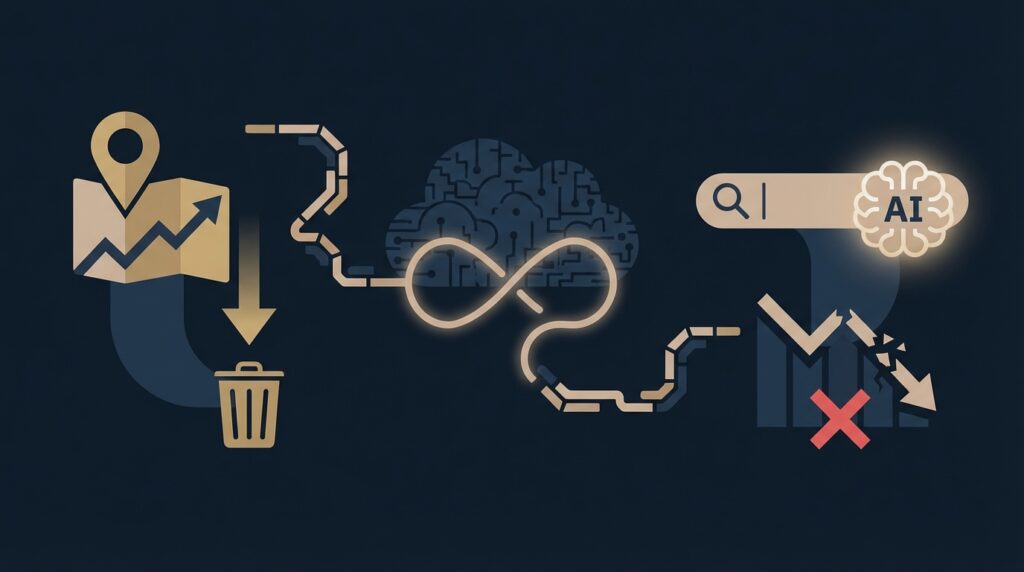
The first two months of 2026 have completely rewritten the rules of engagement for search marketing. If you are looking for the short version here it is. On February 5 Google launched a dedicated Discover Core Update that prioritizes local relevance and penalizes clickbait which signals a massive pivot toward push traffic over pull traffic. Simultaneously we are seeing a structural collapse in traditional click-through rates due to AI Overviews now occupying 30% of results and pushing organic links 1600 pixels down the page. The game has officially moved from driving traffic to ensuring brand survival through citations and optimizing for AI agents rather than just human eyeballs.
It has been a heavy start to the year.
I have been sitting at my desk at Breakline for the last few weeks watching the volatility charts and talking to clients who are frankly terrified. I have been doing this for 15 years. I have seen Panda and Penguin and the Medic update. But this feels different. It feels like the floor is moving while we are trying to stand still.
We need to talk about what just happened.
The February 2026 Google Updates Breakdown
Let’s start with the big one. The “Headline” algorithm update that dropped on February 5 2026. This was the Google Discover Core Update.
This was weird.
Usually core updates are broad. They hit everything. But this one was surgically targeted at Google Discover. If you are not familiar with Discover it is that feed on your phone that shows you articles you didn’t ask for but probably want to read. It is “push” traffic.
For years we treated Discover as a nice bonus. A cherry on top. If you got a spike in Discover traffic you high-fived your team and moved on. You couldn’t really plan for it.
That is over.
This update signals that Google views push traffic as critical as search queries. They are trying to curate a feed that is actually useful rather than just full of shocking headlines. The update prioritizes local relevance heavily. If you are a user in Manchester you are going to see content from UK publishers. Not some content farm in a basement halfway across the globe.
I think this is actually a good move.
It penalizes clickbait and sensationalism. It rewards deep and expert content. But it also means that if your strategy relied on high-volume churn content to game the feed you are in trouble. I have looked at the data and the sites getting hit the hardest are the ones that relied on curiosity gaps in their headlines.
You know the ones.
The “You Won’t Believe What Happened Next” crowd.
They are being wiped out.
For us at Breakline this validates what we have been saying for a long time. Quality wins eventually. But “eventually” can be a long time coming. This specific focus on Google Updates targeting the feed is a sign that the search engine is trying to keep users inside their ecosystem even before they type a query.
The End of the Big Bang Update
There is another shift that happened in January that went somewhat under the radar.
We are entering the “Continuous Update” era.
I remember the old days. You would wait for a named update. You would brace yourself. The update would roll out over two weeks and then the dust would settle. You could assess the damage and make a plan.
That model seems to be dead.
Industry observers noticed in January that we are not seeing those singular massive spikes followed by calm. We are seeing daily volatility. It is constant. The charts look like a heart rate monitor during a sprint.
This is driven by AI systems.
They are continuously re-ranking content based on user intent signals. They aren’t waiting for a manual refresh or a monthly data push. They are reacting in real-time. If a user bounces from your site today it hurts you today. Not next month.
This makes our job harder.
How do you report to a client when rankings change every six hours? You can’t just send a monthly PDF and say “look we are up”. You might be up at 9am and down at 4pm. We have to change how we measure success. We have to stop obsessing over static keyword maps.
Static keywords are a relic.
The Google Updates we are seeing now are about intent. They are fluid. If you are still tracking “blue widgets” as your primary KPI you are missing the forest for the trees. The AI is looking at whether you solved the user’s problem. Not whether you had the keyword in the H1 tag.
The Click Crisis is Real
Now we have to talk about the scary part.
The numbers coming out of early 2026 are brutal. We are calling it the “Click Crisis” or the collapse of the click-based economy.
Here is a stat that will keep you up at night.
Data from major publishers like DMG Media indicates that when an AI Overview appears above a visible link click-through rates on desktop can drop by roughly 89%. That is not a typo.
Eighty-nine percent.
That is not a dip. That is a structural collapse. If your business model relies on getting people to click a blue link and visit your website to see an ad or buy a product you are staring at a cliff.
The AI Overviews are everywhere now.
They appear in roughly 30% of search results. In some sectors like finance or health we are seeing 400% to 500% year-over-year growth in AI answers. And they are huge. They take up space.
They push the first organic result down about 1600 pixels.
On a laptop that is below the fold. On a phone it is practically in the basement. You have to scroll and scroll just to find a website.
So what do we do?
We have to pivot. The goal of SEO has officially shifted from “driving traffic” to “brand survival”. We are fighting for citations. We want the AI to mention us. We want the AI to say “according to Breakline” in that summary.
Because if you aren’t in the summary you might as well not exist.
This is hard for clients to hear. They want traffic. They want sessions. They want users adding things to carts. But if the user gets the answer right there in the search results they aren’t coming to your site. We have to accept that Google Updates have created a wall between us and the user.
We have to paint graffiti on that wall so they know we are here.
Optimizing for Machines Not Humans
This brings me to the weirdest development of Jan-Feb 2026.
We are optimizing for robots.
I know. We always said “write for humans and the bots will follow”. That was the golden rule. It was printed on mugs. It was chanted at conferences.
Well throw the mug away.
The rise of “Agentic SEO” is here. We are seeing a new type of visitor. The AI Agent. These are automated bots performing tasks for humans. Booking flights. Buying groceries. Researching software.
These agents do not care about your beautiful web design.
They do not care about your persuasive copy or your emotional brand story. They definitely don’t care about your stock photos of people shaking hands.
They care about data.
They care about schema markup. They care about API accessibility. They care about clean data structures. If an AI agent cannot read your pricing table because you coded it as an image or a messy div soup then you are invisible to the buyer it represents.
It is a split strategy now.
We have to do Traditional SEO for the humans who still browse. This focuses on UX and emotion and visuals. But we also have to do LLM Optimization for the agents. This focuses on raw facts and logic and entity relationships.
It is double the work.
But it is neccessary. If you ignore the agents you are ignoring the future buyer. I suspect by the end of this year half of our “traffic” won’t be human at all. It will be bots scraping our pricing to tell their owner whether we are a good deal.
This requires a technical overhaul.
Your schema can’t just be “good enough”. It has to be perfect. You need to explicitly tell the bot “this is the price” and “this is the product” and “this is the review”. Ambiguity is death.
Citation Frequency is the New Ranking
I mentioned brand survival earlier.
Let’s unpack that.
The primary KPI for 2026 is Citation Frequency in AI answers. We are moving from Generative Engine Optimization or GEO being a buzzword to it being the main game.
You are no longer fighting for the blue link.
You are fighting to be the source of truth.
How do you do that? You have to publish content that is “un-hallucinatable”. That is a mouthful but it makes sense. AI models hallucinate when they don’t have hard data. They make things up. If you provide original statistics or proprietary case studies or strong opinions that an AI cannot generate on its own it has to cite you.
It has no choice.
If I write a generic article about “how to do SEO” the AI doesn’t need me. It has read a million articles like that. It can synthesize an answer that is better than mine. But if I write “How Breakline increased traffic by 40% using this specific weird trick in Feb 2026” the AI cannot fake that.
It has to reference me.
This is where the Google Updates are pushing us. Toward radical originality. We have to be the primary source. We have to be the ones doing the research.
I tell my team this every day.
Stop rewriting what is already out there. If you are just aggregating other people’s ideas you are feeding the AI for free. You are making it smarter and making yourself obsolete. You have to create something new.
This is scary for content teams.
It is harder to do original research than it is to rewrite a Wikipedia entry. It costs more money. It takes more time. But the alternative is irrelevance. The Google Updates have made commodity content worthless.
Technical Shifts You Might Have Missed
Amidst all the panic about AI there were some technical updates in Jan and Feb that are actually quite cool.
Google Trends got a massive upgrade.
In January they launched the Google Trends Explore Update. They integrated Gemini AI into it. Now instead of just seeing that a topic is trending you can get deeper AI-explained insights into why it is trending. This is huge for content planning.
It helps us understand the trigger.
Is “red shoes” trending because of a movie? Or a celebrity? Or a sale? The AI tells us. We don’t have to guess.
Then in February we got “Campaign Total Budgets” in Google Ads.
Finally.
Advertisers can set a fixed total budget for a specific timeframe. This is ideal for product launches. We used to have to mess around with daily budgets and hope we didn’t overspend or underspend. Now we can just say “spend 5k over these three weeks” and the system handles it.
Also Microsoft Advertising rolled out “Share of Voice” reporting metrics.
This helps brands understand their visibility specifically in the context of AI-crowded SERPs. It is a small change but a useful one. It helps us explain to clients why their impression share might be dropping even if their budget is the same.
It is crowded out there.
These tools give us a bit more visibility. They don’t solve the click crisis but they help us manage the chaos. I appreciate that.
The Human Premium & E-E-A-T Survival
Let’s talk about the “Human Premium”.
As of Feb 2026 “commodity content” is dead. I mean it. If you are writing generic “how-to” guides you are wasting your time. AI answers these queries instantly.
Traffic is holding steady only for content that demonstrates first-hand experience.
This is the Experience filter in E-E-A-T.
Think about it. If I search “how to fix a leak” the AI gives me a perfect step-by-step list. I don’t need to click a website. But if I search “my nightmare experience fixing a leak in a 1920s home” the AI can’t answer that.
It doesn’t have a nightmare.
It doesn’t have a 1920s home. It doesn’t know the frustration of a rusted pipe snapping in your hand at 11pm on a Sunday. That narrative element is what gets the click.
We are seeing this across the board.
The content that performs is the content that feels human. It has a voice. It has flaws. It has opinions. It isn’t a polished corporate press release.
It is messy.
I think this is why the Google Updates are pushing so hard on E-E-A-T. They know that the only thing they have that other AI models don’t is the human web. The stories. The forums. The reviews.
If Google just becomes an answer engine it loses its soul.
So they are trying to surface the humans. We have to be those humans. We have to inject personality into everything we write. We have to use “I” and “me” and “we”.
We have to tell stories.
This is a big shift for SEOs who were trained to be objective and neutral. Neutrality is boring now. Boring gets summarized. Opinionated gets read.
The Death of the Generic SERP
Here is my hot take.
The generic SERP is dead.
By Feb 2026 personalization is so deep that the idea of a singular “Page 1 Ranking” is becoming obsolete. Two people searching for “best CRM” see completely different results.
It depends on their past behavior.
It depends on their intent models. One person might see enterprise solutions because they looked at Salesforce yesterday. Another person might see free tools for startups because they visited a bootstrapping blog.
So when a client asks “where do we rank for X” the answer is “who is asking?”
This breaks our reporting models. We rely on rank trackers that simulate a generic user. But generic users don’t exist anymore. We are all in our own little bubbles of relevance.
And zero-click is the new normal.
The industry is accepting that 60% or more of searches will end without a click. We have to stop fighting this. We have to start measuring “share of model”. How often is our brand mentioned in the zero-click answer?
That is the win.
It is a different kind of win. It doesn’t show up in Google Analytics. You can’t track a conversion from it easily. But it builds mental availability. It builds trust.
If the AI says you are the best people believe it.
We have to get used to being invisible in the analytics but visible in the mind. It is a return to traditional branding in a way. You put up a billboard and you hope people see it. You don’t know exactly who saw it but you know it works.
Google Updates are forcing us back to marketing fundamentals.
Adapting to the New Reality
So how do we actually do this work?
At Breakline we are tearing up our old SOPs. We used to have a checklist. Keyword research. On-page optimization. Link building. Rinse and repeat.
That doesn’t work when the algorithm is changing daily.
Now we are focusing on “Entity Authority”. We are trying to make sure that Google understands who our clients are and what they are experts in. We are building knowledge graphs.
We are cleaning up technical debt that confuses bots.
We are spending more time on PR and less time on guest posts. We want real mentions in real news outlets. That feeds the “Continuous Update” engine better than a low-quality link.
And we are talking to our clients differently.
We are telling them the truth. The easy traffic is gone. The “10 ways to tie a tie” traffic is gone. If you want visitors you have to earn them.
You have to be interesting.
You have to be useful in a way a machine cannot be. You have to be human. It sounds simple but it is the hardest thing to scale.
I see a lot of agencies trying to use AI to generate thousands of pages to capture long-tail keywords. I think that is a suicide mission. Google’s February update explicitly targets that kind of churn.
They will catch you.
And when they do you won’t just lose traffic. You will lose your entity authority. You will be branded as a spammer in the knowledge graph. Good luck coming back from that.
The path forward is slower.
It is more expensive. But it is sustainable. It is about building a brand that people actually search for by name. Because if they search for your brand name the AI can’t intercept that.
Navigational queries are the last safe harbor.
The Technical Realities of Feb 2026
I want to go back to the technical side for a moment.
Because while we talk about “human” content the infrastructure is purely machine-based. The continuous re-ranking means your server speed matters more than ever. If you are slow the bot moves on.
Core Web Vitals are still a thing.
But now we are looking at “Interaction to Next Paint” with obsessive detail. We need the site to feel instant. We need it to be reactive.
And we are looking at structured data in a new light.
It isn’t just about getting stars in the SERPs. It is about feeding the LLM. We are using JSON-LD to define relationships between articles. “This article contradicts that article”. “This article is a sequel to that one”.
We are helping the machine understand the context.
Because if the machine understands the context it is less likely to hallucinate. And if it doesn’t hallucinate it is more likely to cite us.
It is all connected.
The Google Updates are not separate events. The Discover update & the AI Overviews & the continuous re-ranking are all part of the same system. They are all trying to deliver the best answer in the shortest time.
Our job is to be that answer.
Or at least to be the source of that answer. It is a subtle distinction but it changes everything about how we work.
I used to spend my days looking for keyword gaps. Now I spend my days looking for information gaps. What is nobody saying? What data is missing? That is where the value is.
Final Thoughts
It has been a wild two months.
I am tired. My team is tired. The constant shifting of the ground is exhausting. But I am also weirdly optimistic.
I think SEO was getting stale. We were all doing the same things. We were all following the same playbook. The internet was filling up with mediocre content written to please a primitive algorithm.
Now the algorithm is smart.
It forces us to be better. It forces us to be real. The “Click Crisis” is painful but it is also a wake-up call. We can’t just be traffic farmers anymore.
We have to be marketers.
We have to build brands. We have to serve users. The monumental shifts of Jan-Feb 2026 are not the end of SEO. They are just the end of easy SEO.
And frankly I am okay with that. I like a challenge. I like solving problems. And right now we have the biggest problem in the history of the industry to solve.
So let’s get to work.