Is SEO right for your business?

No. Not if you need customers next week.
I am going to save you a lot of time and potential heartache right here at the start.
If your business is struggling to keep the lights on or you are staring at a cash flow gap that needs filling by the end of the month, SEO is absolutely the wrong choice for you.
You should run ads instead. Google Ads or Facebook Ads.
If you have zero budget for ads then you should be picking up the phone or sending cold emails. That is the straightest line to cash.
SEO is slow. It is inconsistent at first and it is complex.
It is not a survival strategy and it won’t save a sinking ship because it takes months to build momentum.
I have seen too many business owners throw their last few thousand dollars at an agency hoping for a miracle cure that simply doesn’t exist in this industry.
But.
If you are running a stable business with consistent revenue and you are looking at where you want to be in twelve months rather than twelve days then the answer changes completely.
In that specific scenario SEO is likely the most profitable investment you can make.
The difference between hunting and farming
I like to think of paid ads as hunting. You go out, you spend money on ammunition, you shoot, you eat. If you stop spending money on ammo you starve.
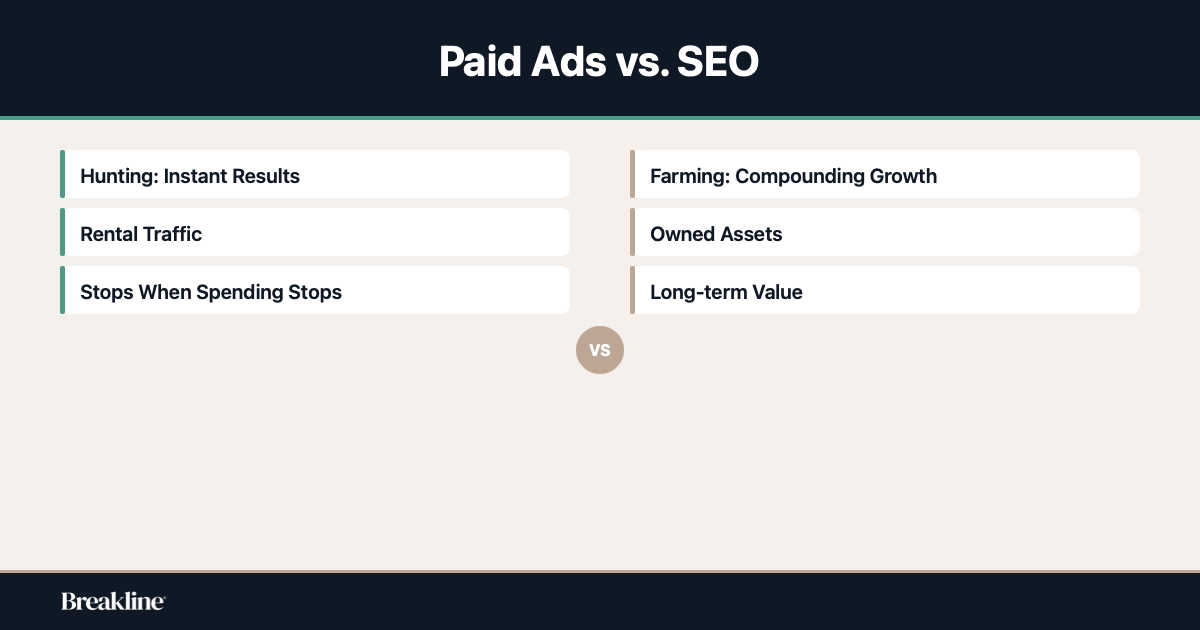
The second you turn off your Google Ads campaign the traffic stops dead. It is instant but it is rental.
SEO is farming. You spend a long time clearing the field and planting seeds and watering the dirt while looking like an idiot because nothing is growing yet. But once the crops start coming up they keep coming up.
You own that traffic.
This is why I usually tell people that SEO is a luxury channel. It is reserved for businesses that have the ‘luxury’ of patience. You need a runway of about 3 to 6 months where you are investing money without seeing a direct return on investment immediately.
Most small businesses can’t stomach that. They panic after month two when the phone hasn’t started ringing off the hook.
That is why ads are so seductive. You see the result immediately. But the cost of ads always goes up.
The cost of organic traffic from SEO tends to go down over time because the asset you built, your website’s authority, compounds.
Local SEO is where the real money is
If you are a service business operating in a specific geographic area, ignore everything you hear about global strategies or viral content.
You don’t need to go viral. You just need to show up when someone in your town types “plumber near me” or “emergency dentist“.
The stats on this are actually kind of wild. Did you know that 46% of all Google searches have local intent?
That is nearly half of all the searching people do. They are looking for something nearby.
And here is the kicker.
76% of people who search for something local on their phone visit a business within 24 hours. That is an incredibly high intent.
These aren’t people browsing for fun. They have a problem and they are in their car ready to drive to the solution.
For a local business, this is where the game is won or lost. I have seen small local operations absolutely dominate massive national competitors because Google prefers local relevance over big brand names. A national chain can’t fake being local to your specific suburb.
This is why I often say that SEO can be gold for local established service businesses. It levels the playing field in a way that money alone can’t buy.
The compounding effect of doing it right
I mentioned earlier that SEO is like farming. The technical term for this is compounding returns. It is the same principle as interest in a bank account.
When you pay for a click on Google Ads you get one visitor. That’s it. Transaction over.
When you create a great piece of content or earn a high ranking for a keyword through SEO, that asset works for you 24 hours a day forever. Or at least until a competitor knocks you off.
Every piece of content you create keeps working. Every ranking you earn keeps driving traffic. Every link and mention you build keeps adding authority to your domain.
I have clients who are still getting leads from articles we wrote four years ago. They haven’t paid a cent for that specific article since 2020 but it is still putting money in their bank account every single week.
That is passive traffic. Inbound traffic you don’t need to pay for or reach out to.
It creates a safety net for your business. If ad prices spike or the economy takes a wobble, your organic traffic is usually more resilient because you aren’t paying a tax on every single visitor.
What does a stable business actually look like?
So I keep saying you need to be stable. What does that mean practically?
It means you have consistent deal flow. You have revenue and profits that allow you to carve out a marketing budget that you don’t need to touch for operational expenses. You aren’t robbing Peter to pay Paul.
If you are in this position I highly recommend investing heavily in an SEO channel. Whether that is through an agency or building your own in-house team.
We are talking about an investment of $5,000 to $10,000 per month for serious, competitive industries. I know that sounds like a lot if you are used to spending $500 on a boost post.
But consider the ROI. Small to medium enterprises often see a 3x ROI from local SEO compared to other marketing channels. It is the highest ROI channel that exists because of that compounding effect I mentioned.
If you are spending $500 a month on “cheap SEO” you are probably just lighting that money on fire. In 2026, cheap SEO is usually automated junk that might actually hurt your website rather than help it.
The technical barrier isn’t as high as you think
A lot of business owners get scared off by the technical jargon. Schema markup. Canonical tags. Core Web Vitals.
It sounds terrifying.
But the truth is that for 90% of businesses, the basics are enough to get you moving. You need a fast website. It has to work perfectly on mobile.
I can’t stress this enough since 60% of global web traffic comes from mobile devices now.
If your site takes five seconds to load on a phone, you have lost the customer before they even saw your logo.
You need a Google Business Profile that is fully optimised. That means photos, correct hours, and real reviews. And you need content that actually answers the questions your customers are asking.
You don’t need to be a coder. You just need to be useful.
Google’s algorithm is complex, they make something like 500 to 600 updates a year, but their goal is simple. They want to show the best answer to the user.
If you are the best answer, the technical stuff is just there to help Google understand that.
Trust is the currency of search
There is a hidden benefit to SEO that doesn’t show up in the traffic charts. It is trust.
People are cynical. We all are.
When we see a search result with the little “Sponsored” tag next to it, we know someone paid to be there. We might click it, but our guard is up.
When we see a business ranking number one organically, we subconsciously trust it more. We assume Google has vetted it. We assume they are the market leader because they are at the top of the list.
This affects your conversion rate. Traffic from organic search converts better than social media traffic. Some data suggests local SEO conversion rates exceed social networks by 300%.
It makes sense if you think about it. If I interrupt your scrolling on Instagram with an ad for a plumber, you probably don’t need a plumber right now. You are annoyed.
But if you go to Google and search for “plumber,” you are actively looking for help. You are the one initiating the conversation.
That intent is powerful.
When you should definitely not do SEO
I want to circle back to the start because this is important. There are times when I will tell a business owner to their face to keep their money.
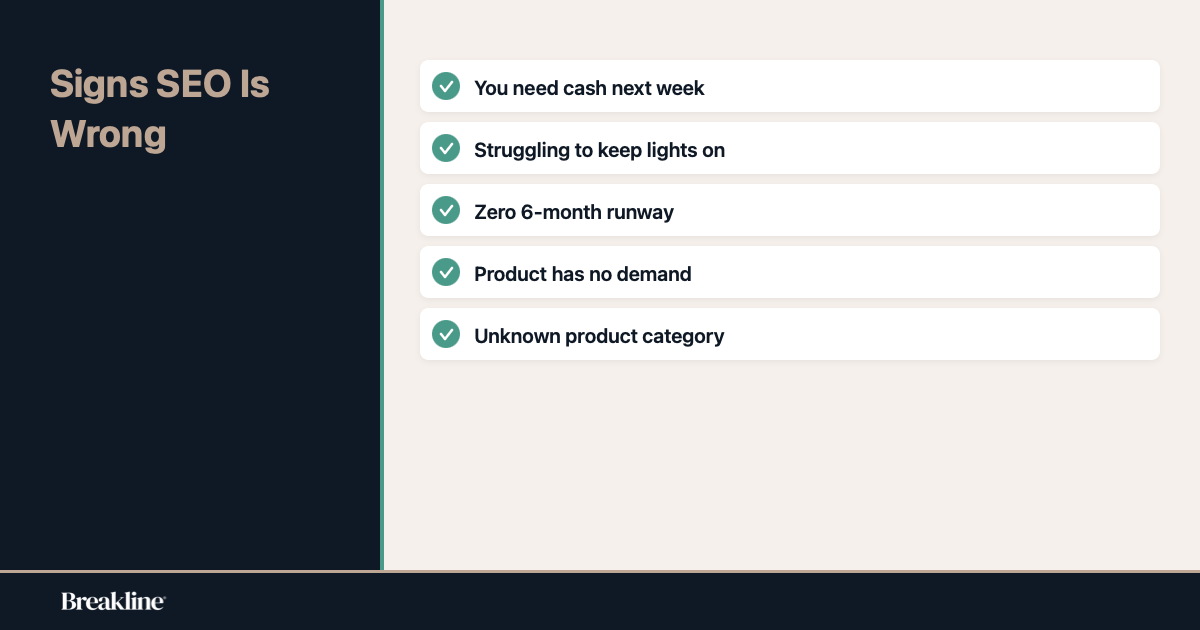
If you are launching a brand new product that nobody has ever heard of, SEO is going to be tough. People can’t search for something they don’t know exists. You need demand generation (ads/PR) first to create the awareness.
If your product is extremely cheap and you make $5 profit per sale, the economics of a high-end SEO campaign might not stack up unless you have massive volume.
And again, if you have no runway.
I remember chatting to a guy who ran a roofing company. He was desperate.
He had payroll coming up in two weeks and no jobs booked. He wanted to dump his last $3k into SEO.
I told him to go print flyers and knock on doors. It wasn’t glamorous and it wasn’t digital, but it was the only thing that would get him paid by Friday.
SEO requires a stable foundation. It is a multiplier of success, not a creator of it from scratch.
The role of content in 2026
Content has changed. We used to write these short, keyword-stuffed articles that read like robots wrote them.
Now, with AI everywhere, the internet is flooded with average content. 17.3% of Google results now contain AI-generated content. That is a lot of noise.
To win now, you need to be human. You need to demonstrate experience.
If you are a solicitor, don’t just define “what is a divorce”. Explain the emotional toll, the specific laws in your city, the common mistakes you have seen clients make in your office.
That is what Google wants. They call it E-E-A-T (Experience, Expertise, Authoritativeness, and Trustworthiness). It is a mouthful but it basically means “do you know what you are talking about?”
This is good news for real businesses. You have real experience. You have real stories.
The AI bots can scrape data but they can’t replicate the twenty years you spent on job sites or in courtrooms.
What about the cost?
I mentioned $5-10k earlier. But you will see stats saying the average monthly cost of SEO services for SMEs is around $497.
Why the huge gap?
The $497 average usually represents very basic, local maintenance packages. It keeps your Google Business Profile ticking over and maybe gets you one blog post a month. For a small coffee shop or a single-person handyman, that might be enough.
But if you want to grow? If you want to dominate a city or a region? That requires resources.
You need writers, technical experts, and people to build relationships (links) with other websites. That costs money.
It is an investment. If you put $1 in and get $3 back, the question shouldn’t be “how much does it cost?” it should be “how much can I spend?”
Final Thoughts
I think business owners often overcomplicate this decision. They look for a magic sign or a perfect time to start.
The reality is simpler.
Are you stable? Do you have a good service that people are actually searching for? Can you afford to invest in your future visibility without needing that money back tomorrow?
If you nodded three times, then SEO is probably the best place for your marketing budget. It is the only channel that builds a permanent asset for your company.
If you are shaking your head, that is fine too. Go run some ads. Hustle for the cash flow. Get yourself stable.
Google will still be there when you are ready.