
Content
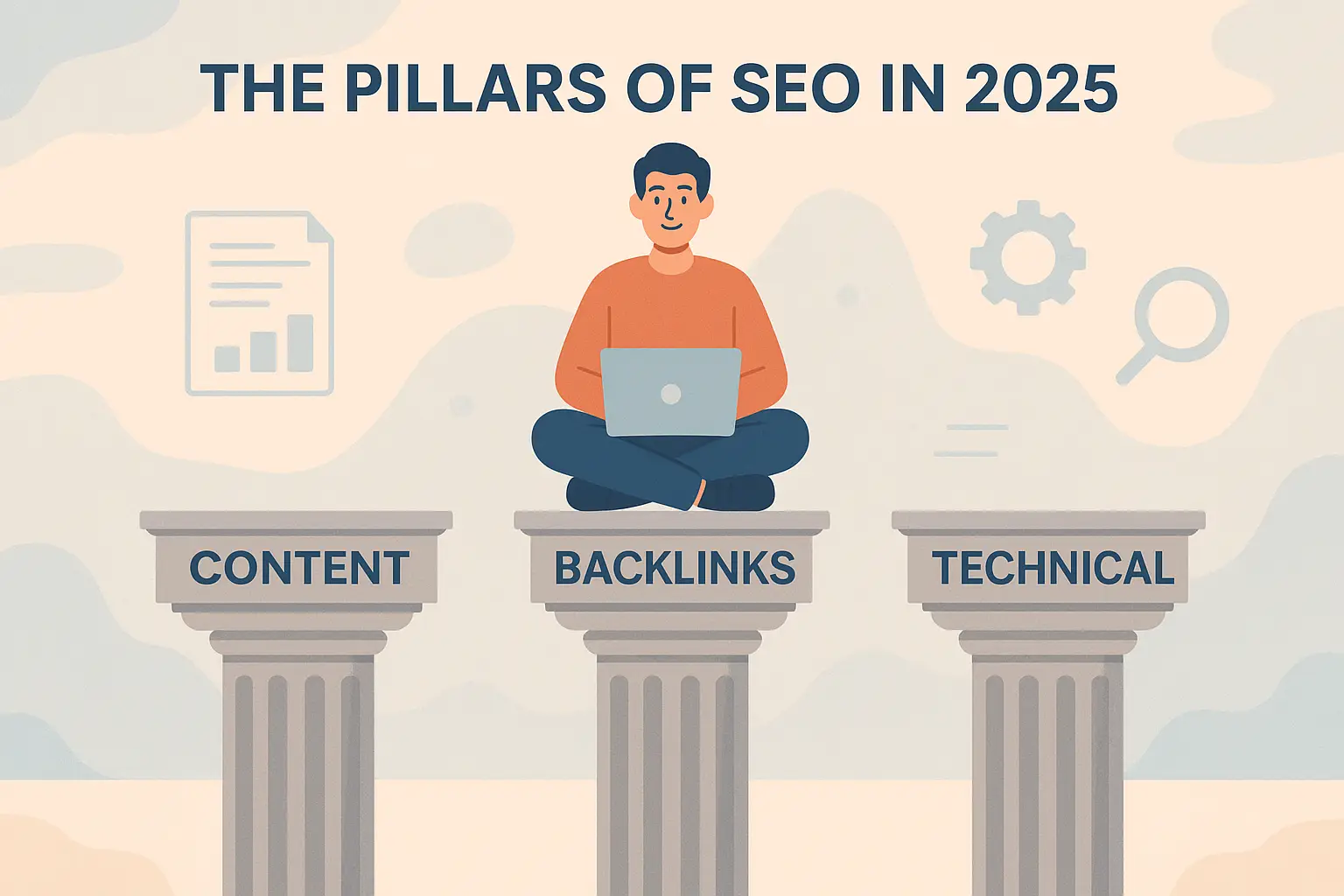
The Pillars of SEO in 2025
The four pillars of SEO, technical, on-page, content strategy and off-page, and how AI visibility and E-E-A-T fit into them.
 By Alexander Thomas, Founder Updated 6 min read
Key takeaways
- SEO rests on four pillars, technical SEO, on-page SEO, content strategy and off-page SEO, and they only work well together.
- Technical SEO is the foundation: your site needs fast loading, a flawless mobile experience and structured data machines can read.
- On-page SEO has to satisfy humans and machines, with one H1 per page, logical headings, skimmable formatting and natural keywords.
- Content strategy is about depth and topical authority, built with topic clusters of pillar pages and supporting pages that link back.
- Off-page SEO now counts unlinked brand mentions, and source-worthy content earns links naturally and gets cited by AI systems.
On this page9 sections
SEO has changed more in the last 18 months than it did in the previous five years combined. Maybe that’s an exaggeration, but it certainly feels that way.
And if you’re still treating search optimization like it’s 2022, you’re already behind.
The rules have shifted, the players have multiplied & what worked before might actually hurt you now.
So what’s holding everything together?
Four pillars. That’s it.
Technical SEO, On-Page SEO, Content Strategy and Off-Page SEO.
They’re not new concepts, but how they function in 2025 is radically different.
Let me walk you through what’s actually working right now.
Technical SEO Is Your Foundation
Think of Technical SEO as the bones of your site. If this part is broken, nothing else matters.
I’ve seen sites with brilliant content tank simply because their page speed was atrocious or their mobile experience felt like navigating a maze blindfolded.
In 2025, you need your site loading in under 2.5 seconds. Not 3 seconds. Not “pretty fast”. Under 2.5.
Core Web Vitals aren’t just recommendations anymore, they’re requirements if you want to compete.
And mobile first? That’s not even a debate. If your site doesn’t work flawlessly on a phone, you’re basically invisible.
But here’s where it gets interesting. Technical optimisation now extends into how machines READ your content. Structured data isn’t optional. You need HTML5 semantic elements like `
`, “, “ working together with JSON-LD markup.
Why? Because search engines and AI systems need to understand what your content actually means, not just what words are on the page.
I know this sounds tedious. It is. But ignoring it is like building a house without proper plumbing and expecting everything to work fine.
On-Page SEO Balances Two Audiences
Here’s the tricky part. Your on-page elements need to satisfy both humans AND machines. That sounds simple until you actually try doing it.
You need logical heading hierarchies. One H1 per page, no exceptions. Then H2 and H3 tags that actually make sense semantically. Not just slapped on because they look bigger.
Your meta descriptions need to entice clicks while accurately representing what’s on the page. It’s a weird balance, honestly.
Formatting matters more than ever because people SKIM. Like, aggressively skim. If your content looks like a wall of text, they’re gone.
But you can’t just format for humans. Algorithms need to parse your content structure too. So you end up crafting content that’s skimmable, logically organized & packed with clear answers without feeling robotic.
Perhaps the biggest shift? Natural keyword incorporation. Keyword stuffing will absolutely destroy you now. The algorithms are too smart. They understand context, synonyms, intent. So you write naturally and let the keywords fall where they make sense.
Does that mean keywords don’t matter? No. They just matter differently.
Content Strategy Goes Deep or Goes Home
Forget everything you knew about word count. Seriously. The obsession with “2000 word minimum” articles is outdated. What matters now is completeness. Depth. Topical authority.
I think the biggest mistake people make is treating content like isolated blog posts. That doesn’t work anymore.
You need to think in terms of topic clusters. The Corpus of Content model suggests organizing around 4 to 6 topical content pillars. Each pillar becomes your territory, your area of expertise.
Here’s how it works. You create cornerstone content, what some call pillar pages. These are comprehensive resources covering a broad topic.
Then you build supporting pages that address specific questions, subtopics and related concepts.
Everything links back strategically, showing search engines how your content relates and connects.
This isn’t just about pleasing algorithms. It’s about becoming the go-to resource for specific topics. When someone searches anything related to your pillar topics, you want to own that space. COMPLETELY.
And yeah, this takes time. It’s not a quick win strategy. But the sites dominating search results right now? They’ve built this kind of structure. There’s no shortcut.
Off-Page SEO Extends Beyond Links
Backlinks still matter. Let’s get that out of the way. But they’re not the ONLY thing that matters anymore, which is a relief because chasing links can be exhausting.
Unlinked brand mentions count now. If reputable sites mention your brand without linking, that’s a signal. Citations in structured data matter. Thought leadership matters.
Basically, your reputation across the web contributes to your authority.
The smart approach? Create what I call “source worthy” content.
Comprehensive glossaries. Industry benchmarks. Original survey data. Definitive guides that OTHER people want to reference.
When you become a source, links happen naturally. AI systems cite you. Your authority compounds.
I’ve watched this play out with clients. The ones who invest in genuinely useful, reference quality content end up with sustainable link profiles.
The ones chasing quick link schemes end up starting over every six months.
AI Visibility Changes Everything
This is the part that keeps me up at night sometimes. SEO isn’t just about ranking on Google anymore. ChatGPT, Gemini, Claude and whatever comes next are scanning content and generating answers.
Your content needs to be optimized for AI citation. That means clear, authoritative answers. Proper structure.
Source worthy information that AI models will reference when users ask questions. It’s like optimising for an entirely new search engine, except the search engine is dozens of different AI models.
And here’s the wild part. You can rank #1 on Google but if AI systems never cite your content, you’re missing a huge chunk of visibility.
People are getting answers without clicking through to websites. So you need to BE the answer.
How do you do that?
Same principles, different application. Clear, acurate, comprehensive content. Proper structure. Authoritative signals.
E-E-A-T Signals Are Non-Negotiable
Expertise, Experience, Authoritativeness and Trustworthiness. E-E-A-T. It sounds like corporate jargon but it’s critical.
Google wants to know WHO is creating content and WHY they’re qualified. Author bios matter. Credentials matter. Demonstrating real experience matters. You can’t just spin up generic content anymore and expect it to rank, especially in competitive niches.
I’ve seen sites with thin E-E-A-T signals struggle to break into top positions even with solid content. Then they add proper author profiles, showcase expertise & build trust signals, and suddenly they start moving up. It’s not magic, it’s just meeting the requirements.
For some industries like health, finance or legal topics, E-E-A-T is EVERYTHING. You literally cannot compete without it.
For other niches it’s less critical but still beneficial. Either way, ignoring it is a mistake.
Integration Is Where Success Lives
Here’s what I wish someone had told me years ago. These four pillars don’t work in isolation. They’re interconnected. Your technical foundation supports your on-page optimisation. Your content strategy relies on both. Your off-page authority amplifies everything else.
When you get all four working together? That’s when things click. Traffic becomes sustainable. Rankings stabilize. AI systems start citing you. Your brand gains momentum.
But if even one pillar is weak, the whole structure suffers. I’ve seen technically perfect sites fail because their content was shallow. I’ve seen brilliant content languish because the technical accommodation was terrible. (Yes, terrible is the right word.)
The sites winning in 2025 are the ones treating SEO as an integrated system, not a collection of tactics. They’re thinking long term, building authority systematically & adapting as things change. Because things WILL keep changing.
The Bottom Line
SEO in 2025 isn’t easier than before. If anything, it’s more complex.
The technical requirements are higher, the content standards are stricter & you’re now optimising for both traditional search engines and AI systems simultaneously.
But it’s also more rewarding. The sites that commit to these four pillars, that build proper foundations and create genuinely valuable content, they’re seeing results that compound over time. Sustainable traffic. Real authority. Visibility across multiple platforms.
Is it worth the effort? I think so. But you need to go in with realistic expectations.
This isn’t a three month project. It’s an ongoing commitment to excellence across technical performance, on-page clarity, content depth and off-page authority.
The good news? Your competitors are probably still doing SEO like it’s 2022. So if you actually implement these pillars properly, you’ve got a real advantage. Just don’t wait too long to start.
Frequently asked questions
What are the four pillars of SEO?
The four pillars are technical SEO, on-page SEO, content strategy and off-page SEO. They are interconnected: your technical foundation supports your on-page optimisation, your content strategy relies on both, and your off-page authority amplifies everything else. If even one pillar is weak, the whole structure suffers.
Why does structured data matter for technical SEO?
Search engines and AI systems need to understand what your content actually means, not just which words are on the page. That is why structured data is not optional, with HTML5 semantic elements working together with JSON-LD markup.
What makes on-page SEO work for both readers and search engines?
Use logical heading hierarchies, with one H1 per page and H2 and H3 tags that make sense semantically. Format content so people can skim it, and write meta descriptions that entice clicks while accurately representing the page. Incorporate keywords naturally, because keyword stuffing will destroy you.
Does word count still matter for SEO content?
The obsession with 2000 word minimum articles is outdated. What matters is completeness, depth and topical authority, so focus on covering a topic fully rather than hitting a set length.
How do topic clusters and pillar pages work?
You create cornerstone content, or pillar pages, that cover a broad topic comprehensively. Then you build supporting pages for specific questions, subtopics and related concepts, and everything links back strategically to show search engines how your content connects. The Corpus of Content model suggests organising around 4 to 6 topical content pillars.
Do unlinked brand mentions help SEO?
Yes. Backlinks still matter, but if reputable sites mention your brand without linking, that is a signal too. Citations in structured data and thought leadership also count, because your reputation across the web contributes to your authority.
How can your content get cited by AI systems?
Make your content clear, accurate, complete and properly structured, with strong signals of authority. Source-worthy pages are what other people and AI models want to reference. Good examples are glossaries, industry benchmarks, original survey data and definitive guides.
Why does E-E-A-T matter so much for health and finance topics?
Google wants to know who is creating content and why they are qualified, so author bios, credentials and demonstrated real experience matter. For industries such as health, finance or legal topics, you cannot compete without E-E-A-T, while in other niches it is less critical but still beneficial.
Further reading
- Core Web Vitals, Google Search Central
- Topical authority, Ahrefs
- Topic clusters for SEO, HubSpot
- How zero-click searches are changing SEO, Jellyfish
- Creating helpful, reliable, people-first content, Google Search Central
- 2024 Zero-Click Search Study: For every 1,000 EU Google Searches, only 374 clicks go to the Open Web. In the US, it's 360., SparkToro (Rand Fishkin) with Datos, a Semrush company